

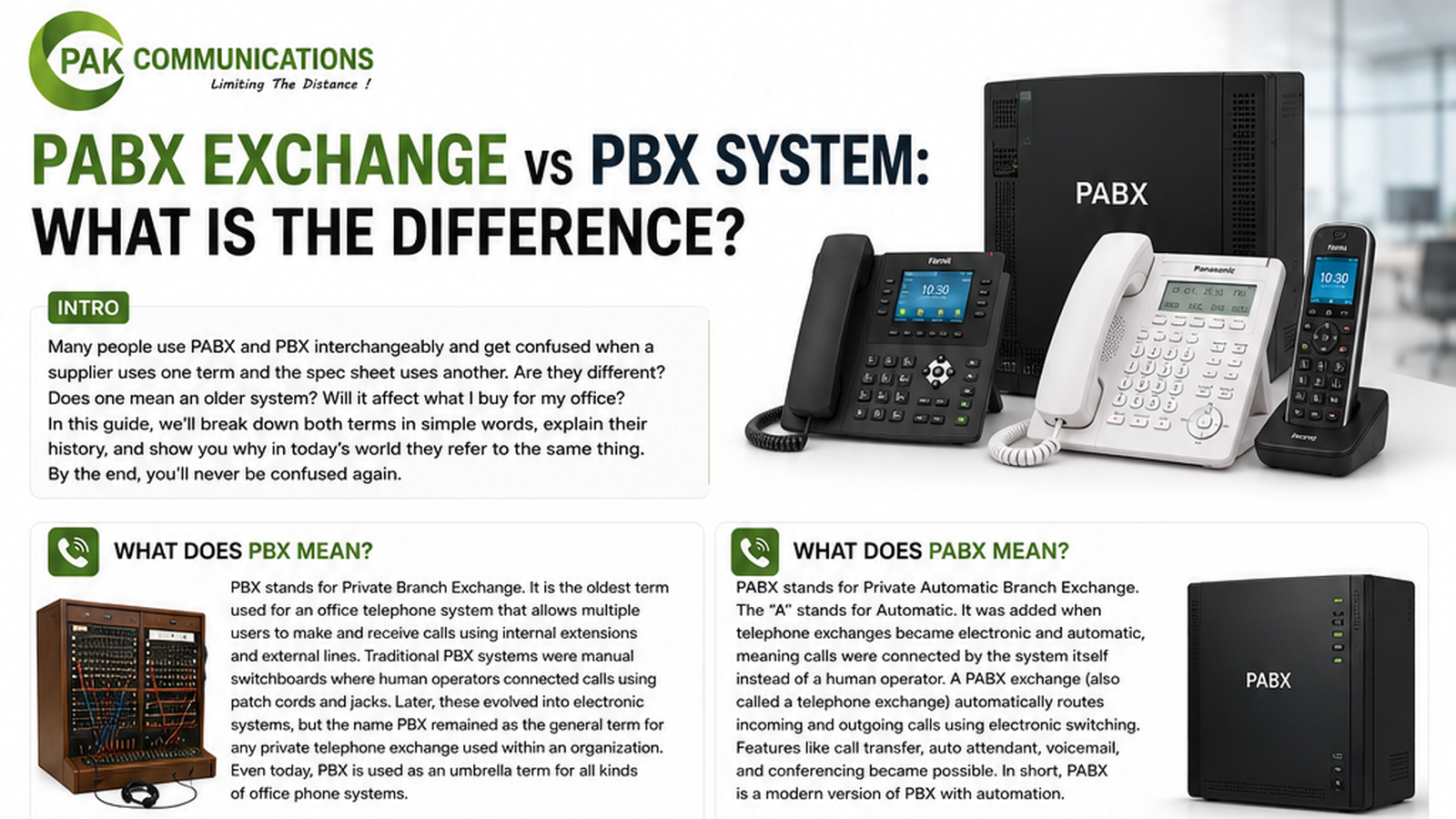
If you have ever asked a supplier about an office phone system and heard both “PBX” and “PABX” in the same conversation, you are not alone. Most office managers, IT buyers, and business owners use the two terms without knowing whether they refer to the same thing or two completely different products.
The confusion is understandable because both terms appear on spec sheets, supplier websites, and product manuals, sometimes for identical equipment. This guide explains what each term means, where the difference came from, and what actually matters when you are choosing a system for your office.
What Does PBX Mean?
PBX stands for Private Branch Exchange. It is the oldest term in office telephony and describes a switching system that a business owns and operates privately, separate from the public telephone network.
In the early days of office communication, a PBX required a human operator. Every incoming call arrived at a central switchboard, and a trained operator physically connected that call to the right desk by plugging a cable into the correct port. This was the original Private Branch Exchange in its truest form.
The term PBX became the general label for any office phone switching system, regardless of technology. Even today, many suppliers, manuals, and industry documents use PBX as the default term to describe the entire category of business telephone exchanges.
What Does PABX Mean?
PABX stands for Private Automatic Branch Exchange. The word “Automatic” is the only addition, and it carries the full weight of the difference between the two terms.
When electronic switching technology replaced the manual switchboard, offices no longer needed a human operator to connect calls. The exchange handled routing on its own, automatically, based on the number dialed. To mark this shift, manufacturers added the letter “A” to the name, and PABX was born.
A PABX telephone exchange connects incoming calls to internal extensions, routes internal calls between desks, and manages outside lines without any manual intervention. The automatic switching happens in milliseconds and is invisible to both the caller and the person receiving the call. This is the standard behaviour of every office telephone exchange sold in the market today.
What is the Real Difference Between PABX and PBX?
Here is the honest answer: in today’s market there is almost no functional difference between the two terms.
Every modern office phone system is automatic. Manual switchboards have not been sold commercially for decades. Whether a supplier calls their product a PBX or a PABX, the hardware inside works the same way. The call routing is automatic, the extension management is automatic, and the outside line sharing is automatic in both cases.
The two names exist side by side in the market simply because different manufacturers, regions, and suppliers adopted different naming conventions at different times. Some brands kept the PBX label because it was already familiar. Others adopted PABX to signal that their product was a modern automatic system. The result is a market where both terms describe the same category of equipment.
If you are ready to browse actual units, the full range of PABX exchange system options covers analog, digital, and IP setups across all office sizes and extension counts.
Where the Terminology Still Matters
Even though the two terms refer to the same equipment today, there are three situations where knowing the difference still helps.
Reading older documents and tenders. Government tenders and older procurement documents sometimes specify “PBX” and mean traditional analog copper-line equipment from a specific era. If you are responding to such a document, clarify whether the specification allows digital or IP alternatives before quoting.
Comparing IP systems. When the conversation moves to internet-based calling, the standard industry term is IP PBX, not IP PABX. You will almost never see “IP PABX” on a product listing. Knowing this helps you search correctly and compare like with like when evaluating modern systems.
Speaking with suppliers. Some suppliers in certain markets use only one term and may look confused if you use the other. Knowing both names lets you communicate clearly with any supplier regardless of which term they prefer, and it signals that you understand the product category well enough to ask the right questions.
PABX vs PBX: Side by Side
The table below shows how the two terms compare across the details that matter most when you are evaluating an office phone system.
| Feature | PBX | PABX |
|---|---|---|
| Full form | Private Branch Exchange | Private Automatic Branch Exchange |
| Origin era | Early 20th century | Mid 20th century onward |
| Switching type | Manual (original) then automatic | Always automatic |
| Common use today | General industry term | Specific product label |
| Functional difference | None in modern equipment | None in modern equipment |
| Market terminology | Used by most global brands | More common in South Asia and Middle East |
The key takeaway from this table is the last two rows. In practice, buying a product labeled PBX and buying one labeled PABX puts the same type of equipment on your desk. The specification that matters is the port capacity, the system type (analog, digital, or IP), and the features included, not the label on the box.
Which Term Should Your Office Use?
Use whichever term your local supplier uses. It does not change the equipment you receive, the features you get, or the quality of the calls your office makes.
What does change your experience is choosing the right system type and capacity for your specific office size and call volume. A small office has very different needs from a fifty-person operation, and picking the correct capacity from the start prevents the two most common and expensive mistakes in office telephony: running out of extensions too soon and overpaying for features that nobody uses. The guide on how to choose the right PABX system for your office size covers exactly that decision, step by step.
Conclusion
PBX and PABX both describe the same category of office telephone exchange. PBX is the older general term, and PABX simply added the word “Automatic” to reflect the shift from manual switchboards to electronic switching. Today every system on the market is automatic, so the two names are used interchangeably by suppliers, buyers, and manufacturers alike. When you are choosing a system for your office, focus on capacity, type, and features rather than the label on the product.
Frequently Asked Questions
Is PABX better than PBX?
Neither is better because both terms describe the same equipment in today’s market. A product sold as PABX and one sold as PBX can be identical in hardware, features, and performance. Compare the port capacity, system type, and included features rather than the name.
Can I use PBX and PABX interchangeably?
Yes, in everyday conversation and when speaking with suppliers you can use either term and be understood correctly. The only exception is technical documents or IP system comparisons, where the specific term matters for clarity.
What is an IP PBX and how is it different?
An IP PBX is a modern office phone exchange that routes calls over an internet connection or internal computer network instead of traditional copper telephone lines. It supports remote staff, branch offices, and software phones on laptops and mobiles. The core switching function is the same as a traditional PABX, but the delivery method is different and the setup requires a stable internet connection and basic IT knowledge to manage.