

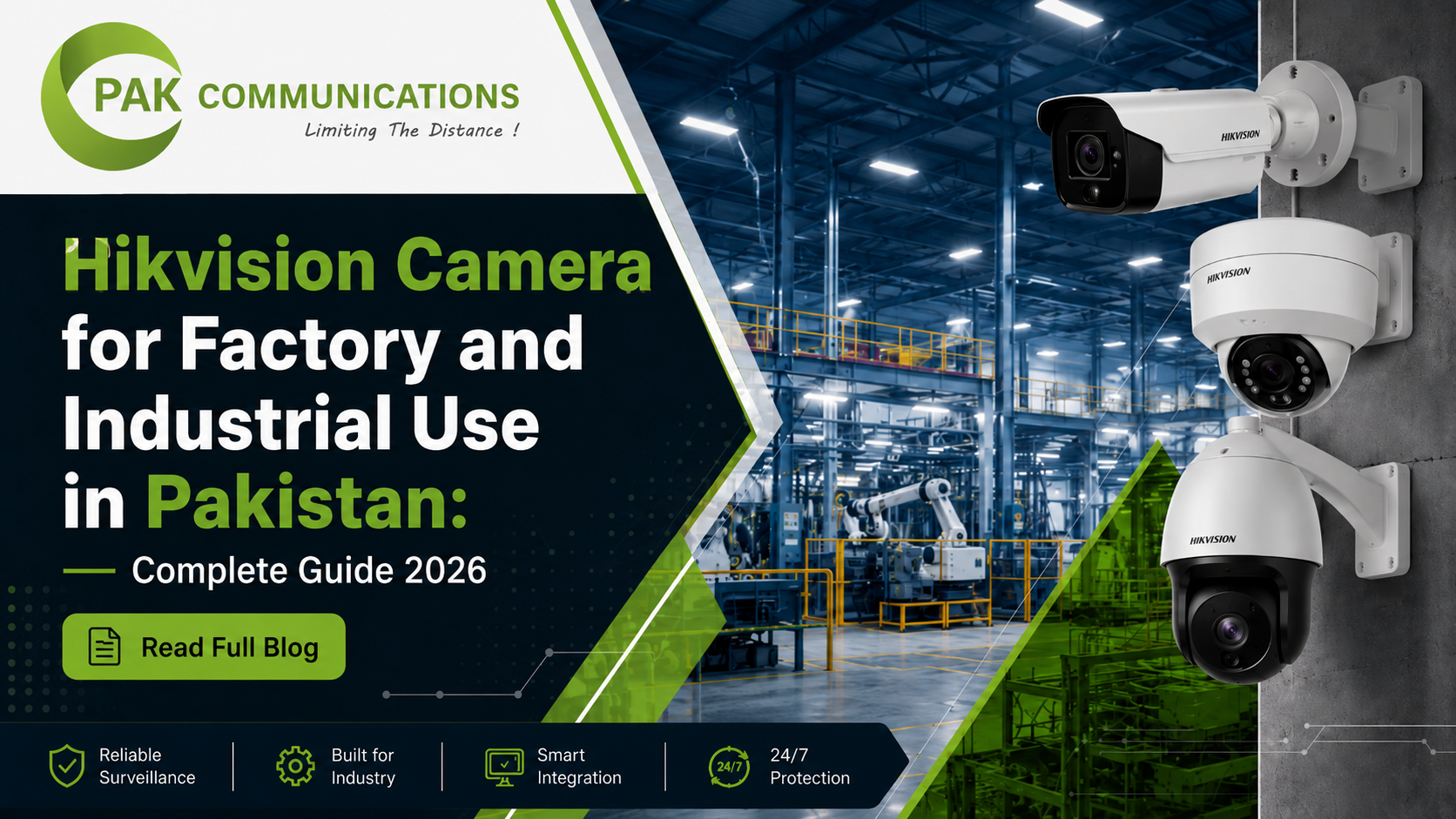
Pakistani factories face a surveillance challenge that residential and standard commercial CCTV installations do not encounter at the same scale. A factory in SITE Area Karachi may have a production floor spanning 3,000 square meters, a perimeter wall running 400 meters around the full site boundary, a loading dock with multiple bays handling high-value goods movements, a main entry gate capturing every vehicle and worker entering and leaving, and an outdoor yard covering vehicle parking, raw material storage, and finished goods dispatch simultaneously. Covering all of these zones adequately with a single CCTV system requires a camera selection approach that differs fundamentally from residential and small commercial installations.
The specific challenges of Pakistani factory surveillance compound these coverage requirements further. Load shedding means cameras operate on IR illumination for hours every night across industrial zones in Karachi, Lahore, Faisalabad, and interior Pakistan. Night shift operations require cameras that maintain identification-quality footage during the hours when most factory theft and unauthorized access incidents occur. Dust from production processes and outdoor industrial environments degrades outdoor camera lenses faster than standard commercial installations. Extended perimeter distances exceed the cable run limits of standard IP camera PoE installations without additional infrastructure. And the scale of Pakistani factory sites means camera count, NVR channel capacity, and storage planning require a different framework than four to eight camera residential installations.
This guide covers the correct Hikvision camera specification for every major coverage zone in a Pakistani factory, how many cameras a standard Pakistani industrial property requires, NVR and storage planning for factory-scale systems, and how Hikvision’s AcuSense AI, DarkFighter, and PTZ camera range address the specific surveillance challenges that Pakistani industrial properties present.
For the full range of Hikvision cameras suited to Pakistani factory and industrial installations, visit Hikvision cameras in Karachi at PAK Communications before reading further.
Contact PAK Communications:
- Phone: (021) 4832293-4
- WhatsApp: 0341-2574866
- Email: info@pakcommunications.com
- Address: Suite #08, 4th Floor, Dar-ul-Furqan Building, Gulshan-e-Iqbal Block 13-B, Main University Road, Karachi
- Hours: Mon-Sat 9:30 AM – 6:30 PM
Why Pakistani Factories Need Dedicated CCTV Planning
A Pakistani factory CCTV system planned using the same approach as a residential or small commercial installation produces a system that covers some zones adequately and leaves critical zones either uncovered or underspecified. The coverage distances, environmental conditions, operational hours, and security risk profile of a Pakistani factory differ from every other property type in ways that directly affect camera specification, camera count, NVR selection, and storage planning. Understanding these differences before purchasing a single camera eliminates the most common and most costly Pakistani factory CCTV planning mistakes.
The Five Coverage Zones of a Pakistani Factory
Zone One: Production Floor
The production floor is the highest-value zone in any Pakistani factory and the area where internal theft, worker safety incidents, and production process monitoring requirements all converge on the same camera system. Production floor cameras must cover distances of 10 to 30 meters from ceiling mount positions to the furthest worker or equipment position, maintain footage quality during shift changes when the floor is at maximum activity density, and operate continuously through 8 to 24 hour production cycles without performance degradation.
Zone Two: Perimeter Wall
The factory perimeter wall is the primary unauthorized access boundary for Pakistani industrial properties. Perimeter wall cameras face the most demanding combination of coverage distance, IR range requirement, weatherproofing demand, and false alert challenge of any camera position in a Pakistani factory installation. They cover distances of 20 to 100 meters along wall sections between corner positions, operate in complete darkness during load shedding, face wind-driven dust and monsoon rainfall on fully exposed outdoor surfaces, and must distinguish genuine perimeter breach attempts from the constant environmental movement that generates false alerts on standard motion detection cameras.
Zone Three: Loading Dock
The loading dock is the highest theft-risk zone in most Pakistani factories. Goods entering and leaving the facility through loading bays represent the primary target for both external theft and internal pilferage. Loading dock cameras must capture vehicle number plates at bay approach distances, record worker activity at goods handling positions, and maintain footage quality during night shift loading operations when the majority of high-value goods movements occur at Pakistani manufacturing facilities.
Zone Four: Main Entry Gate
The factory main gate is the primary access control point for workers, vehicles, management, and visitors. Gate cameras must capture facial detail of every person entering and leaving the facility, read vehicle number plates at the gate approach distance, and maintain this identification capability throughout the 24-hour operational cycle including overnight shifts and early morning worker arrival periods when ambient lighting is at its lowest.
Zone Five: Outdoor Yard
Factory outdoor yards covering vehicle parking, raw material storage, finished goods dispatch, and generator and utility areas represent open spaces with variable camera-to-subject distances that fixed cameras struggle to cover efficiently. A single PTZ camera or multiple wide-coverage fixed cameras address this zone depending on yard size and the specific surveillance requirements at each outdoor area.
Pakistani Industrial Environmental Challenges
Load Shedding and Night Shift Coverage
Pakistani industrial zones in SITE Area Karachi, Korangi Industrial Area, Sundar Industrial Estate Lahore, and Hattar Industrial Estate Khyber Pakhtunkhwa experience the same load shedding schedules as residential areas but with significantly higher consequences when recording gaps occur. Night shift operations at Pakistani factories mean cameras must deliver identification-quality footage during complete darkness load shedding events when the facility’s own generator powers production equipment but may not maintain full perimeter and outdoor area lighting at all positions. For a comprehensive overview of which Hikvision camera models from the current lineup address these industrial requirements most effectively, the guide covering top rated Hikvision cameras In Pakistan provides a useful model reference before selecting specific cameras for each factory zone.
Dust and Industrial Atmosphere
Pakistani factory environments generate airborne dust, fiber, chemical particles, and humidity from production processes that accumulate on camera lenses faster than outdoor commercial installations. Production floor cameras above textile machinery accumulate fiber on lenses within weeks of installation. Chemical plant outdoor cameras face corrosive atmospheric conditions that standard IP67 housings handle adequately but that accelerate lens contamination requiring more frequent cleaning maintenance than standard commercial installations. Factory CCTV maintenance schedules must account for this accelerated lens contamination rate to maintain consistent footage quality throughout the operational lifespan.
Extended Cable Runs at Pakistani Industrial Sites
Pakistani factory sites with buildings spanning 200 to 500 meters require cable runs from perimeter and outdoor cameras to the central NVR location that exceed the 90-meter PoE limit of standard IP camera installations. Addressing these extended cable runs through PoE extenders, fiber optic converters, or analog Turbo HD cameras whose coaxial cable runs extend to 500 meters at standard HD resolutions is a planning requirement that residential and small commercial installations never encounter.
Best Hikvision Camera for Factory Production Floor
The production floor is the most technically demanding indoor camera position in any Pakistani factory installation. It combines the coverage distance requirements of a large open space, the false alert challenge of continuous machinery and conveyor movement, the dust and fiber accumulation of an industrial atmosphere, and the identification requirement of a position where worker activity, goods handling, and access to high-value inventory all occur simultaneously. The correct Hikvision camera specification for a Pakistani factory production floor addresses all four of these requirements without compromise.
Camera Specification for Pakistani Production Floors
Resolution and Coverage Distance
A 4MP Hikvision AcuSense dome camera is the correct specification for Pakistani production floor ceiling mount positions where the furthest worker or goods handling position falls within 15 to 18 meters of the camera mount. At 4MP resolution facial identification extends to 15 to 18 meters and worker activity at goods handling positions is clearly identifiable throughout the full production floor depth from a single ceiling mount. For larger Pakistani factory floors where production zones extend beyond 18 meters from the nearest practical ceiling mount position, 8MP cameras extend reliable identification distance to 25 to 30 meters, covering the full floor depth of most Pakistani manufacturing facilities without requiring additional intermediate camera positions.
For Pakistani factory managers who want to confirm the full range of IP camera options available across resolution tiers before finalizing their production floor specification, browsing Hikvision IP cameras In Pakistan at PAK Communications gives a live inventory reference showing current models and specifications before contacting the team for a system quote.
Wide Angle Coverage for Full Floor Width
A 2.8mm wide angle lens on the production floor dome camera delivers a 100 to 110 degree field of view that covers the full width of a standard Pakistani factory floor bay from a single ceiling mount position at three to five meters mounting height. Pakistani textile factories, garment manufacturing facilities, and light industrial production floors with bay widths of 8 to 15 meters are covered completely from a single central ceiling mount without requiring additional cameras at each end of the bay. For production floors with multiple parallel bays, one camera per bay from a central ceiling position provides complete coverage of each bay’s full width and depth.
AcuSense for Pakistani Production Floor False Alert Management
Machinery and Conveyor Movement Filtering
Pakistani production floor cameras using standard motion detection trigger constantly from conveyor belt movement, machinery vibration, automated equipment operation, and the continuous worker movement that characterizes active production shifts. A production floor camera generating motion alerts every 30 seconds during an eight-hour shift produces a notification volume that makes the alert system completely unusable for genuine security purposes. AcuSense human detection on the production floor camera filters every mechanical movement source from the alert stream, triggering only when a human enters a defined detection zone outside normal production activity areas such as a restricted storage room entrance, a management office corridor, or a high-value inventory area.
After-Hours Production Floor Monitoring
Pakistani factories that operate single-shift production schedules and leave production floors unoccupied overnight benefit most from AcuSense after-hours monitoring. A production floor AcuSense camera set to human detection mode after shift end sends a genuine alert to the factory manager’s Hik-Connect app when any person enters the production floor during unoccupied hours, distinguishing a genuine unauthorized access event from the environmental movement that would trigger constant false alerts on standard motion detection cameras in the same position.
IK10 Vandal Resistance and IP67 for Industrial Environments
Physical Protection on Pakistani Production Floors
Pakistani production floor cameras installed at accessible ceiling heights in facilities where forklifts, overhead cranes, and material handling equipment operate near the camera positions benefit from IK10 vandal-resistant dome housings that withstand accidental physical contact without housing damage. A standard dome camera housing struck by a raised forklift attachment or a swinging crane cable sustains damage that an IK10 rated housing survives without requiring replacement. For Pakistani factories with overhead material handling operations, specifying IK10 dome cameras at production floor positions eliminates housing damage replacement costs from the ongoing maintenance budget.
Dust Resistance for Pakistani Industrial Atmospheres
IP67 dust ingress protection on production floor cameras prevents the fine particles generated by Pakistani textile processing, garment manufacturing, woodworking, and light chemical production from entering the camera housing and accumulating on the sensor. External lens contamination from production atmosphere particles requires regular cleaning maintenance regardless of IP rating, but IP67 housing integrity prevents internal sensor contamination that causes permanent image quality degradation requiring full camera replacement rather than simple lens cleaning.
Best Hikvision Camera for Factory Perimeter Wall
The perimeter wall camera position is the most demanding outdoor camera specification in any Pakistani factory CCTV installation. It combines the longest coverage distances, the most extreme environmental exposure, the highest false alert challenge, and the most critical after-hours security requirement of any single camera position across the entire factory site. A perimeter wall camera that underperforms in any one of these dimensions leaves the most important security boundary of a Pakistani industrial property inadequately protected during the overnight and weekend periods when unauthorized access incidents most commonly occur.
Camera Specification for Pakistani Factory Perimeter Walls
Coverage Distance and Resolution Requirements
Pakistani factory perimeter walls in industrial zones including SITE Area Karachi, Korangi Industrial Area, Sundar Industrial Estate Lahore, and Hattar Industrial Estate typically span 50 to 400 meters around the full site boundary. Corner-mounted perimeter cameras must cover the wall section in both directions from the corner position, with each direction requiring identification-quality coverage of anyone approaching or climbing the wall at distances up to 20 to 30 meters from the camera mount. A 4MP Hikvision AcuSense ColorVu bullet camera covers this distance requirement reliably at mid-range specification, with 8MP cameras specified at positions where wall sections between corners exceed 30 meters and require longer identification range to maintain forensic-quality footage across the full wall coverage zone.
IR Range for Complete Darkness Perimeter Coverage
Pakistani factory perimeter walls face complete darkness during load shedding events when industrial zone street lighting and neighboring property lighting all cut simultaneously. A perimeter wall camera whose IR range does not exceed the coverage distance to the furthest point of its wall section produces underexposed footage of anyone approaching at the far end of the coverage zone during complete darkness. Hikvision mid-range bullet cameras with 60 to 80 meter IR range cover standard Pakistani factory perimeter wall sections between corner positions adequately during complete darkness load shedding, maintaining clear black and white IR footage of anyone approaching the wall from outside or attempting to climb over from inside.
AcuSense Cross Line Detection for Pakistani Perimeter Security
Virtual Tripwire at Perimeter Wall Top
The most effective perimeter protection configuration for Pakistani factory boundary walls uses AcuSense cross line detection with a virtual tripwire drawn across the top of the boundary wall image in the camera frame. Any human who attempts to climb over the wall crosses the virtual tripwire and triggers an immediate alert to the factory security team’s Hik-Connect app regardless of whether a security guard is actively monitoring the live feed. This automated perimeter breach detection provides genuine after-hours security at Pakistani factory perimeter positions without requiring continuous live monitoring by security personnel who are realistically unable to watch every camera feed simultaneously across a large industrial site.
Eliminating External Road Traffic False Alerts
Pakistani factory perimeter cameras facing outward toward industrial zone access roads trigger constant false motion alerts on standard detection cameras from vehicle headlights, passing workers, and road traffic movement outside the boundary. AcuSense cross line detection at the perimeter wall position eliminates every passing road traffic trigger because vehicles and pedestrians moving parallel to the factory boundary on the road outside do not cross the virtual tripwire drawn at the wall line. Only a subject who actually approaches and crosses the boundary line triggers the configured alert, delivering genuine breach detection rather than continuous road traffic notifications.
ColorVu for Pakistani Factory Perimeter Night Coverage
Color Evidence at Perimeter Breach Positions
ColorVu warm white LED illumination on perimeter wall cameras delivers color footage of any person attempting to breach the factory boundary, capturing clothing color, footwear, any carried equipment, and physical appearance details that black and white IR footage cannot provide. For Pakistani factory owners whose security incidents involve unauthorized access attempts that are reviewed for police reporting and insurance claims, color perimeter footage provides significantly more actionable identification evidence than monochrome IR footage of the same incident.
ColorVu Active Deterrence at Factory Perimeters
The visible white light illumination that ColorVu produces at night creates a lit perimeter zone that communicates active surveillance to anyone approaching the factory boundary from outside. Pakistani industrial properties in areas where opportunistic perimeter breach attempts are a regular security challenge benefit from this active illumination deterrence that signals monitored boundaries without requiring security guard presence at every perimeter wall section simultaneously. A factory perimeter in SITE Area Karachi lit by ColorVu camera illumination at every corner position communicates comprehensive monitoring to potential intruders approaching from any direction.
Weatherproofing for Pakistani Industrial Perimeter Positions
Monsoon and Dust Exposure on Factory Perimeter Walls
Pakistani factory perimeter wall cameras are among the most environmentally exposed camera positions in any installation type. Fully exposed to monsoon rainfall, summer heat above 50 degrees Celsius on sun-facing wall surfaces, industrial zone dust from adjacent facilities, and coastal humidity at Karachi industrial sites, perimeter wall cameras require IP67 weatherproofing as a minimum specification. The aluminum alloy bullet camera housing conducts heat away from the sensor during summer months while sealed gaskets maintain water exclusion during monsoon season, maintaining consistent performance through Pakistan’s most extreme seasonal conditions at the most environmentally demanding camera positions across the factory site.
Best Hikvision Camera for Factory Gate and Entry Points
The factory main gate is the primary identification checkpoint for every person and vehicle entering and leaving a Pakistani industrial property. Unlike residential gate cameras whose primary subject is a visitor approaching on foot, factory gate cameras must simultaneously capture facial detail of workers arriving on motorcycles and in vehicles, read number plates of delivery trucks, supplier vehicles, and management cars at gate approach distances of 5 to 15 meters, and maintain this dual identification capability across three shift changes per day including the early morning and late night shifts when ambient lighting is at its lowest across Pakistani industrial zones.
Camera Specification for Pakistani Factory Gates
Number Plate Reading at Factory Gate Distances
A 4MP Hikvision AcuSense ColorVu bullet camera at the factory gate position delivers reliable number plate reading at distances up to 12 to 15 meters, covering the full approach lane from the road entry point to the gate barrier on standard Pakistani industrial zone access roads. The 4MP resolution captures sufficient plate detail for manual review and post-incident vehicle identification at all approach speeds typical of controlled factory gate entry lanes where vehicles slow to a stop for security clearance. For Pakistani factories with wider approach lanes or multiple simultaneous entry points requiring longer-range plate coverage, a dedicated license plate recognition camera alongside the standard gate camera provides automated plate capture at extended distances beyond standard 4MP identification range.
Worker Face Identification at Shift Changes
Pakistani factory shift changes produce concentrated pedestrian and vehicle traffic at the main gate during 30 to 60 minute windows that represent the highest-volume identification requirement of any daily camera operation. The gate camera must capture clear facial detail of every worker passing through the gate during these peak periods at the identification distances that characterize controlled factory entry lanes. ColorVu color night vision maintains full color facial identification footage during early morning and late night shift changes when industrial zone ambient lighting is at its lowest, capturing clothing color and facial detail that black and white IR footage cannot provide during these critical identification windows.
AcuSense at Pakistani Factory Gates
After-Hours Gate Alert Management
During non-shift hours when the factory gate is closed and the facility is operating at reduced or zero staffing, AcuSense human and vehicle detection at the gate position sends genuine alerts to the factory manager’s Hik-Connect app when any person or vehicle approaches the closed gate. Standard motion detection at a Pakistani factory gate on an industrial zone road generates continuous false alerts from passing vehicles, motorcycle traffic, and pedestrian movement on the adjacent road throughout the night. AcuSense cross line detection configured at the gate entry point filters every external road movement from the alert stream, delivering notifications only when a subject actually approaches and enters the gate zone.
Multiple Gate Camera Configuration
Pakistani factories with separate entry and exit gates, a dedicated goods vehicle gate alongside the personnel gate, or a secondary emergency access point require dedicated cameras at each gate position rather than attempting to cover multiple gates from a single wide angle camera. Each gate position has its own approach distance, lane width, and traffic type that requires individual camera specification and AcuSense detection zone configuration. A factory in Korangi Industrial Area with a main personnel gate, a goods vehicle gate, and a rear emergency access point requires three separate gate cameras, each specified and configured for its specific traffic type and approach geometry.
Gate Camera Mounting for Pakistani Industrial Properties
Height and Angle for Number Plate Capture
Pakistani factory gate cameras for number plate reading mount at two and a half to three meters height on the gate pillar or boundary wall, angled slightly downward and to the side of the approach lane to face the front of an approaching vehicle at approximately 10 to 15 degrees downward tilt. This mounting geometry captures the vehicle front number plate clearly at the approach distance without the steep downward angle that captures only the vehicle roof. A security guard booth or gate pillar provides the ideal mounting surface at this height on most Pakistani industrial zone gate configurations, giving the camera an unobstructed view of the full approach lane from road entry to gate barrier.
Best Hikvision Camera for Loading Dock and Goods Storage
The loading dock is the highest theft-risk zone in most Pakistani factories and warehouses. It is the point where finished goods leave the facility and where raw materials arrive, making it the zone where both external theft and internal pilferage opportunities are concentrated in a single physical location. Pakistani loading dock incidents follow a consistent pattern: goods are misdirected, quantities are misrecorded, or vehicles depart with undocumented loads during the shift change periods and overnight loading operations when supervision is at its lowest. A correctly specified Hikvision camera system at the loading dock creates a continuous documented record of every goods movement that eliminates the ambiguity that allows these incidents to go unresolved.
Camera Specification for Pakistani Loading Dock Positions
Bay Approach Coverage for Vehicle Identification
A 4MP Hikvision AcuSense bullet camera at the loading dock bay approach position covers the vehicle entry lane from the yard to the bay door, capturing number plates of every vehicle reversing into the loading position and driver facial detail at the cab level. Pakistani factories with multiple loading bays require a dedicated approach camera covering the entry lane to each bay group rather than a single wide angle camera attempting to cover all bays simultaneously from a single position. A camera covering three to four bays from a central elevated position at the bay approach end delivers number plate capture and vehicle identification for all bays without requiring individual cameras at each bay.
Bay Interior Coverage for Goods Handling Recording
A 4MP dome or turret camera positioned inside each loading bay or above the bay door threshold covers the goods handling area where workers load and unload vehicles, capturing the quantity and type of goods being moved, the workers involved in each goods movement, and the vehicle loading state at departure. This interior bay coverage provides the documentary record that Pakistani factory managers use to investigate discrepancies between goods dispatch records and actual loaded quantities, identifying the specific loading event and workers involved in any quantity mismatch.
Goods Storage Area Coverage
High-Value Inventory Zone Monitoring
Pakistani factory goods storage areas containing finished goods awaiting dispatch, imported raw material stocks, and high-value components represent the zones where pilferage incidents most commonly originate. A 4MP AcuSense dome camera covering each storage zone from a ceiling mount position delivers the wide angle coverage needed to monitor the full storage area from a single camera while AcuSense intrusion detection triggers an alert when any person enters a designated restricted storage zone outside authorized working hours.
AcuSense Intrusion Detection for Pakistani Goods Storage
Drawing an AcuSense intrusion zone across the full goods storage area in the camera frame and setting a dwell time of three to five seconds means any worker who enters and remains in the storage area outside authorized shift hours triggers an immediate alert to the factory manager’s Hik-Connect app. Pakistani factories that experience repeated pilferage from goods storage areas without being able to identify the responsible workers benefit from this AcuSense intrusion detection capability that creates a timestamped record of every unauthorized storage zone entry regardless of whether a supervisor is present at the time of the incident.
Night Shift Loading Dock Coverage
ColorVu for After-Hours Goods Movement
Pakistani factories with night shift loading operations require camera performance at the loading dock that maintains identification-quality color footage during the overnight hours when facility lighting may be at reduced levels and when the majority of undocumented goods movement incidents occur. ColorVu warm white LED illumination at loading dock positions maintains full color footage throughout overnight loading operations, capturing clothing color and physical appearance details of every worker involved in night shift goods handling. This color evidence capability significantly strengthens the evidentiary value of loading dock footage for Pakistani factory owners investigating overnight pilferage incidents where multiple workers were present and individual identification from black and white footage would be ambiguous.
How Many Hikvision Cameras Does a Pakistani Factory Need
Camera count planning for a Pakistani factory follows a zone-by-zone framework rather than the plot-size framework used for residential properties. Each factory zone has its own coverage requirement that determines how many cameras it needs independently of the other zones. Summing the camera count across all five zones gives the total system camera count before NVR channel capacity and storage are planned. Pakistani factory owners who estimate camera count without this zone-by-zone approach consistently underspecify their systems and discover blind spots in critical zones after installation.
Camera Count by Factory Size
Small Pakistani Factory: 8 to 12 Cameras
A small Pakistani factory with a single production floor bay of 500 to 1000 square meters, a perimeter wall spanning 100 to 150 meters, a single loading bay, one main gate, and a compact outdoor yard requires 8 to 12 cameras for complete coverage. A typical zone breakdown for this factory size covers two production floor ceiling cameras, three perimeter wall corner cameras, one loading bay approach camera, one bay interior camera, two gate cameras covering entry and exit lanes, and one outdoor yard camera. This 10-camera configuration covers every critical zone in a small Pakistani factory without meaningful blind spots at any high-risk position.
Mid-Size Pakistani Factory: 14 to 20 Cameras
A mid-size Pakistani factory in industrial zones like SITE Area Karachi or Sundar Industrial Estate Lahore with a production floor spanning 1000 to 3000 square meters, a perimeter wall of 200 to 300 meters, two to three loading bays, a main gate with separate entry and exit lanes, an outdoor yard, and an office block requires 14 to 20 cameras. A typical zone breakdown covers four to six production floor cameras, six to eight perimeter wall cameras at corners and mid-wall positions, two to three loading bay cameras, two gate cameras, two outdoor yard cameras, and two office interior cameras. A 16-channel Hikvision NVR with a 32-channel recorder specified for future expansion accommodates this camera count with room for growth.
Large Pakistani Factory: 24 to 32 Cameras
A large Pakistani manufacturing facility with multiple production floors, an extended perimeter exceeding 300 meters, four to six loading bays, multiple gate positions, a large outdoor yard, and separate office and welfare blocks requires 24 to 32 cameras for complete site coverage. This camera count requires a 32-channel Hikvision NVR with dual hard drive bays for adequate storage capacity, a managed PoE switch infrastructure across multiple buildings, and potentially fiber optic cable backbone between buildings where camera positions exceed 90 meters from the central NVR location.
PTZ Cameras as a Camera Count Reduction Strategy
Replacing Multiple Fixed Cameras With PTZ Units
Pakistani factory outdoor yards, large open production floors, and extended perimeter sections between corner positions benefit from Hikvision PTZ cameras that cover the same area as four to six fixed cameras from a single mounting point. A mid-range Hikvision PTZ camera with 25x optical zoom and AcuSense auto-tracking mounted on a central pole in a Pakistani factory outdoor yard covers the full yard area with patrol mode systematic coverage and auto-tracking capability that no fixed camera network can match for active after-hours monitoring. Including two to three PTZ cameras in a Pakistani factory system reduces total fixed camera count by eight to fifteen units while maintaining equivalent or better coverage of open area zones.
Hybrid Fixed and PTZ System for Pakistani Factories
The most cost-effective Pakistani factory camera system combines fixed cameras at positions with defined coverage requirements including production floor bays, loading dock bays, gate lanes, and perimeter wall corners, with PTZ cameras at open area positions including outdoor yards, large open floor areas, and extended perimeter wall sections where a single PTZ unit replaces multiple fixed cameras. This hybrid approach delivers the coverage precision of fixed cameras at defined-zone positions and the coverage efficiency of PTZ cameras at open area positions, optimizing total system camera count and cost within the factory’s security coverage requirement.
NVR and Storage Planning for Pakistani Factory Systems
A Pakistani factory CCTV system with 16 to 32 cameras requires NVR, storage, and power planning at a scale that residential and small commercial installations never encounter. Getting these infrastructure decisions wrong at the planning stage produces a system that either fills its hard drive within days rather than weeks, drops frame rates on high-resolution channels during peak recording periods, or fails completely during load shedding events because the UPS was sized for a four-camera residential system rather than a 24-camera industrial installation.
NVR Channel Capacity Planning for Pakistani Factories
Selecting the Correct Channel Count
Pakistani factory CCTV systems require Hikvision NVR models with channel counts that accommodate the total camera installation plus a minimum 25 percent spare channel capacity for future expansion. A 16-camera factory system requires a 16-channel NVR as a minimum but a 32-channel NVR as the correct specification when future expansion to 20 or 24 cameras is anticipated within two to three years of initial installation. Pakistani factory owners who specify exactly the channel count their initial installation requires discover the recorder must be replaced entirely when the first expansion phase adds cameras beyond the initial count.
Processing Capacity for Mixed Resolution Factory Systems
Pakistani factory systems that mix 4MP cameras at production floor and gate positions with 8MP cameras at perimeter and critical identification positions require an NVR with sufficient simultaneous processing capacity to handle all channels at their native resolution without frame rate reduction on any channel. Not all Hikvision NVR models rated for a given channel count process all channels simultaneously at maximum resolution. Pakistani factory buyers should confirm their chosen NVR model’s simultaneous full-resolution processing specification across all channels at the camera resolution mix planned for their installation before purchasing to avoid a recorder that throttles high-resolution channels during peak recording periods.
Hard Drive Sizing for Pakistani Factory CCTV Systems
Storage Calculation for 16-Camera Factory Systems
A 16-camera Pakistani factory system with eight 4MP cameras and eight 2MP cameras generates approximately 350 to 420 gigabytes of storage per 24 hours at H.265 compression across all channels recording continuously. A dual 4-terabyte hard drive configuration in the NVR provides approximately 18 to 20 days of continuous recording retention across all 16 channels at this mixed resolution consumption rate. Pakistani factory managers who require 30 days retention at 16 cameras and mixed resolution should specify dual 6-terabyte surveillance-grade hard drives to achieve their target retention period without the storage shortfall that default hard drive configurations frequently produce.
Storage Calculation for 32-Camera Factory Systems
A 32-camera Pakistani factory system at mixed 4MP and 8MP resolution generates approximately 800 to 1000 gigabytes of storage per 24 hours at H.265 compression. Achieving 30 days retention at this consumption rate requires 24 to 30 terabytes of total storage, which exceeds the dual hard drive capacity of standard 32-channel NVR models. Pakistani large factory installations at 32 cameras and high resolution either implement motion-triggered recording at secondary monitoring positions to reduce storage consumption at non-critical zones, or specify a Hikvision NVR with external storage expansion capability that accommodates additional hard drives beyond the internal bay count.
UPS Sizing for Pakistani Factory CCTV Systems
Total System Power Consumption at Factory Scale
A 16-camera Pakistani factory CCTV system with a 16-channel NVR, a managed PoE switch, and dual hard drives draws approximately 200 to 300 watts total system power under full operational load. A 32-camera system with additional PoE switches and a higher-specification NVR draws 350 to 500 watts. Pakistani factory CCTV UPS systems must be sized for these industrial-scale power consumption figures rather than residential estimates. A UPS rated for 600 VA that adequately backs up a four-camera residential system provides only 30 to 45 minutes backup at 300-watt factory system load, falling far short of the two to four hour load shedding backup requirement that Pakistani industrial operations demand.
Rack-Mounted UPS for Pakistani Industrial Installations
Pakistani factory CCTV installations at 16 cameras and above benefit from rack-mounted UPS systems with modular battery expansion capability rather than standard consumer-grade tower UPS units. Rack-mounted UPS systems allow battery capacity to be increased by adding battery modules without replacing the entire UPS unit, providing a scalable backup power solution that grows with the factory CCTV system expansion. PAK Communications can advise on the correct UPS specification for any specific factory camera count and load shedding backup duration requirement before installation begins.
Frequently Asked Questions
Q) Which Hikvision camera is best for a factory in Pakistan?
The best Hikvision camera for a Pakistani factory depends on the specific zone. For production floors, a 4MP AcuSense dome camera with IK10 vandal resistance delivers wide angle ceiling coverage with smart detection filtering machinery movement. For perimeter walls, a 4MP AcuSense ColorVu bullet camera delivers color night vision and cross line detection for breach alerts. For factory gates, a 4MP ColorVu bullet camera delivers number plate reading and worker face identification. For large outdoor yards, a 4MP AcuSense PTZ camera covers wide areas from a single mount.
Q) How many CCTV cameras does a Pakistani factory need?
Camera count depends on factory size and zone count. A small Pakistani factory with a single production bay, 100 to 150 meter perimeter, one loading bay, and one gate requires 8 to 12 cameras. A mid-size factory in industrial zones like SITE Area Karachi or Sundar Industrial Estate Lahore requires 14 to 20 cameras. A large manufacturing facility with multiple production floors, extended perimeter, and multiple gates requires 24 to 32 cameras. Count cameras per zone independently and sum across all zones for your total system requirement.
Q) Does Hikvision AcuSense work for factory surveillance in Pakistan?
Yes. AcuSense is particularly valuable for Pakistani factory installations because it filters the constant mechanical movement on production floors, conveyor systems, and automated equipment from the motion alert stream, delivering only genuine human detection alerts. At perimeter wall positions AcuSense cross line detection eliminates industrial zone road traffic false alerts while maintaining sensitivity to genuine boundary breach attempts. During load shedding when factory cameras operate on IR illumination, AcuSense continues functioning on the camera’s onboard AI chip without requiring cloud connectivity or internet access.
Q) How much storage does a 16-camera factory CCTV system need in Pakistan?
A 16-camera Pakistani factory system with a mix of 4MP and 2MP cameras recording continuously generates approximately 350 to 420 gigabytes of storage per 24 hours at H.265 compression. Dual 4-terabyte surveillance-grade hard drives in a compatible Hikvision NVR provide approximately 18 to 20 days of continuous recording retention. For 30 days retention at 16 cameras and mixed resolution, dual 6-terabyte surveillance-grade drives are the correct specification. Enable motion-triggered recording at secondary monitoring positions to extend retention without additional hard drive investment.
Q) Can Hikvision cameras handle load shedding at Pakistani factories?
Yes, with a correctly sized UPS backup system. A 16-camera Pakistani factory CCTV system draws approximately 200 to 300 watts total system power. A correctly sized UPS providing two to four hours backup at this load maintains continuous recording and Hik-Connect remote access throughout typical Pakistani load shedding cycles. Factory installations should include the internet router in the UPS load calculation to maintain Hik-Connect app access and push notification delivery during load shedding alongside continuous camera recording.
Q) Is Hikvision IP or analog camera better for a Pakistani factory?
IP cameras are the recommended direction for new Pakistani factory installations because AcuSense AI detection and ColorVu color night vision are available on IP models at mid-range price points. Analog Turbo HD cameras are the correct choice for Pakistani factories upgrading existing coaxial infrastructure, for camera positions beyond 90 meters from the central NVR where coaxial runs to 500 meters eliminate PoE extender hardware costs, and for budget-conscious factory upgrades where smart detection is not the primary requirement.
Conclusion
Pakistani factory CCTV planning requires a fundamentally different approach from residential and small commercial installations. The five-zone framework this guide covers, production floor, perimeter wall, loading dock, factory gate, and outdoor yard, gives Pakistani factory managers and industrial property owners a structured methodology for specifying the correct camera at each position rather than applying a uniform specification across all zones regardless of their individual coverage requirements.
The production floor requires AcuSense dome cameras that filter machinery and conveyor movement from the alert stream while delivering wide angle ceiling coverage across the full bay width. The perimeter wall requires AcuSense ColorVu bullet cameras with cross line detection that eliminate industrial zone road traffic false alerts while maintaining immediate notification of genuine boundary breach attempts. The loading dock requires cameras that document every goods movement with identification-quality footage of vehicles, workers, and cargo quantities for post-incident investigation. The factory gate requires ColorVu cameras that maintain color identification footage through shift changes and overnight operations when industrial zone ambient lighting is at its lowest. The outdoor yard benefits from PTZ cameras that cover the full yard area from a single mount with patrol mode systematic coverage and AcuSense auto-tracking for after-hours monitoring.
Camera count follows from the zone-by-zone framework rather than a single rule: 8 to 12 cameras for small Pakistani factories, 14 to 20 for mid-size industrial properties, and 24 to 32 for large manufacturing facilities. NVR selection must confirm simultaneous full-resolution processing capacity across all channels at the factory’s camera resolution mix. Hard drive sizing must account for factory-scale storage consumption at 350 to 1000 gigabytes per day depending on camera count and resolution. UPS sizing must address 200 to 500 watt system power consumption rather than residential estimates that leave industrial systems without backup power within the first hour of a load shedding event.
Load shedding, night shift operations, industrial atmosphere dust accumulation, and extended perimeter cable run distances are the four Pakistani-specific challenges that every factory CCTV specification must address before a single camera is purchased. Each challenge has a documented solution within Hikvision’s current product range and none of them requires premium tier hardware to resolve at standard Pakistani mid-size factory scale.
Get the Right Hikvision Camera System for Your Factory in Pakistan
PAK Communications has supplied Hikvision camera systems to Pakistani industrial properties across Karachi’s major industrial zones including SITE Area and Korangi, as well as to commercial and manufacturing facilities in Lahore, Islamabad, Faisalabad, and other major Pakistani cities. The team understands the specific coverage requirements, environmental challenges, and scale planning that Pakistani factory CCTV installations demand and can advise on the correct specification for every zone in your facility before any purchase is committed.
Whether your factory requires an eight-camera starter system covering the essential zones of a small production facility or a 32-camera industrial network covering a large manufacturing complex with multiple buildings and an extended perimeter, PAK Communications assembles complete genuine Hikvision systems with compatible NVR, surveillance-grade hard drives, and full warranty documentation on every component. For buyers outside Karachi, nationwide delivery brings verified original Hikvision hardware to Lahore, Islamabad, Faisalabad, Multan, Peshawar, and all major Pakistani cities through courier service.
To browse the full range of Hikvision cameras suited to Pakistani factory and industrial installations and confirm current stock before requesting a system quote, visit Hikvision CCTV price In Pakistan at PAK Communications and shortlist the models that match your factory’s zone coverage requirements before calling or placing an order.
Contact PAK Communications:
- Phone: (021) 4832293-4
- WhatsApp: 0341-2574866
- Email: info@pakcommunications.com
- Address: Suite #08, 4th Floor, Dar-ul-Furqan Building, Gulshan-e-Iqbal Block 13-B, Main University Road, Karachi
- Hours: Mon-Sat 9:30 AM – 6:30 PM