

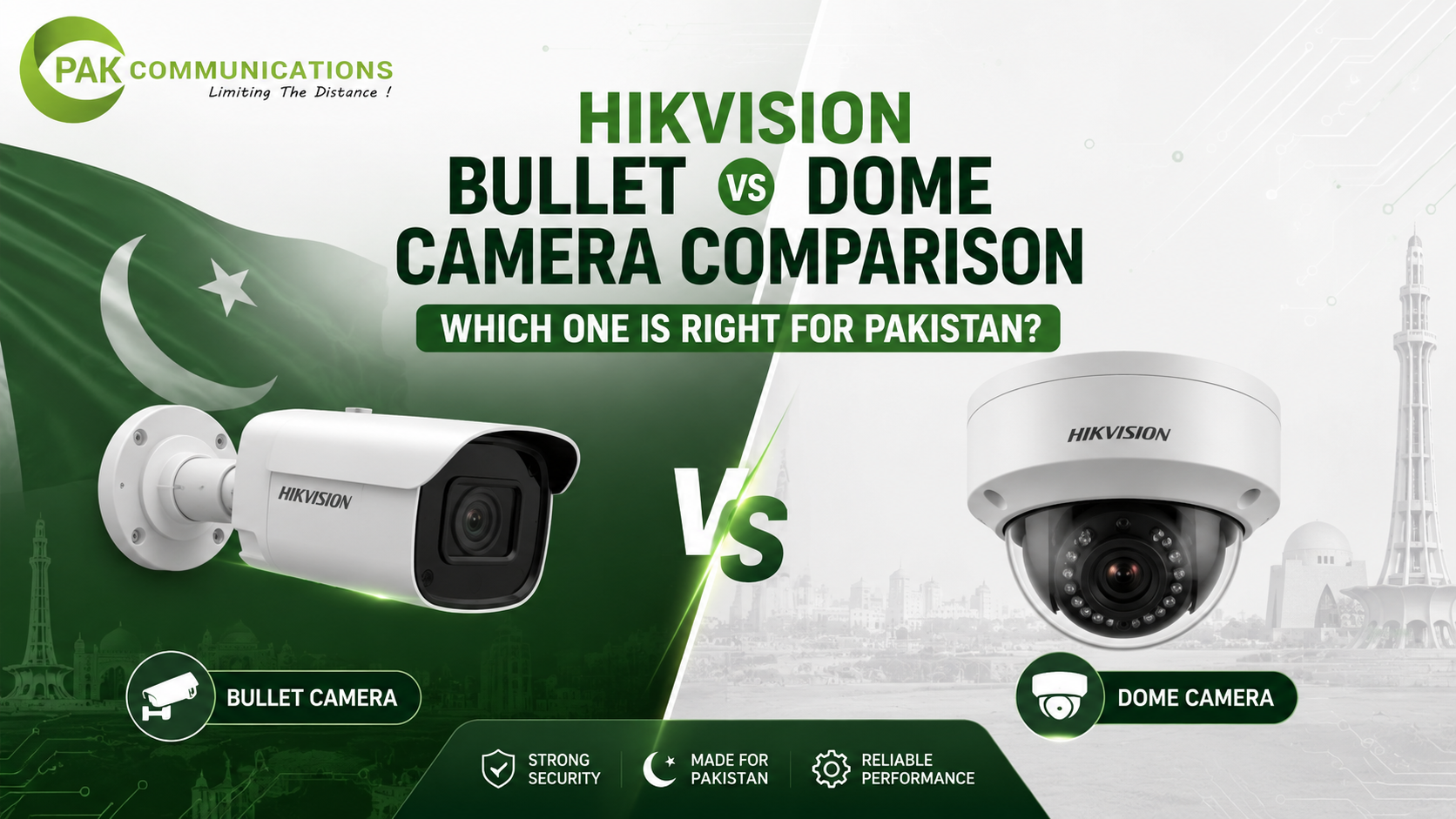
Pakistani property owners who are buying Hikvision cameras for the first time consistently reach the same selection question before they can move forward with their installation: should they use bullet cameras or dome cameras for each position on their property? Both types appear on the same product listing pages, both are available in 2MP, 4MP, and 8MP resolutions, both support ColorVu color night vision and AcuSense AI detection, and both connect to the same Hikvision DVR and NVR recorders. The physical form factor difference between bullet and dome is visible immediately, but what that difference means for outdoor gate positions, indoor office corridors, shop floors, perimeter walls, and car porch areas in Pakistani residential and commercial properties is not always explained in product listings. For the full current range of Hikvision CCTV cameras in Pakistan at PAK Communications, browse the complete selection before reading further.
Contact PAK Communications:
- Phone: (021) 4832293-4
- WhatsApp: 0341-2574866
- Email: info@pakcommunications.com
- Address: Suite #08, 4th Floor, Dar-ul-Furqan Building, Gulshan-e-Iqbal Block 13-B, Main University Road, Karachi
- Hours: Mon-Sat 9:30 AM – 6:30 PM
What Is a Hikvision Bullet Camera?
A Hikvision bullet camera takes its name from its long cylindrical body, which sits on an adjustable mounting bracket that can be tilted and rotated after installation to aim the lens at the exact coverage angle the position requires. The lens protrudes visibly from the front of the housing, and anyone standing in the camera’s field of view can see the direction the camera is pointing. This visible, directional appearance is not a design limitation. It is an intentional characteristic that gives bullet cameras a strong deterrence effect at positions where the goal is to discourage approach attempts, not just to record them.
Physical Design and Housing
The bullet camera body is manufactured from aluminum alloy or engineering-grade ABS plastic depending on the model tier, with the outdoor IP67-rated models using metal housings that conduct heat away from internal components during Pakistani summer months when exterior surfaces reach temperatures exceeding 50 degrees Celsius. The bracket assembly allows the camera to be mounted on a flat wall surface, a corner wall, or a ceiling, with adjustment screws that fix the angle after aiming is complete. Hikvision bullet cameras are available in white, grey, and dark grey housing finishes to suit different installation environments.
The IP67 weatherproofing rating on Hikvision outdoor bullet models provides complete protection against dust ingress and against water submersion up to one metre for up to thirty minutes, which exceeds the conditions any Pakistani outdoor installation position produces during monsoon rainfall. Buyers should confirm that the conduit entry point for the power and data cables at the bracket mount is sealed correctly during installation, as this entry point is where weatherproofing failures most commonly occur in Pakistani outdoor camera installations regardless of the camera’s own IP rating.
Where Bullet Cameras Excel in Pakistani Properties
The outdoor perimeter wall is the position where a bullet camera’s directional long-range coverage advantage over a dome camera is most clearly demonstrated in Pakistani property installations. A bullet camera mounted on a boundary wall at three metres height, aimed outward and slightly downward toward the exterior perimeter, covers the approach path from the street to the gate entry point at distances of 15 to 30 metres depending on the lens specification chosen. A dome camera mounted at the same boundary wall position cannot replicate this directional coverage because its ceiling-optimised optics and downward-facing design produce an upward-looking distorted image when wall-mounted in a horizontal orientation.
Gate entry positions in Pakistani residential and commercial properties benefit from the bullet camera’s ability to be aimed precisely at the vehicle approach lane and pedestrian entry path from a bracket mounted on the gate pillar or boundary wall. The camera height and aiming angle can be adjusted to capture both facial detail of pedestrians and front number plate detail of vehicles approaching the gate, which requires the directional flexibility that the bullet camera’s adjustable bracket provides and that a fixed dome camera at the same gate pillar position cannot deliver.
Parking areas in Pakistani commercial properties, particularly car parks where the monitoring requirement is to capture vehicle movements along defined lanes and identify vehicles at entry and exit points, benefit from bullet cameras mounted at height on poles or walls aimed along the parking lanes. The bullet camera’s longer identification range at its chosen angle covers the full length of a parking lane from a single mounting position, while multiple dome cameras would be required to cover the same lane length from ceiling-mount positions.
Factory and warehouse boundary perimeters in Pakistani industrial estates use bullet cameras at regular intervals along the boundary wall because the directional coverage of each bullet camera can be overlapped with adjacent cameras to create continuous perimeter coverage with no blind spots between camera positions. This continuous perimeter coverage approach with bullet cameras is more cable and installation efficient than attempting the same perimeter coverage with dome cameras, which require ceiling or overhead structures to mount correctly.
Bullet Camera Range and Coverage Angle
The lens focal length specification on a Hikvision bullet camera determines the coverage angle and the maximum identification distance at that angle. A 2.8mm lens produces a wide field of view of approximately 100 to 110 degrees that covers a broad entrance area at shorter distances, suited to positions where the primary subject zone is within 8 to 12 metres of the camera. A 4mm lens produces a narrower field of view of approximately 80 to 85 degrees that extends the reliable identification distance to 15 to 20 metres, which is the most commonly specified lens focal length for Pakistani residential gate and boundary positions. A 6mm lens narrows the field of view further to approximately 55 to 60 degrees and extends identification distance to 25 to 30 metres, suited to factory boundary positions and road approach monitoring where the primary subject zone is at greater distance from the camera mount.
Hikvision PoE bullet cameras receive both network data and electrical power through a single Cat6 cable connected to the NVR’s built-in PoE port, eliminating the need for a separate power supply at the camera position. This is the most common installation configuration for new Pakistani CCTV systems. Hikvision Turbo HD bullet cameras connect to DVR recorders via coaxial cable and require a separate power supply at the camera position, which suits Pakistani properties with existing coaxial infrastructure from an older analog installation where the property owner wants to upgrade cameras without replacing the entire cable infrastructure.
What Is a Hikvision Dome Camera?
A Hikvision dome camera takes its name from the compact circular dome housing that encloses the camera, lens, and IR or LED illumination components inside a sealed unit with a transparent or smoked dome cover on the front face. The smoked dome cover is the defining operational advantage of the dome camera over the bullet camera: it conceals the direction the lens is pointing from anyone standing in the camera’s coverage area. A person entering a shop, office reception, or car porch covered by a dome camera cannot tell whether the camera is aimed at them, at the door behind them, or at a position elsewhere in the space, which delivers a surveillance atmosphere that discourages dishonest behaviour without creating the watched-individual discomfort that a clearly aimed bullet camera produces.
Physical Design and Housing
The dome housing is manufactured from polycarbonate or aluminium depending on the vandal resistance specification of the model. IK10 vandal-resistant dome cameras use an aluminium housing that withstands up to 20 joules of impact force, equivalent to a deliberate strike with a hand tool, without housing fracture or lens cover damage. The IK10 rating is standard on Hikvision dome cameras recommended for Pakistani commercial and public installations where deliberate camera interference is a documented risk at certain property types including petrol pumps, parking areas, and ground-floor commercial premises.
Outdoor dome cameras from Hikvision carry an IP66 weatherproofing rating that provides complete protection against dust ingress and against high-pressure water jets from any direction, which is adequate for every Pakistani outdoor installation position including rooftop, exterior facade, and covered outdoor area positions during monsoon rainfall. The dome housing design concentrates rain runoff away from the lens cover surface through the dome profile, which reduces lens smearing from water deposits in outdoor installations compared to the flat front surface of a bullet camera housing.
Where Dome Cameras Excel in Pakistani Properties
The shop floor is the position in Pakistani retail environments where a dome camera’s concealed lens direction delivers a surveillance advantage that no bullet camera configuration can replicate. A Pakistani shop owner whose display area is covered by dome cameras creates uncertainty in the mind of a potential shoplifter about which specific display area is being monitored at any given moment, because the smoked dome cover on each camera hides whether the lens is aimed at the electronics display, the clothing rack, or the entrance door. Bullet cameras at the same shop floor positions would show exactly which area each camera is covering, allowing a determined shoplifter to identify uncovered positions between camera fields of view.
Office reception areas and corridors in Pakistani commercial buildings benefit from ceiling-mounted dome cameras because the downward-facing wide-angle coverage of a ceiling dome mount captures the full floor area below the camera with no blind spots from furniture, partitions, or obstructions that wall-mounted bullet cameras must aim around. A single 2.8mm wide-angle dome camera mounted at ceiling centre in a Pakistani office reception covers the full reception desk, the seating area, and the entry door from a single camera position that would require two or three wall-mounted bullet cameras to cover with equivalent completeness.
Car porch areas in Pakistani residential homes suit ceiling-mounted dome cameras because the porch ceiling provides the ideal mounting surface for a dome camera covering the full covered entry area including the vehicle position and the main house entrance door simultaneously. The same area covered by a wall-mounted bullet camera requires bracket height and angle adjustment to avoid capturing underside vehicle detail rather than face and vehicle identification detail, while the ceiling-mounted dome camera’s downward orientation naturally captures this area from the correct perspective.
Dome Camera Coverage Angle and Mounting
Wide-angle dome cameras with 2.8mm lenses cover 100 to 110 degrees horizontally from a ceiling mount position, which is sufficient to cover the full floor area of a standard Pakistani bedroom, office, or shop room from a single ceiling mount without requiring multiple cameras. Varifocal dome cameras with manually adjustable lenses allow the installer to set the focal length anywhere between 2.8mm and 12mm after mounting, which suits ceiling positions at different heights in Pakistani commercial buildings where the correct field of view depends on the ceiling height and the specific coverage area required at each camera position.
Fisheye dome cameras with 1.68mm ultra-wide lenses deliver 360-degree horizontal coverage from a single ceiling mount, eliminating all blind spots in covered areas. These cameras are suited to large open-plan Pakistani commercial spaces including restaurant dining areas, retail shop floors, and open-plan offices where multiple standard dome cameras would be required to cover the same area with equivalent completeness. The fisheye dewarping function in Hikvision’s NVR software converts the circular fisheye image into a corrected rectangular view that shows all areas of the covered space in a single display panel without the distortion that is visible in the raw fisheye image.
Hikvision Bullet vs Dome: Complete Head-to-Head Comparison
The decision between a bullet camera and a dome camera for any specific position in a Pakistani property installation comes down to four practical factors: the mounting surface available at the position, the coverage direction and distance required, the desired visibility of the camera lens direction to subjects, and the vandal resistance requirement at the position.
A bullet camera on a wall bracket delivers directional long-range coverage with visible deterrence and adjustable aiming, suits outdoor boundary and gate positions, carries IP67 weatherproofing, and requires no ceiling structure at the mounting position. A dome camera on a ceiling or wall mount delivers wide-area downward coverage with concealed lens direction, suits indoor and car porch positions, carries IK10 vandal resistance on commercial models, and requires a ceiling surface or flush-mount ceiling void at the mounting position.
Both camera types are available across the same resolution tiers from 2MP to 8MP, both support ColorVu color night vision on relevant model variants, both support AcuSense AI detection on mid-range and premium variants, and both connect to the same Hikvision NVR and DVR recorders. The choice between the two types should never be made on the basis of price, because the price difference between equivalent bullet and dome models in the same Hikvision series is typically between Rs 500 and Rs 2,000, which is not a meaningful budget consideration relative to total installation cost.
Which Pakistani Property Positions Need Bullet and Which Need Dome?
Understanding which camera type belongs at which position is the most practical information a Pakistani buyer needs before selecting their camera mix. The position requirements are consistent across property types and should override any preference for visual uniformity in the installed system.
Residential Home
The main gate approach position on a Pakistani residential property requires a bullet camera aimed outward from the gate pillar or boundary wall toward the street approach. This position’s requirement for directional coverage of an approach path at 10 to 20 metres distance, combined with the need to capture both facial detail and vehicle number plate detail at varying distances along the approach, is exactly the coverage scenario that a bullet camera’s adjustable bracket and directional long-range lens delivers. A dome camera at the same gate pillar position cannot be aimed to cover the approach path at the correct angle and distance without producing a poorly composed image with significant coverage gaps.
The car porch position in a Pakistani residential home requires a dome camera ceiling-mounted on the porch structure covering the full covered entry area. The porch ceiling provides the mounting surface that makes a dome camera the correct choice: the downward orientation captures the full vehicle parking position, the path from the vehicle to the main house entrance, and the main house entrance door itself from a single camera position. A bullet camera at the same porch position would need to be wall-mounted and aimed across the porch, producing directional coverage of one portion of the porch area rather than the complete overhead coverage the dome camera delivers.
The perimeter wall corner positions on a Pakistani residential boundary require bullet cameras at each corner aimed outward and along the boundary length. The corner position and the required coverage angle along two wall faces from a single camera mount suit a bullet camera’s directional adjustable aiming. The rear boundary wall position, if exposed to open ground behind the property, also requires a bullet camera aimed outward at the boundary exterior.
The interior main entrance lobby inside the main house door benefits from a dome camera ceiling-mounted above the entrance, which covers the entry point and the immediate interior without the exposed bracket hardware of a bullet camera that would be out of place in a residential interior.
Retail Shop
Pakistani retail shops require a specific mix of bullet and dome cameras that matches each camera type to the requirement at each position within the shop layout. The entrance position above the shop doorway suits a bullet camera mounted just above the door frame aimed outward and slightly downward to capture the face of every customer entering and leaving at a distance of 2 to 4 metres. This position requires facial identification quality at close range from a camera that can be aimed directly at the entry and exit flow, which is the bullet camera’s strength at this position.
The cashier counter position requires a ceiling-mounted dome camera with a wide-angle lens that covers the full counter area including the cash register screen, the cash transaction zone, and the facial detail of both the cashier and the customer at the counter simultaneously. This overhead wide-area coverage requirement is exactly what a ceiling-mounted dome camera delivers, and a wall-mounted bullet camera aimed at the counter would capture the same area from a side angle that misses important transaction details visible only from directly above.
The shop floor display area requires dome cameras ceiling-mounted at regular intervals to cover the full floor area with the smoked dome cover hiding the lens direction from customers browsing the display area. Using bullet cameras on the shop floor ceiling would expose the exact direction each camera is pointing, allowing a potential shoplifter to identify camera coverage gaps between fields of view.
The storage room entrance position benefits from a dome camera covering the door and immediate interior area from a ceiling mount just inside the storage room entrance, providing wide-area coverage of who enters and what they carry in both directions.
Office
A Pakistani office building’s exterior entrance requires a bullet camera mounted above or beside the entrance facing outward along the approach path from the street or building compound, capturing the face and appearance of every person approaching the entrance from a distance of 5 to 15 metres before they reach the door. The outdoor exterior environment and the directional approach coverage requirement make this a bullet camera position.
The reception area inside the office entrance benefits from a ceiling-mounted dome camera covering the full reception desk, waiting area seating, and entrance door simultaneously from a single overhead position. The professional interior environment suits the discreet dome housing, and the wide-area overhead coverage requirement suits the dome’s ceiling-mount orientation.
Corridor positions throughout a Pakistani office building benefit from ceiling-mounted dome cameras at junction points where two corridors meet, with each dome camera covering both corridor directions from the ceiling mount above the junction. A bullet camera mounted on a corridor wall would cover one direction only, requiring an additional camera for the opposite direction that a single dome camera handles from the overhead position.
The building’s outdoor car parking area requires bullet cameras mounted on poles or exterior walls aimed along the parking lanes, capturing vehicle movement along each lane and number plate detail at the entry and exit points of each lane.
Factory and Warehouse
Pakistani factory perimeter boundary walls require bullet cameras mounted at regular intervals aimed outward along the perimeter, with each camera’s coverage overlapping the adjacent camera’s coverage area to eliminate blind spots along the full boundary length. The outdoor boundary wall environment, the directional coverage requirement, and the long-range identification distances involved at factory perimeters all make bullet cameras the correct choice for this application.
The main vehicle entry gate to a Pakistani factory requires a bullet camera aimed at the vehicle approach lane that captures both the driver’s face through the windscreen at close range and the front number plate at the approach distance. A second bullet camera at the vehicle exit lane captures the same detail on vehicles leaving the site.
The factory production floor requires dome cameras ceiling-mounted at regular intervals across the full floor area, covering all machinery positions, workstation areas, and movement zones from overhead with the concealed lens direction that dome cameras provide. The indoor environment, the overhead ceiling structure, and the wide-area coverage requirement from multiple positions all make dome cameras the appropriate choice for production floor coverage.
The loading bay at a Pakistani factory or warehouse is a semi-outdoor covered position where bullet cameras mounted on the loading bay structure facing the vehicle loading area capture truck and vehicle positioning, loading activity, and driver and worker movements at the loading points.
Hikvision Bullet Cameras with ColorVu for Pakistani Night Coverage
Pakistani properties that need color footage during load shedding at outdoor bullet camera positions should specify ColorVu bullet models at gate, perimeter, and parking positions. The practical advantage of ColorVu at an outdoor bullet camera position is significant for Pakistani buyers whose primary security concern is after-dark incidents during the hours when load shedding removes all street and property lighting. A vehicle or person entering the gate area during a 2 AM load shedding event is captured by a ColorVu bullet camera with full color detail including clothing color, vehicle color, hair color, and any distinctive accessories or markings that make the subject identifiable from the recorded footage. The same event captured by a standard IR bullet camera produces black and white footage where the subject is visible but where identifying color details are entirely absent.
Understanding exactly how ColorVu technology maintains color imaging during complete darkness at outdoor positions, what the difference between LED-illuminated color footage and ambient-light color footage looks like in practice, and which Pakistani property positions deliver the strongest ColorVu return on investment is covered in detail in the complete Hikvision ColorVu technology guide. Pakistani buyers who are deciding whether to upgrade from standard IR bullet cameras to ColorVu bullet cameras at gate and perimeter positions will find the practical comparison between the two technologies directly relevant to their specific installation planning.
Price Comparison: Hikvision Bullet vs Dome in Pakistan 2026
The price difference between equivalent bullet and dome models within the same Hikvision series is consistently small across all resolution tiers in Pakistan’s authorized dealer market, typically ranging from Rs 500 to Rs 2,000 per camera. This small price difference confirms that the selection between bullet and dome should be made entirely on the basis of position requirements and coverage needs rather than cost savings, because choosing the wrong camera type for a position in order to save Rs 1,000 per unit produces a coverage result that cannot be corrected without replacing the camera.
For buyers who are specifying Turbo HD analog cameras to connect to an existing Hikvision DVR system and need both bullet and dome configurations across their installation, the full current range of Hikvision analog camera price in Pakistan including all bullet and dome variants across 2MP, 5MP, and 8MP resolutions is listed on the PAK Communications Hikvision analog camera page with current availability.
2MP Hikvision Bullet vs Dome Price in Pakistan 2026
A 2MP Hikvision standard IR bullet camera in Pakistan’s authorized dealer market is currently priced between Rs 5,500 and Rs 7,000 depending on the series and IR range specification. The equivalent 2MP Hikvision standard IR dome camera is priced between Rs 5,000 and Rs 6,500. The 2MP Hikvision ColorVu bullet camera that produces full color footage at night is priced between Rs 8,000 and Rs 10,500, and the equivalent 2MP ColorVu dome camera is priced between Rs 7,500 and Rs 10,000.
4MP Hikvision Bullet vs Dome Price in Pakistan 2026
A 4MP Hikvision standard IR bullet camera is currently priced between Rs 9,000 and Rs 13,000 in the authorized dealer market. The equivalent 4MP dome camera is priced between Rs 8,500 and Rs 12,500. The 4MP AcuSense bullet camera that includes AI human and vehicle detection is priced between Rs 14,000 and Rs 18,000, and the equivalent 4MP AcuSense dome camera is priced between Rs 13,500 and Rs 17,500.
8MP (4K) Hikvision Bullet vs Dome Price in Pakistan 2026
An 8MP 4K Hikvision bullet camera is currently priced between Rs 18,000 and Rs 26,000 in the authorized market. The equivalent 8MP 4K dome camera is priced between Rs 17,500 and Rs 25,000. The marginal price difference at the 4K tier, as at all other resolution tiers, confirms that the resolution and feature specification should drive the camera selection rather than the form factor price difference.
All prices listed are indicative based on current authorized dealer market pricing. Contact PAK Communications directly for confirmed current stock pricing before finalizing any order.
Common Mistakes Pakistani Buyers Make When Choosing Bullet vs Dome
Pakistani CCTV buyers who approach the bullet versus dome decision without understanding the position-specific requirements for each camera type consistently make a small set of installation mistakes that reduce system effectiveness and require costly camera replacements to correct.
The most common mistake is mounting dome cameras on outdoor boundary walls aimed horizontally along the perimeter. A dome camera designed for ceiling mount cannot produce correct directional coverage when mounted on a vertical wall surface because its lens assembly and IR illumination are optimised for downward-facing ceiling installation. The resulting footage from a wall-mounted dome camera aimed along a boundary perimeter is distorted, poorly illuminated, and provides significantly inferior coverage compared to a bullet camera at the same position at the same price point.
The second common mistake is mounting bullet cameras on indoor shop floor ceilings as a cost-saving measure when dome cameras are not immediately available. A bullet camera mounted on a shop ceiling with its bracket and directional lens visible to customers on the floor eliminates the concealed lens direction advantage that makes dome cameras effective in retail surveillance environments. Customers and potential shoplifters can see exactly which area each bullet camera is covering, which undermines the surveillance effect that smoked dome cameras create through concealed coverage.
The third common mistake is choosing between bullet and dome based on which type is currently cheaper at a specific dealer rather than which type suits the position requirement. A Rs 1,000 saving per camera across a four-camera installation saves Rs 4,000 on a total system that likely costs between Rs 80,000 and Rs 150,000 including recorder, hard drive, and installation, which is not a meaningful saving relative to the coverage quality reduction that results from installing the wrong camera type at any position.
The fourth common mistake is attempting to use a single camera type across the entire installation for visual uniformity. Pakistani property owners who specify all bullet cameras or all dome cameras for their installation to achieve a uniform appearance inevitably end up with either bullet cameras in positions that need dome coverage or dome cameras in positions that need bullet coverage. The correct installation uses the camera type that matches each position’s requirements, and the visual difference between bullet and dome cameras on a finished installation is not a presentation concern that overrides coverage performance.
Conclusion: Which Hikvision Camera Is Right for Your Pakistani Property?
The correct answer for the majority of Pakistani residential, commercial, and industrial installations is not bullet or dome in isolation, but a properly specified mix of both types matched to each position’s specific requirements. Bullet cameras belong outdoors on adjustable wall and pole brackets at gates, boundary walls, perimeter positions, and parking areas where directional long-range coverage, adjustable aiming, and strong visible deterrence are the primary requirements. Dome cameras belong on ceilings at indoor shop floors, office corridors, reception areas, car porches, and any position where wide-area overhead coverage, concealed lens direction, and IK10 vandal resistance suit the environment and the surveillance requirement.
Both types are available with ColorVu color night vision for positions where color footage during load shedding matters, and both types are available with AcuSense AI detection for installations where false alert elimination is a priority. The resolution, technology features, and price tier of the camera matter more to system performance than the form factor choice between bullet and dome, but the form factor choice determines whether the camera can physically deliver the coverage its specification promises at the specific position where it is installed.
If you are specifying cameras for a new Pakistani property installation and want confirmation of which camera type and model suits each specific position in your home, shop, office, or factory, the team at PAK Communications provides free pre-sale technical guidance for all installations. Browse the complete range of Hikvision security camera price in Pakistan at PAK Communications or contact us on WhatsApp 0341-2574866 to discuss your specific installation before ordering.