

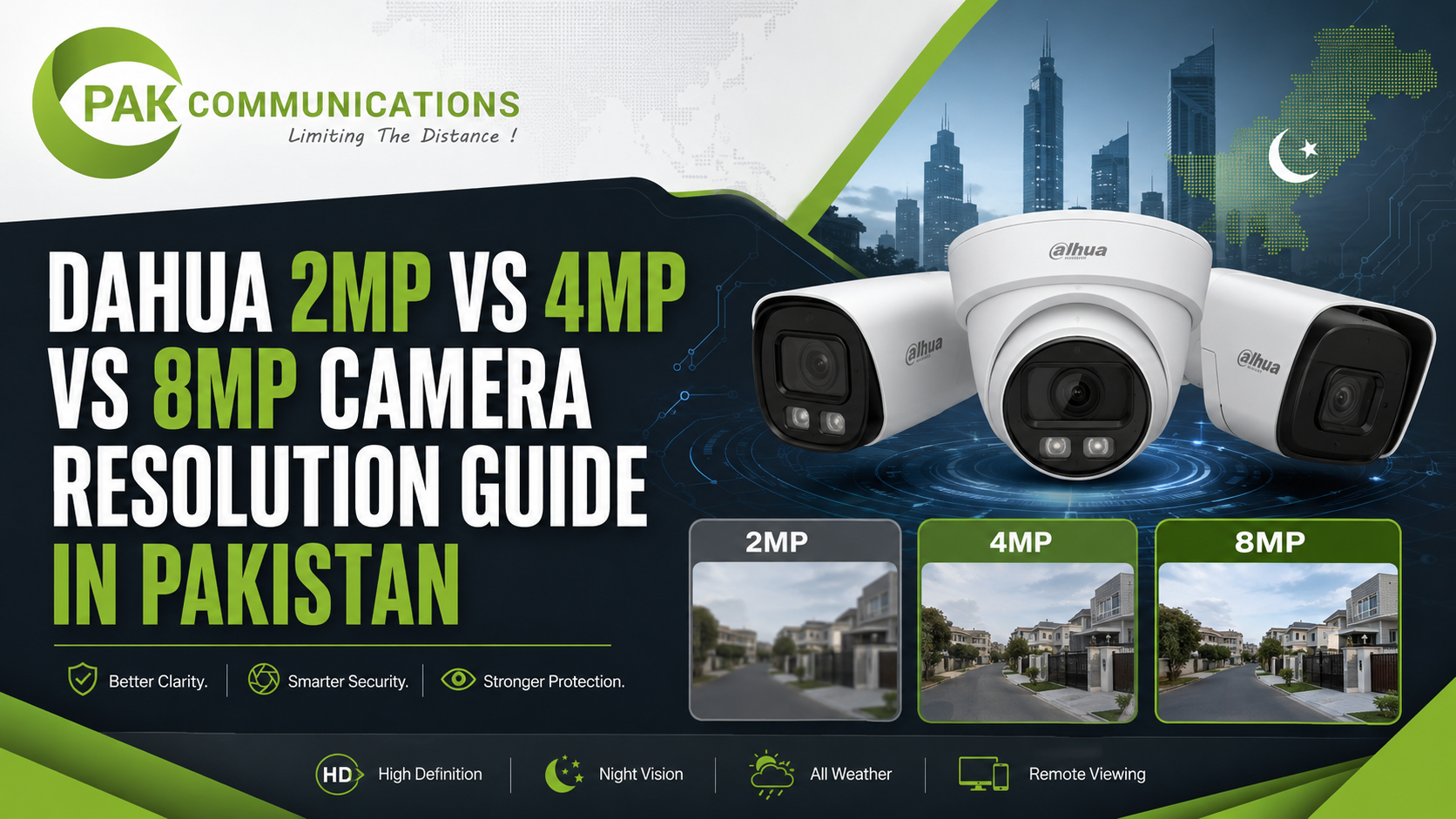
When a first-time CCTV buyer in Pakistan walks into a camera shop in Saddar or searches online for a Dahua camera, one of the first things they notice is that cameras with identical-looking housings carry very different price tags. The difference in most cases comes down to one specification: megapixels. A 2MP Dahua camera and an 8MP Dahua camera can look identical on a shelf, connect to the same NVR, and cover the same wall angle, but deliver footage so different in clarity that one can identify a face at 20 meters while the other cannot.
The problem is that most buyers in Pakistan make their resolution decision based on either the lowest price they can find or a vague sense that higher numbers must be better. Both approaches lead to the same outcome: a camera system that either wastes money on resolution the site does not need, or saves money upfront and fails to deliver usable footage when an incident actually occurs.
This guide cuts through the confusion. It covers what megapixels actually mean in practical surveillance terms, what each resolution tier delivers for Pakistani property types, how resolution affects your storage costs, and which Dahua camera resolution you actually need based on your specific site rather than general assumptions.
For the full range of available Dahua camera models across all resolution tiers, visit Dahua cameras in Pakistan at PAK Communications before reading further so you have a live product reference as you work through this guide.
Contact PAK Communications:
- Phone: (021) 4832293-4
- WhatsApp: 0341-2574866
- Email: info@pakcommunications.com
- Address: Suite #08, 4th Floor, Dar-ul-Furqan Building, Gulshan-e-Iqbal Block 13-B, Main University Road, Karachi
- Hours: Mon-Sat 9:30 AM – 6:30 PM
What Does Megapixel Actually Mean in a CCTV Camera
Most Pakistani buyers treat megapixels the way they treat mobile phone cameras: higher number equals better camera, full stop. This thinking works reasonably well for smartphone photography where you are holding the phone close to a subject in good light. It does not work the same way for CCTV surveillance, where distance, lighting, lens quality, and compression all affect what you actually see in recorded footage far more than the megapixel count alone.
Understanding what megapixels actually measure helps you make a smarter buying decision before spending money on a Dahua camera system.
Megapixels Are a Pixel Count, Not a Quality Rating
One megapixel equals one million pixels. A 2MP camera captures approximately 1920 by 1080 pixels per frame, which is the same resolution as a standard full HD television screen. A 4MP camera captures approximately 2560 by 1440 pixels per frame. An 8MP camera captures approximately 3840 by 2160 pixels per frame, which is 4K resolution.
What this means in practical terms is that higher megapixel cameras capture more detail per frame, which allows you to zoom into recorded footage digitally and still see a usable image. A 2MP recording zoomed in to 400 percent becomes a blurry, unusable mess. The same scene recorded at 8MP zoomed to 400 percent still shows recognizable facial features or a readable number plate.
This is the real value of higher resolution in surveillance: not that the live image looks sharper on a monitor, but that recorded footage holds up under digital zoom during post-incident review.
Resolution and Identification Distance
The most useful way to think about camera resolution in a Pakistani surveillance context is in terms of identification distance: how far away from the camera can a person or vehicle be and still be clearly identified in the recorded footage.
Here is a practical reference for Dahua cameras across resolution tiers:
| Resolution | Identification Distance | Number Plate Reading Distance |
|---|---|---|
| 2MP (1080p) | Up to 8 to 10 meters | Up to 6 to 8 meters |
| 4MP (1440p) | Up to 15 to 18 meters | Up to 12 to 15 meters |
| 8MP (4K) | Up to 25 to 30 meters | Up to 20 to 25 meters |
These distances assume a standard fixed lens camera mounted at a typical height of three to four meters. PTZ cameras with optical zoom extend these distances significantly regardless of resolution tier.
For a shop owner in Gulshan-e-Iqbal whose cashier counter is four meters from the camera mount, a 2MP Dahua camera delivers perfectly clear facial identification footage. For a factory manager in SITE Area whose loading dock is 20 meters from the nearest wall mount, a 2MP camera produces footage where workers appear as unidentifiable figures. The correct resolution choice is entirely dependent on distance.
Why Higher Resolution Is Not Always Better
Higher resolution creates three costs that buyers frequently overlook:
Storage cost: An 8MP camera recording continuously generates roughly three to four times more data per hour than a 2MP camera at equivalent quality settings. For a four-camera system running 24 hours, this difference translates into either a much larger hard drive requirement or a shorter recording retention period before footage overwrites.
Bandwidth cost: IP camera systems transmit video over your internal network. Higher resolution cameras consume more network bandwidth. In a large installation with many cameras, mixing 8MP cameras throughout can strain a standard network switch and introduce latency into live viewing.
Processing cost: NVRs process video streams from every connected camera simultaneously. Higher resolution streams require more processing power. A basic Dahua NVR that handles eight 2MP cameras smoothly may struggle or drop frames when connected to eight 8MP cameras if it is not rated for that resolution load.
None of these costs means you should avoid high resolution cameras. They mean you should choose the resolution that your specific site actually requires rather than defaulting to the highest available option.
The Pakistani Context: What Most Sites Actually Need
The majority of Pakistani commercial and residential properties have camera positions that fall within the 2MP to 4MP identification distance range. A standard shop in Karachi’s commercial areas, a residential compound in Lahore’s DHA, or a mid-size office in Islamabad’s Blue Area all have camera-to-subject distances that 2MP or 4MP handles comfortably.
The properties that genuinely need 8MP are those with long identification distances, wide open spaces, or specific requirements like number plate reading from a main road entry point where vehicles pass at speed from 15 meters or more away.
Knowing your distance requirement before choosing a resolution tier saves money, reduces storage costs, and prevents the common mistake of building a high-resolution system on an NVR that cannot process it properly.
Dahua 2MP Camera: What It Delivers and Who It Suits
Many Pakistani buyers dismiss 2MP cameras as the budget option, assuming higher resolution automatically means a better purchase. This assumption costs them money on storage, NVR processing capacity, and camera hardware without delivering any practical improvement in footage quality for their specific site. For a large percentage of Pakistani properties, 2MP is not the compromise choice. It is the correct choice.
What 2MP Actually Delivers
A 2MP Dahua camera records at 1920 by 1080 pixels per frame, which is full HD resolution. On a monitor, this footage looks sharp, clear, and completely usable for live viewing and post-incident review. At camera-to-subject distances up to 8 to 10 meters, facial features are clearly identifiable. At distances up to 6 to 8 meters, number plates are readable.
For the majority of indoor camera positions in Pakistani properties, these distances cover every realistic surveillance requirement. A shop counter, a reception desk, a corridor, a stairwell, a car porch, and a gate entry point at close range all fall comfortably within 2MP identification range.
Where 2MP Performs Best
Indoor Fixed Positions
Any indoor camera position where the subject passes within 8 to 10 meters of the lens is a natural fit for 2MP. This includes shop interiors in Karachi’s commercial areas like Tariq Road and Hyderi Market, office reception areas, bank branch interiors, school corridors, and apartment building lobbies. At these distances, a 2MP Dahua camera produces footage indistinguishable from higher resolution cameras in terms of practical identification value.
Residential Compounds and Gate Entry
Private housing societies across Karachi, Lahore, and Islamabad use 2MP cameras extensively for gate entry monitoring, car porch coverage, and boundary wall angles where the camera-to-subject distance is short and controlled. A gate camera mounted at three meters height covering a single vehicle entry lane has no practical use for 4MP or 8MP resolution because the subject fills the frame adequately at 2MP.
Small and Mid-Size Shops
A standard retail shop in Pakistan with a floor depth of 6 to 10 meters from the camera mount to the back wall is a 2MP installation. The camera covers the full floor, the cashier counter, and the entrance without any resolution limitation affecting footage quality. Shop owners in areas like Saddar Karachi, Liberty Market Lahore, and F-7 Markaz Islamabad running two to four camera systems on a tight budget get full surveillance capability from 2MP without paying for resolution their layout does not require.
Storage and NVR Advantages of 2MP
A single 2MP Dahua camera recording continuously at standard quality generates approximately 15 to 20 gigabytes of data per 24-hour period. For a four-camera system, a 2-terabyte hard drive in your NVR provides approximately 25 days of continuous recording before footage begins overwriting.
This storage efficiency has two practical benefits for Pakistani buyers. First, it reduces the upfront cost of your NVR hard drive. Second, it extends your recording retention period, which matters during post-incident investigations where the incident may not be discovered until several days after it occurred.
A basic Dahua NVR handles 2MP streams from multiple cameras without any processing strain, which means your system runs smoothly without dropped frames or lag during live viewing and playback.
Who Should Choose 2MP
Property Types
- Residential homes and apartment flats in urban Pakistani cities
- Small retail shops with floor depths under 10 meters
- Office interiors with short camera-to-desk distances
- School and college corridors
- Apartment building lobbies and stairwells
- Small warehouses with defined camera zones under 10 meters
Who Should Not Choose 2MP
- Any outdoor camera position covering distances beyond 10 meters
- Petrol pump forecourts where number plate reading from the gate is required
- Factory floors or open yards where workers need to be identified from 15 meters or more
- Main road entry points where vehicles pass at speed from beyond 8 meters
2MP is not an inferior product. It is a correctly specified product for the right application. The mistake is not choosing 2MP. The mistake is choosing 2MP for a site that requires 4MP or 8MP identification distances.
Dahua 4MP Camera: The Middle Ground Most Pakistani Buyers Choose
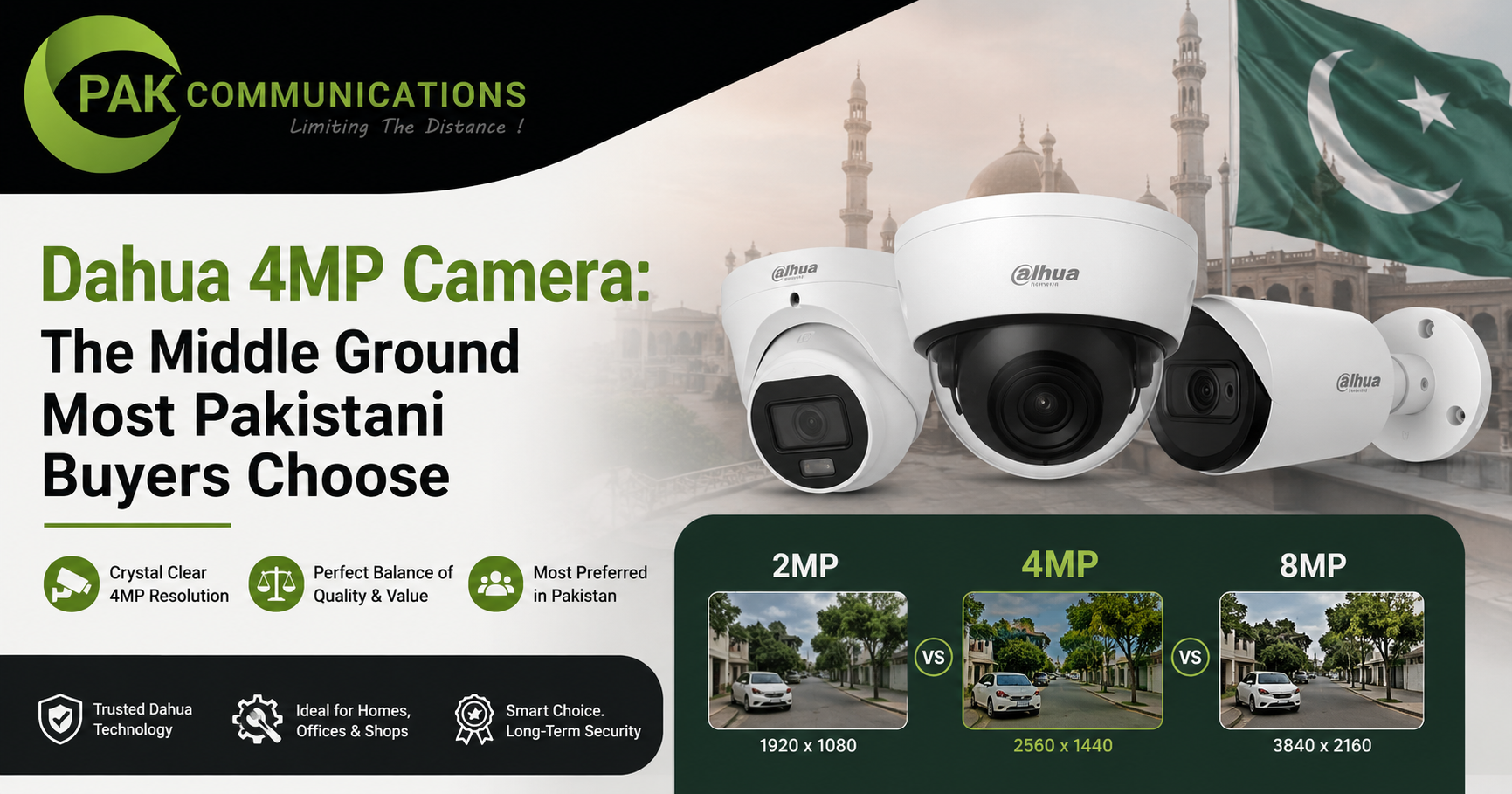
The 4MP Dahua camera sits at the point where resolution starts delivering a meaningful practical upgrade over 2MP for outdoor and semi-outdoor Pakistani installations. It is the tier where identification distances extend enough to cover the majority of commercial property layouts without pushing storage and NVR costs into 8MP territory. For this reason it is the most commonly recommended resolution tier for new commercial CCTV installations across Karachi, Lahore, and other major Pakistani cities in 2026.
What 4MP Delivers Over 2MP
A 4MP Dahua camera records at 2560 by 1440 pixels per frame. Compared to 2MP, this delivers approximately 78 percent more pixel information per frame, which translates directly into a longer identification distance and better digital zoom capability during post-incident footage review.
Identification Distance Improvement
At 4MP, facial identification extends to 15 to 18 meters and number plate reading extends to 12 to 15 meters. This distance improvement is the single most important reason commercial Pakistani buyers choose 4MP over 2MP. A petrol pump forecourt, a school entrance gate, a factory loading dock, or a commercial plaza parking lot all have camera-to-subject distances that fall inside 4MP range but outside reliable 2MP range.
Digital Zoom in Post-Incident Review
When an incident occurs and your security team reviews recorded footage, the ability to zoom into a specific area of the frame without losing usable image quality becomes critical. At 4MP, digital zoom up to 200 to 300 percent still produces footage where facial features and clothing details remain clearly visible. This capability has directly helped Pakistani business owners identify perpetrators in post-incident reviews where 2MP footage would have produced an unusable blurred image at the same zoom level.
Where 4MP Performs Best
Petrol Pumps and Fuel Stations
A petrol pump forecourt in Karachi, whether in a busy area like Shahrah-e-Faisal or a neighborhood station in Nazimabad, typically has a distance of 12 to 20 meters between the camera mount and the far end of the forecourt. This distance sits comfortably inside 4MP identification range and outside reliable 2MP range. The number plate reading capability at 4MP also means entry and exit gate cameras capture vehicle plates clearly without requiring a separate dedicated plate recognition camera.
Schools and Educational Campuses
School entrance gates, parking areas for staff and parents, and outdoor assembly areas across Pakistani cities from Karachi to Peshawar all benefit from 4MP resolution. The extended identification distance means a camera mounted above the main gate captures clear facial detail of every person entering and exiting, which is a requirement that school administrations increasingly prioritize for student safety.
Commercial Plazas and Retail Strips
Multi-story commercial plazas along major Karachi roads like Tariq Road, Shahra-e-Faisal, and MA Jinnah Road have open corridors, parking areas, and common spaces where distances regularly exceed 10 meters. A 4MP camera covering a plaza corridor or open parking area delivers footage that identifies individuals clearly across the full coverage zone.
Mid-Size Factories and Warehouses
Factory floors and warehouse spaces in Pakistani industrial areas where camera-to-subject distances fall between 10 and 18 meters are natural 4MP installations. Workers on a production floor, personnel at a loading dock, and vehicles in a goods receiving area all fall within 4MP identification range for facilities of standard size in areas like Korangi Industrial Area and Sundar Industrial Estate Lahore.
Storage and NVR Impact of Choosing 4MP
A single 4MP Dahua camera recording continuously at standard quality generates approximately 30 to 35 gigabytes of data per 24-hour period, roughly double the storage consumption of a 2MP camera. For a four-camera 4MP system, a 4-terabyte NVR hard drive provides approximately 28 to 30 days of continuous recording retention.
This storage increase is manageable for most Pakistani commercial buyers and represents a reasonable trade-off for the identification distance improvement. The key planning point is to size your NVR hard drive correctly from the start rather than installing a 2-terabyte drive with 4MP cameras and discovering your retention period is only 14 days.
Your NVR must also be rated to handle 4MP streams. Most current Dahua NVR models support 4MP across all channels without processing strain, but confirming your specific NVR’s resolution support before purchasing 4MP cameras avoids compatibility issues.
Who Should Choose 4MP
Property Types That Suit 4MP
- Petrol pumps and fuel stations with open forecourts
- Schools and colleges with outdoor entrance and assembly areas
- Commercial plazas with open corridors and parking areas
- Mid-size factories and warehouses with floor distances of 10 to 18 meters
- Outdoor perimeter cameras on residential compounds covering distances beyond 10 meters
- Shops with floor depths exceeding 10 meters or mezzanine level camera positions
Who Should Consider Moving to 8MP Instead
- Any outdoor camera position covering distances consistently beyond 18 meters
- Sites where number plate reading is required from beyond 15 meters
- Large industrial sites with open yard areas exceeding standard factory floor dimensions
- Properties requiring forensic-quality footage for regulatory or legal compliance purposes.
Dahua 8MP and 4K Camera: When High Resolution Actually Makes Sense
The jump from 4MP to 8MP is the most significant resolution step in the Dahua camera lineup. It is also the most frequently misapplied one. Pakistani buyers who install 8MP cameras across every position in a standard commercial property are paying a significant premium in camera cost, storage, and NVR processing capacity for resolution their site layout cannot actually use. Understanding exactly where 8MP delivers genuine value helps you apply it correctly rather than universally.
What 8MP and 4K Actually Delivers
A Dahua 8MP camera records at 3840 by 2160 pixels per frame, which is full 4K resolution. Compared to 4MP, this delivers approximately double the pixel information per frame. In practical surveillance terms this means facial identification extends to 25 to 30 meters and number plate reading extends to 20 to 25 meters. It also means that digital zoom during post-incident review holds usable image quality at zoom levels that would completely degrade 4MP and 2MP footage.
Forensic Zoom Capability
The most important practical advantage of 8MP over lower resolution tiers is not the live image quality but the post-incident forensic zoom capability. An 8MP recording of a wide outdoor area contains enough pixel data that investigators can zoom into a small corner of the frame, such as a face in a crowd or a number plate on a vehicle parked at the edge of the frame, and still extract a clearly identifiable image. This capability has real value for Pakistani commercial properties where incidents are often reviewed days after they occur when the only available evidence is recorded footage.
Wide Area Coverage From a Single Camera
At 8MP, a single camera covers a wider area with identifiable detail than any lower resolution camera at the same focal length. This means fewer cameras are needed to cover a large open space to identification standard, which in large installations partially offsets the higher per-camera cost of 8MP hardware.
Where 8MP Performs Best
Large Industrial Sites and Factories
Factories and industrial facilities in Pakistani industrial zones like SITE Area Karachi, Hattar Industrial Estate, and Faisalabad Industrial Estate with open floor areas, large outdoor yards, and perimeter walls covering distances consistently beyond 18 meters are the primary 8MP use case. At these distances 4MP identification becomes unreliable and 8MP delivers the clarity needed to identify workers, vehicles, and intruders across the full site.
Main Road Entry Points and Toll Gates
Any camera position covering a main road entry where vehicles pass at speed from beyond 15 meters requires 8MP for reliable number plate reading. Petrol pumps on major arterial roads in Karachi like University Road and Korangi Road, commercial plazas with busy main road frontage, and gated communities with fast vehicle entry lanes all benefit from 8MP at the entry gate position specifically, even if the rest of the installation uses 4MP or 2MP.
Port and Logistics Facilities
Port-adjacent warehouses in Keamari, logistics hubs near Karachi Port, and large cold storage facilities with wide loading areas and vehicle movement across extended distances are natural 8MP installations. The combination of long identification distances, high-value goods, and regulatory compliance requirements justifies the full cost of 8MP hardware and storage infrastructure at these sites.
4K CCTV Cameras and the Dahua 4K Lineup
Dahua’s 4K camera range covers both IP and analog output options for Pakistani buyers. For a complete look at available 4K CCTV cameras in Pakistan across current stock, PAK Communications carries the full Dahua 4K lineup with availability across entry, mid-range, and premium configurations.
For buyers specifically comparing 4K model pricing before making a resolution decision, the detailed breakdown of Dahua 4K camera prices in Pakistan covers the full cost range across models and helps you confirm whether the 8MP tier fits your budget before committing.
(H3) Storage and NVR Requirements for 8MP
A single 8MP Dahua camera recording continuously at standard quality generates approximately 55 to 65 gigabytes of data per 24-hour period. For a four-camera 8MP system, a 6 to 8 terabyte NVR hard drive is the minimum practical storage configuration for 30 days of recording retention.
This storage requirement is significantly higher than 4MP and represents a real ongoing cost consideration for Pakistani buyers. Hard drive replacements, NVR upgrades, and potential network infrastructure improvements to handle 8MP bandwidth all add to the total cost of an 8MP installation beyond the camera hardware itself.
Your NVR must be specifically rated for 8MP or 4K stream processing. Not all Dahua NVR models handle 8MP across all channels simultaneously. Confirming NVR compatibility before purchasing 8MP cameras is an essential step that PAK Communications can assist with before your purchase is finalized.
Who Should Choose 8MP
Property Types That Suit 8MP
- Large factories and industrial sites with distances consistently beyond 18 meters
- Main road entry points requiring number plate reading beyond 15 meters
- Port facilities, logistics hubs, and large cold storage operations
- Government and corporate installations with forensic footage requirements
- Large open outdoor areas like sports grounds, large farmhouses, and event venues with wide coverage distances
Who Should Stay at 4MP
- Standard commercial properties with distances under 18 meters
- Schools, petrol pumps, and mid-size factories where 4MP identification distance is sufficient
- Any installation where NVR and storage budget does not support 8MP infrastructure requirements
- Properties with mixed camera positions where only one or two positions genuinely require 8MP range.
Resolution vs Storage: What Higher MP Costs You in Hard Drive Space
Choosing a higher resolution Dahua camera without planning your storage correctly is one of the most common and most expensive mistakes Pakistani CCTV buyers make after installation. The camera works, the footage looks sharp, and then three weeks later the system starts overwriting recent recordings because the hard drive filled up faster than expected. Understanding exactly how much storage each resolution tier consumes helps you size your NVR hard drive correctly from day one.
How Resolution Affects Storage Consumption
Every increase in megapixels increases the amount of data your camera generates per hour of recording. The relationship is not perfectly linear because video compression algorithms handle different resolutions differently, but the practical storage difference between resolution tiers is significant enough to affect every Pakistani buyer’s hardware budget.
Storage Consumption Per Camera Per 24 Hours
| Resolution | Approximate Daily Storage Per Camera |
|---|---|
| 2MP (1080p) | 15 to 20 gigabytes |
| 4MP (1440p) | 30 to 35 gigabytes |
| 8MP (4K) | 55 to 65 gigabytes |
These figures assume continuous recording at standard H.265 compression, which is the default compression format on current Dahua NVR and camera systems. H.265 delivers roughly half the file size of older H.264 compression at equivalent quality, so buyers upgrading from an older system to a new Dahua H.265 setup will notice a meaningful reduction in storage consumption even at higher resolutions.
Storage Consumption for a Four Camera System Over 30 Days
| Resolution | 4 Cameras Daily | 30 Day Total | Recommended Hard Drive |
|---|---|---|---|
| 2MP | 60 to 80 gigabytes | 1.8 to 2.4 terabytes | 2 terabyte |
| 4MP | 120 to 140 gigabytes | 3.6 to 4.2 terabytes | 4 terabyte |
| 8MP | 220 to 260 gigabytes | 6.6 to 7.8 terabytes | 8 terabyte |
For Pakistani buyers planning an eight-camera system, simply double the four-camera figures above to get your minimum hard drive requirement for 30 days of continuous recording retention.
H.265 Compression and Why It Matters for Pakistani Buyers
All current Dahua cameras support H.265 video compression as standard. For Pakistani buyers this matters for two practical reasons.
Reduced Storage Cost
H.265 compression reduces storage consumption by approximately 50 percent compared to H.264 at the same visual quality. This means a 4MP Dahua camera using H.265 generates roughly the same storage footprint as a 2MP camera using H.264. If you are upgrading an older analog or H.264 IP system to a new Dahua H.265 system, your storage costs may not increase as much as the resolution jump suggests.
NVR Compatibility Requirement
H.265 decoding requires an NVR that supports the H.265 standard. Older Dahua NVR models and third-party recorders may only support H.264. Connecting an H.265 camera to an H.264-only NVR forces the camera to fall back to H.264 encoding, which eliminates the storage efficiency advantage. Always confirm your NVR supports H.265 before purchasing H.265 cameras. PAK Communications can confirm compatibility for any Dahua NVR and camera combination before purchase.
Motion-Based Recording as a Storage Reduction Strategy
Continuous 24-hour recording is not always the most practical approach for Pakistani properties, particularly those that are unoccupied for significant portions of the day. Switching your Dahua NVR to motion-triggered recording rather than continuous recording can reduce storage consumption by 40 to 70 percent depending on activity levels at your property.
How Motion Recording Works
When motion recording is enabled, your NVR records only when the camera detects movement in the frame. During periods of no movement, the system stores a low-resolution thumbnail frame at a reduced frame rate rather than a full-quality continuous stream. For a residential property in a Karachi housing society that sees activity for four to six hours daily and minimal movement overnight, motion recording can reduce a 4MP system’s daily storage consumption from 30 to 35 gigabytes per camera to 10 to 15 gigabytes per camera.
When Continuous Recording Is Better
For high-activity commercial properties like busy shops, petrol pumps, and factory floors where movement is constant throughout operating hours, motion recording provides minimal storage benefit because the camera is triggered almost continuously anyway. For these sites continuous recording at the correct compression setting is the simpler and more reliable configuration.
Hard Drive Availability and Pricing in Pakistan
Surveillance-grade hard drives differ from standard desktop hard drives in one important way: they are designed for continuous write operation 24 hours a day, seven days a week. Standard desktop hard drives are rated for much lower write duty cycles and fail significantly faster in continuous CCTV recording environments.
Dahua-compatible surveillance hard drives from brands like Western Digital Purple and Seagate SkyHawk are available through electronics markets in Karachi including Saddar and Jodia Bazaar, as well as through dedicated CCTV suppliers along University Road. PAK Communications stocks surveillance-grade hard drives in configurations compatible with Dahua NVR systems across all resolution tiers.
For buyers in Lahore, Hall Road electronics market carries a range of surveillance hard drives. Islamabad buyers can source through F-6 Markaz and Blue Area electronics suppliers.
Practical Storage Planning Before You Buy
Before finalizing your Dahua camera resolution choice, work through these three steps to confirm your storage requirement fits your budget.
Step One: Calculate Daily Storage
Multiply the per-camera daily storage figure from the table above by the number of cameras in your planned system. This gives you your total daily storage consumption.
Step Two: Decide Your Retention Period
Most Pakistani commercial properties aim for 30 days of recording retention as a minimum. Multiply your daily total by 30 to get your minimum hard drive requirement.
Step Three: Add a 20 Percent Buffer
Hard drives should not be filled to 100 percent capacity as this degrades performance and shortens lifespan. Add 20 percent to your calculated minimum and round up to the nearest available hard drive size. This gives you your correct hard drive purchase specification.
Which Dahua Camera Resolution Do You Actually Need
Every section in this guide has pointed toward the same conclusion: the correct Dahua camera resolution for your property is determined by distance, not by budget or preference. This section brings that principle together into a practical decision framework you can apply to your specific site before contacting a supplier or booking an installation.
The One Question That Decides Everything
Before comparing any resolution tier, measure or estimate the distance between your intended camera mounting point and the furthest subject you need to identify clearly in recorded footage. This single measurement determines your minimum resolution requirement more accurately than any other factor.
Distance to Resolution Reference
| Maximum Identification Distance | Correct Resolution |
|---|---|
| Up to 10 meters | 2MP |
| 10 to 18 meters | 4MP |
| 18 to 30 meters | 8MP |
| Beyond 30 meters | 8MP with PTZ optical zoom |
Apply this reference to every camera position in your planned installation individually. A property with six camera positions may correctly use 2MP at four positions and 4MP at two positions. Buying the same resolution for every camera regardless of position wastes money at close-range positions and underdelivers at long-range positions.
Mixed Resolution Systems
Most Pakistani commercial properties benefit from a mixed resolution approach rather than a single resolution across all cameras. This approach matches the resolution to the specific requirement of each camera position rather than applying a blanket specification to the entire system.
How a Mixed System Works in Practice
Consider a mid-size factory in Korangi Industrial Area with the following camera positions:
- Reception entrance: 3 meters camera to subject distance
- Office corridor: 5 meters camera to subject distance
- Factory floor: 15 meters camera to subject distance
- Main gate outdoor: 20 meters camera to subject distance
The correct resolution assignment for this installation is 2MP at the reception and corridor positions and 4MP at the factory floor and main gate positions. Installing 4MP across all four positions adds unnecessary cost and storage consumption at the two indoor positions without improving the footage quality at those distances.
NVR Compatibility for Mixed Resolution Systems
Current Dahua NVR models support mixed resolution inputs across channels, meaning you can connect 2MP and 4MP cameras to the same NVR without any compatibility issues. Each channel handles its input resolution independently. Confirm this capability with PAK Communications for your specific NVR model before planning a mixed resolution installation.
Property Type Resolution Guide for Pakistan
Residential Properties
| Camera Position | Recommended Resolution |
|---|---|
| Indoor rooms and corridors | 2MP |
| Car porch and driveway | 2MP |
| Boundary wall angles | 2MP to 4MP depending on plot size |
| Main gate entry | 4MP |
Commercial Properties
| Camera Position | Recommended Resolution |
|---|---|
| Shop interior | 2MP |
| Shop entrance | 2MP to 4MP |
| Parking area | 4MP |
| Main road entry gate | 4MP to 8MP |
Industrial Properties
| Camera Position | Recommended Resolution |
|---|---|
| Office and corridor | 2MP |
| Factory floor under 15 meters | 4MP |
| Factory floor beyond 15 meters | 8MP |
| Outdoor yard and perimeter | 8MP |
When to Ask for a Site Survey
If your property has camera positions where you are uncertain about the correct distance measurement or where structural constraints affect mounting options, a site survey by a qualified installer removes the guesswork from your resolution decision. An experienced installer measures distances accurately, accounts for lens angle, mounting height, and lighting conditions, and recommends the correct resolution for each position based on real site data rather than estimates.
PAK Communications provides site consultations for Karachi properties. A site survey before purchase prevents the most expensive CCTV mistake Pakistani buyers make: installing the wrong resolution and discovering the problem only after an incident produces unusable footage.
Resolution and Night Vision: What Pakistani Buyers Get Wrong
The most common night vision mistake Pakistani CCTV buyers make is assuming that a higher resolution camera automatically produces better night footage. This assumption leads to installations where expensive 8MP cameras produce darker, grainier night footage than cheaper 2MP cameras positioned at the same angle, simply because the buyer prioritized megapixels over IR illumination strength when making their purchase decision.
Resolution and night vision are two separate specifications that work independently of each other. Understanding how they interact helps you avoid a camera system that looks impressive on paper but fails at night, which in Pakistan means failing during load shedding hours when ambient lighting disappears entirely and your camera’s IR becomes the only light source available.
How Resolution and IR Illumination Work Together
A camera sensor needs light to produce a clear image regardless of its megapixel count. During daytime, natural and artificial light provides this input and higher resolution cameras produce proportionally sharper images because there is enough light for the additional pixels to capture meaningful detail.
At night, available light drops dramatically. In Pakistani residential and commercial areas during load shedding, ambient light can drop to near zero. At this point the camera’s IR illuminator becomes the sole light source, projecting infrared light invisible to the human eye but detectable by the camera sensor.
What Happens When IR Is Too Weak for the Resolution
If a camera’s IR illuminator does not produce enough light to illuminate the full coverage area adequately, the sensor receives insufficient light input regardless of its megapixel count. An 8MP sensor receiving weak IR input produces an 8MP image of a dark, noisy, low-contrast scene. A 2MP sensor receiving strong IR input from a powerful illuminator produces a 2MP image of a clearly lit, well-contrasted scene. In practical surveillance terms the 2MP camera with stronger IR delivers more useful night footage than the 8MP camera with weaker IR.
IR Range Must Match Coverage Distance
Every Dahua camera specifies an IR illumination range, typically expressed as the maximum distance at which the IR provides adequate illumination for the sensor. This range must match or exceed your coverage distance requirement just as the resolution specification must match your identification distance requirement.
| Coverage Distance | Minimum IR Range Required |
|---|---|
| Up to 20 meters | 20 to 30 meter IR |
| 20 to 50 meters | 50 meter IR |
| 50 to 100 meters | 100 meter IR |
| Beyond 100 meters | Laser IR or PTZ with strong IR |
For Pakistani outdoor installations where load shedding removes all ambient light for extended periods, selecting a camera whose IR range comfortably exceeds your coverage distance by at least 20 percent provides a safety margin that maintains usable footage quality even when the IR is working at its outer limits.
Load Shedding and Night Vision Across Resolution Tiers
Load shedding creates a unique night vision challenge for Pakistani CCTV systems that buyers in other countries do not face at the same scale. When grid power cuts, street lights, neighboring property lights, and commercial signage all go dark simultaneously. A camera that produces acceptable night footage with ambient street lighting may produce significantly worse footage during load shedding hours when that ambient light disappears.
2MP Cameras During Load Shedding
A 2MP Dahua camera with a 30-meter IR range performs consistently during load shedding at coverage distances up to its IR specification because its sensor requires less light input to fill its pixel array than a higher resolution sensor. At short to medium distances during complete darkness, 2MP cameras with adequate IR frequently outperform higher resolution cameras with equivalent IR strength.
4MP and 8MP Cameras During Load Shedding
Higher resolution Dahua cameras perform well during load shedding when their IR illumination specification is correctly matched to the coverage distance. The critical point is that the IR range specification becomes more important at higher resolutions because the sensor requires more light to fill its larger pixel array adequately. A 4MP camera with a 50-meter IR range handles load shedding darkness at distances up to 50 meters reliably. The same 4MP camera with a 20-meter IR range produces underexposed footage at 35 meters during load shedding even though its resolution specification would suggest it should cover that distance.
Coastal Karachi Conditions and IR Performance
Properties in coastal areas of Karachi including Clifton, DHA, Keamari, and areas near Manora face an additional night vision challenge that inland Pakistani cities do not. Salt-laden sea air deposits a fine residue on outdoor camera lenses over time, gradually reducing the amount of both visible and infrared light that passes through the lens to the sensor. This lens contamination effect is gradual and easy to miss until footage quality has degraded significantly.
For coastal Karachi installations, scheduling regular lens cleaning as part of a maintenance routine preserves night vision performance across all resolution tiers. Premium Dahua PTZ cameras with built-in wiper systems address this automatically, but fixed cameras require manual cleaning every three to four months in high salt-air exposure positions.
Practical Night Vision Checklist for Pakistani Buyers
Before finalizing any Dahua camera purchase, confirm these three points for every outdoor camera position in your installation.
Check One: IR Range vs Coverage Distance
Confirm the camera’s specified IR range exceeds your coverage distance by at least 20 percent. If your outdoor camera covers 25 meters, select a model with at least 30-meter IR.
Check Two: Adaptive IR Availability
Mid-range and premium Dahua cameras include adaptive IR technology that automatically adjusts IR intensity as the camera zooms or as subjects move closer to the lens, preventing overexposure of nearby subjects while maintaining illumination at distance. Confirm whether your chosen model includes adaptive IR, particularly for camera positions where subjects pass at varying distances from the lens.
Check Three: UPS Sizing for IR Operation
IR illuminators draw significant power, and PTZ cameras with long-range IR draw more than standard fixed cameras. Confirm your UPS backup system is sized to maintain IR operation throughout your expected load shedding duration, not just camera standby power. An undersized UPS that cuts out after two hours leaves your property without any night vision coverage during extended load shedding events.
Frequently Asked Questions
Is 2MP enough for a home CCTV camera in Pakistan?
For most Pakistani homes, 2MP is sufficient. Indoor positions like corridors, rooms, and car porches typically have camera-to-subject distances under 8 to 10 meters, which falls comfortably within 2MP identification range. A 2MP Dahua camera at these distances produces clear facial detail in recorded footage. The only home positions that may benefit from 4MP are main gate outdoor cameras covering distances beyond 10 meters or large plot boundary wall angles in bigger residential properties.
What is the difference between 2MP and 4MP CCTV camera quality in Pakistan?
The primary difference is identification distance. A 2MP camera identifies faces clearly up to 8 to 10 meters. A 4MP camera extends this to 15 to 18 meters. For indoor positions the difference is minimal because distances are short. For outdoor positions like petrol pump forecourts, school gates, and factory floors where distances exceed 10 meters, 4MP delivers meaningfully better identification quality that 2MP cannot match regardless of other settings.
Does higher megapixel mean more storage in a Dahua camera system?
Yes, directly. A 2MP Dahua camera generates approximately 15 to 20 gigabytes of storage per 24 hours. A 4MP camera generates 30 to 35 gigabytes and an 8MP camera generates 55 to 65 gigabytes per 24 hours at standard H.265 compression. For a four-camera system over 30 days, this difference means the gap between a 2-terabyte hard drive for 2MP and an 8-terabyte hard drive for 8MP. Plan your NVR hard drive size before purchasing cameras.
Which Dahua camera resolution is best for a factory in Pakistan?
Factory floor resolution depends on distance. For floor areas where the furthest worker is within 15 meters of the camera, 4MP delivers reliable identification quality. For larger factory floors in industrial areas like SITE Area Karachi or Sundar Industrial Estate Lahore where distances exceed 15 to 18 meters, 8MP is the correct choice. Outdoor yards and perimeter walls consistently require 8MP for identification-quality footage at the distances involved.
Can a Dahua 4MP camera read number plates in Pakistan?
Yes, at distances up to 12 to 15 meters under good lighting conditions. For main road entry points where vehicles approach from beyond 15 meters or pass at speed, 8MP delivers more reliable plate reading. Camera angle also affects plate readability significantly. A camera mounted at too steep a downward angle distorts the plate perspective regardless of resolution. A qualified installer positions the camera at the correct angle for reliable plate capture at your specific entry point distance.
Does camera resolution affect night vision quality during load shedding?
Resolution and night vision are separate specifications. During load shedding when ambient light disappears, footage quality depends primarily on the camera’s IR illumination strength and range, not its megapixel count. A 2MP camera with strong 30-meter IR produces better load shedding footage than a 4MP camera with weak 20-meter IR at the same distance. Always check the IR range specification alongside resolution when choosing a Dahua camera for Pakistani outdoor positions.
Which Dahua Camera Resolution Is Right for Your Property in Pakistan
The answer to this question is simpler than most Pakistani buyers expect. Measure the distance between your camera mounting point and the furthest subject you need to identify. If that distance is under 10 meters, choose 2MP. If it falls between 10 and 18 meters, choose 4MP. If it exceeds 18 meters, choose 8MP. Every other specification, storage planning, NVR compatibility, IR range, and compression format, flows from this single distance-based decision.
The most expensive mistake in any Pakistani CCTV installation is not choosing the wrong brand or the wrong camera housing. It is choosing the wrong resolution for the distance your site actually requires, either overspending on 8MP at positions where 2MP delivers identical practical results, or underspending on 2MP at outdoor positions where 4MP or 8MP is the minimum for usable identification footage.
Dahua’s camera lineup covers every resolution tier with models built and rated for Pakistan’s specific conditions: IP66 and IP67 weatherproofing for monsoon season, operating temperature ranges that handle summer heat in Karachi, Multan, and Sukkur, H.265 compression that keeps storage costs manageable across all resolution tiers, and IR illumination specifications matched to the identification distances each resolution tier serves.
Whether you are planning a two-camera residential installation in a Karachi housing society, a six-camera commercial system for a shop or office, or a 16-camera industrial network for a factory in SITE Area or Korangi, the correct resolution choice starts with your distance requirement and ends with a Dahua camera that delivers usable footage at that distance every time.
To explore the full range of available models across all resolution tiers and confirm current stock before making a purchase decision, browse the best Dahua camera in Pakistan selection at PAK Communications and shortlist the models that match your site requirements before calling or visiting the store.
Contact PAK Communications:
- Phone: (021) 4832293-4
- WhatsApp: 0341-2574866
- Email: info@pakcommunications.com
- Address: Suite #08, 4th Floor, Dar-ul-Furqan Building, Gulshan-e-Iqbal Block 13-B, Main University Road, Karachi
- Hours: Mon-Sat 9:30 AM – 6:30 PM