

Pakistani CCTV systems generate thousands of motion alerts every week that nobody acts on. A camera pointed at a busy street triggers every time a vehicle passes. An outdoor camera near a tree fires alerts through the night as branches move in the wind. A petrol pump camera sends notifications every few seconds as customers come and go. The result is alert fatigue: property owners disable notifications entirely because the volume of false triggers makes genuine alerts indistinguishable from background noise.
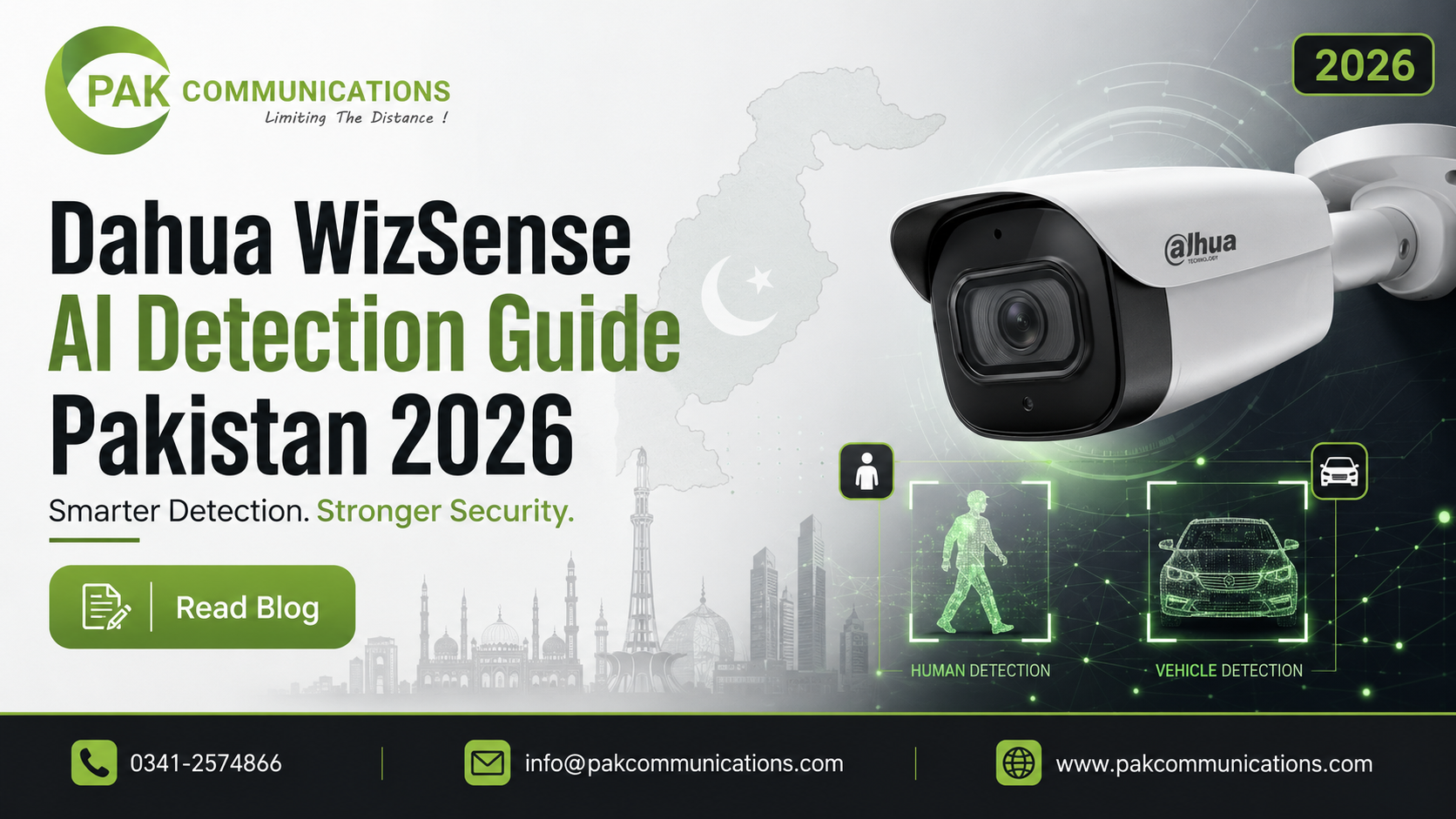
Dahua WizSense is the AI technology built into Dahua’s mid-range and premium camera range that solves this problem at the source. Instead of triggering on any movement in the frame, WizSense cameras analyze each motion event using onboard AI processing and classify it as a human, a vehicle, or irrelevant background movement before deciding whether to send an alert. A branch moving in the wind is not a human. A cat crossing a yard is not a vehicle. WizSense filters these out before they reach your phone, delivering only the alerts that actually require your attention.
This guide covers every WizSense AI feature available in Pakistan’s Dahua camera lineup, how each feature works in practical Pakistani surveillance conditions, which camera and NVR models support WizSense, and how to enable these features on your existing Dahua system. Whether you are dealing with constant false alerts from a busy Karachi road frontage or planning a new installation and want AI detection built in from the start, this guide gives you the complete picture before you make any purchasing or configuration decision.
For the full range of WizSense-enabled Dahua cameras available in Pakistan, visit Dahua 4K cameras at PAK Communications before reading further.
Contact PAK Communications:
- Phone: (021) 4832293-4
- WhatsApp: 0341-2574866
- Email: info@pakcommunications.com
- Address: Suite #08, 4th Floor, Dar-ul-Furqan Building, Gulshan-e-Iqbal Block 13-B, Main University Road, Karachi
- Hours: Mon-Sat 9:30 AM – 6:30 PM
What Is Dahua WizSense and How Does It Work
WizSense is Dahua’s proprietary AI detection technology embedded directly into the camera’s onboard processor or the NVR’s processing chip rather than relying on cloud servers to analyze footage. This architectural distinction is the most important technical fact about WizSense for Pakistani property owners, because onboard AI processing continues functioning during load shedding, during internet outages, and during any period when cloud connectivity is unavailable. The camera thinks for itself rather than waiting for a remote server to tell it what it is looking at.
Onboard AI Processing vs Cloud AI
How Standard Motion Detection Works
Standard motion detection cameras analyze changes in pixel values across the camera frame. When enough pixels change between consecutive frames, the camera or NVR registers a motion event and triggers an alert. This pixel-change analysis has no understanding of what caused the change. A leaf blowing across the frame, a shadow from a passing cloud, a reflection from a vehicle headlight, and a person walking through the entrance all trigger identical motion events. The system cannot distinguish between them and alerts on all of them equally.
How WizSense AI Detection Works
WizSense cameras use a deep learning neural network model trained on millions of human and vehicle images, embedded directly into the camera’s onboard processor. When motion is detected in the frame, the camera does not immediately trigger an alert. Instead it runs the motion region through the neural network model, which analyzes the shape, size, movement pattern, and proportion of the detected object and classifies it as a human, a vehicle, or an unclassified background object. Only confirmed human and vehicle detections trigger alerts. Everything else is filtered silently without generating a notification.
Why Onboard Processing Matters in Pakistan
Cloud-dependent AI systems send camera footage to remote servers for analysis before returning a classification result. This round-trip requires a stable internet connection and adds latency to the detection process. In Pakistani installations where load shedding interrupts internet connectivity for hours at a time and where mobile broadband speeds vary significantly across different areas of major cities, cloud-dependent AI delivers unreliable performance. WizSense’s onboard processing eliminates this dependency entirely. The AI runs on the camera chip regardless of internet status, delivering consistent detection performance whether your router is online or offline.
WizSense Camera and NVR Compatibility
Camera Level WizSense
WizSense processing can occur at the camera level on cameras equipped with Dahua’s AI chipset. These cameras perform the human and vehicle classification independently and only send classified event data to the NVR rather than sending raw motion events. This reduces the processing load on the NVR and allows WizSense features to function even when cameras are connected to older NVR models that do not have their own AI processing capability.
NVR Level WizSense
Dahua WizSense NVR models include their own AI processing chip that can apply WizSense classification to footage from connected cameras, including cameras that do not have onboard AI chipsets themselves. This means Pakistani property owners with an existing Dahua IP camera installation can gain WizSense functionality by upgrading to a WizSense NVR without replacing every camera in their system. The NVR processes the incoming video streams and applies human and vehicle classification at the recorder level rather than at the camera level.
Matching WizSense Camera to WizSense NVR
For maximum WizSense performance, pairing a WizSense camera with a WizSense NVR delivers the full feature set including perimeter protection, face detection, and advanced event management alongside SMD Plus human and vehicle filtering. Pairing a WizSense camera with a standard NVR limits functionality to the features the camera can process independently. PAK Communications can confirm the correct camera and NVR pairing for your specific WizSense feature requirements before purchase.
Dahua SMD Plus: Human and Vehicle Detection Explained
SMD Plus, which stands for Smart Motion Detection Plus, is the foundational WizSense feature that every WizSense-enabled Dahua camera and NVR includes as standard. It is the feature responsible for the dramatic reduction in false alert frequency that Pakistani property owners experience when they upgrade from standard motion detection cameras to WizSense models. Understanding exactly how SMD Plus works and what its practical limitations are helps you configure it correctly for your specific Pakistani property type and coverage zone.
How SMD Plus Human Detection Works
Detection Accuracy and Confidence Threshold
SMD Plus human detection analyzes the shape, proportions, movement pattern, and size of detected objects against the neural network model trained on human body characteristics. The system assigns a confidence score to each detection. Only detections above a set confidence threshold trigger an alert. This threshold prevents low-confidence detections, such as a partially visible person at the extreme edge of the frame, from generating false alerts while ensuring high-confidence detections at the primary coverage zone always trigger correctly.
Effective Human Detection Distance
SMD Plus human detection performs most reliably at distances where the human subject occupies a meaningful portion of the camera frame. At 2MP resolution, reliable human detection extends to approximately 10 to 15 meters from the camera. At 4MP resolution this extends to 15 to 20 meters. Beyond these distances the detected human subject becomes too small in the frame for the neural network to classify with sufficient confidence. Pakistani property owners whose primary intrusion concern involves a perimeter boundary more than 20 meters from the camera position should pair SMD Plus with perimeter protection features rather than relying on SMD Plus alone for long-distance human detection.
What SMD Plus Does Not Classify as Human
SMD Plus does not classify animals, mannequins, statues, or moving objects that share some human proportions as humans. Pakistani outdoor cameras near livestock areas, farms on the outskirts of Karachi along the Super Highway corridor, and rural properties in Sindh and Punjab where animal movement is common near camera positions benefit from this distinction. A goat crossing a yard does not trigger a human detection alert on an SMD Plus enabled camera, which eliminates a significant source of overnight false alerts for Pakistani rural and peri-urban properties.
How SMD Plus Vehicle Detection Works
Vehicle Classification Range and Types
SMD Plus vehicle detection classifies cars, motorcycles, trucks, rickshaws, and other motorized vehicles moving through the camera frame. Vehicle detection operates at longer distances than human detection because vehicles occupy a larger portion of the frame at equivalent distances. A 2MP SMD Plus camera reliably detects and classifies vehicles up to 20 to 25 meters from the camera position, making it effective for petrol pump entry gate cameras, factory main gate coverage, and residential compound entry monitoring across Pakistani commercial and residential properties.
Motorcycle Detection in Pakistani Context
Motorcycle detection is particularly relevant for Pakistani urban properties where motorcycles represent the most common vehicle involved in theft and snatching incidents. SMD Plus classifies motorcycles as vehicles regardless of whether a rider is present, which means a motorcycle being pushed silently into a compound after hours triggers a vehicle detection alert in the same way a driven motorcycle does. This detection capability addresses a specific Pakistani security concern that standard motion detection handles no differently from any other movement in the frame.
SMD Plus Alert Configuration for Pakistani Properties
Separate Alert Channels for Human and Vehicle Detection
SMD Plus allows separate alert configuration for human detections and vehicle detections independently. A Pakistani shop owner whose premises are on a busy road can enable human detection alerts for after-hours monitoring while disabling vehicle detection alerts that would otherwise trigger on every passing car throughout the night. A residential compound owner in a quiet housing society can enable both human and vehicle detection alerts around the clock because traffic volume at the property boundary is low enough that vehicle alerts represent genuine access events rather than background traffic.
SMD Plus in the DMSS App
SMD Plus alert snapshots delivered through the DMSS app include a bounding box overlay on the detected human or vehicle in the snapshot image, making it immediately clear what triggered the alert without needing to open full playback. Pakistani property owners receiving an SMD Plus alert see a snapshot with the detected person or vehicle highlighted, which allows instant assessment of whether the alert requires immediate action or can be reviewed later.
Dahua Perimeter Protection: Cross Line and Intrusion Detection
SMD Plus tells you that a human or vehicle is present in your camera frame. Perimeter protection tells you that a human or vehicle has crossed a specific line or entered a specific zone that you have defined as a boundary. This distinction matters enormously for Pakistani commercial and industrial property owners whose security concern is not general movement near their property but specific unauthorized crossing of a defined boundary line such as a perimeter wall, a restricted area entrance, or a property boundary.
Cross Line Detection
Cross line detection triggers an alert when a classified human or vehicle crosses a virtual line drawn across the camera frame in a specific direction. The line can be configured to trigger on crossing in one direction only, both directions, or either direction independently with separate alert actions for each.
How to Draw a Cross Line
On your Dahua NVR navigate to Main Menu, then Event, then Smart Plan for the relevant camera channel. Select Tripwire or Cross Line Detection from the available smart event options. A drawing interface appears over the camera frame. Draw a line across the section of the frame representing your boundary, such as across the top of a perimeter wall, across a gateway opening, or across a driveway entry point. Set the crossing direction that triggers the alert. Save the configuration and enable the feature.
Cross Line Detection Use Cases in Pakistan
A factory perimeter wall camera in SITE Area Karachi uses cross line detection drawn across the top of the wall image. Any human attempting to climb over the wall crosses the virtual line and triggers an immediate alert before they reach the ground on the inside. A residential compound camera in DHA covering the boundary wall uses the same configuration. A farmhouse camera on the Hub River Road outskirts of Karachi draws the cross line across the property boundary gate gap, triggering on any human or vehicle that passes through the entry point after hours without requiring manual NVR monitoring.
Direction Sensitivity for Pakistani Installations
Setting the cross line to trigger on inward crossing only eliminates alerts from authorized personnel leaving the property while maintaining alerts for anyone entering. A Pakistani factory that operates day shifts with legitimate worker movement through the boundary can set perimeter cameras to alert only on inward crossings after closing time, eliminating authorized exit movement from the alert stream entirely.
Intrusion Detection
Intrusion detection triggers an alert when a classified human or vehicle enters and remains within a defined zone drawn across the camera frame for a set dwell time. Unlike cross line detection which triggers on the moment of crossing, intrusion detection requires the subject to remain inside the defined zone for a minimum period before triggering, which eliminates brief transient crossings from generating alerts.
How to Configure an Intrusion Zone
On your Dahua NVR navigate to Main Menu, then Event, then Smart Plan for the relevant camera channel. Select Intrusion Detection from the smart event options. Draw a polygon zone over the area of the frame you want to protect, such as a restricted storage area, a generator compound, or a server room entrance corridor visible in the camera frame. Set the minimum dwell time, typically three to five seconds, before the intrusion triggers an alert. Save and enable the configuration.
Intrusion Detection Use Cases in Pakistan
A warehouse camera in Korangi Industrial Area draws an intrusion zone over the goods storage area visible in the frame. Any person who enters and remains in that zone for more than three seconds triggers an alert, which catches genuine unauthorized access attempts while filtering out staff who pass through the zone briefly during legitimate work activity. A Pakistani school camera draws an intrusion zone over the server room corridor entrance. Any person entering and remaining near the server room door after school hours triggers an immediate alert to the principal’s phone through the DMSS app.
Dwell Time Configuration for Pakistani Properties
The dwell time setting is the most important intrusion detection configuration variable for Pakistani properties. Setting dwell time too short generates false alerts from authorized personnel passing through defined zones briefly. Setting dwell time too long allows a genuine intruder to act within the zone before the alert is triggered. For Pakistani commercial properties a dwell time of three to five seconds suits most restricted area monitoring requirements. For outdoor perimeter zones where any human presence after hours is unauthorized, a dwell time of one to two seconds is appropriate.
Perimeter Protection vs SMD Plus: Choosing the Right Feature
When to Use SMD Plus
SMD Plus is the correct feature for general area monitoring where you want to know about any human or vehicle activity in the camera frame without defining specific crossing boundaries. It suits Pakistani residential property monitoring, shop interior coverage, and any camera position where the full frame is the zone of interest rather than a specific line or area within it.
When to Use Perimeter Protection
Perimeter protection is the correct feature for boundary-specific monitoring where the alert trigger must be a defined crossing or zone entry rather than general frame activity. It suits Pakistani factory perimeter walls, restricted area entrances, after-hours property boundary monitoring, and any installation where the camera covers both legitimate and illegitimate movement zones simultaneously and must distinguish between them based on location within the frame rather than subject classification alone.
Dahua Face Detection and Recognition Features
Face detection and face recognition are two distinct features in Dahua’s WizSense lineup that Pakistani buyers frequently conflate. Understanding the difference between them clarifies which feature is relevant for your specific security requirement and prevents overspending on face recognition capability when face detection alone covers your actual use case.
Face Detection vs Face Recognition
What Face Detection Does
Face detection identifies that a human face is present in the camera frame and captures a clear image of that face as a snapshot event. It does not compare the detected face against any database or identify who the person is. Every face that appears in the camera frame above the minimum size threshold generates a face detection event with a snapshot stored on the NVR and optionally sent as a push notification through the DMSS app. Face detection is available on mid-range WizSense Dahua cameras and is the feature most relevant for standard Pakistani commercial and residential installations.
What Face Recognition Does
Face recognition goes beyond detection by comparing detected faces against a pre-loaded database of known individuals stored on the NVR. When a detected face matches a database entry the NVR triggers a specific configured alert action, such as sending a priority notification, unlocking a door relay, or logging an attendance record. When a detected face does not match any database entry the NVR can trigger a separate alert for unrecognized individuals. Face recognition requires a Dahua NVR with dedicated face recognition processing capability and is available on premium WizSense NVR models rather than standard WizSense configurations.
Face Detection Use Cases in Pakistani Installations
Corporate Office and Bank Branch Entry Monitoring
Pakistani corporate offices in Karachi’s Clifton and DHA business districts and bank branches across major cities use face detection cameras at entrance points to capture a clear facial image of every person who enters the premises. This face capture creates a searchable record in the NVR that investigators can use after an incident to identify individuals who were present at a specific time, even when the live view footage does not provide a clear enough angle for identification during normal playback.
Restricted Area Access Monitoring
Dahua face detection cameras at restricted area entrances in Pakistani facilities, including server rooms, finance departments, and executive floors, capture a face image every time someone passes through the entry point. This face log provides a complete access record tied to captured images rather than just a timestamp, which delivers more actionable investigation data than standard motion detection footage when an unauthorized access incident is being reviewed.
Face Recognition for Pakistani Access Control Applications
Building a Face Database on Dahua NVR
Pakistani corporate facilities implementing face recognition load authorized personnel photographs into the Dahua NVR face database through the NVR interface or through Dahua’s DSS management software. Each database entry includes the person’s photograph and an identifying label. The NVR compares incoming face detections against this database in real time and triggers the configured alert action when a match or non-match is identified.
Practical Limitations of Face Recognition in Pakistan
Face recognition performance depends on face image quality at the camera position, which requires controlled lighting, a camera angle that captures the face directly rather than from extreme side angles, and a minimum face size in the frame that the recognition algorithm can process reliably. Pakistani outdoor installations with variable lighting from load shedding, strong directional sunlight, and uncontrolled approach angles produce inconsistent face recognition results compared to controlled indoor entry point installations. For most Pakistani commercial properties, face detection rather than full face recognition delivers the practical benefit without the configuration complexity that reliable face recognition requires.
How WizSense Reduces False Alarms in Pakistani Conditions
Pakistan presents a more challenging false alarm environment than most countries where Dahua cameras are deployed. The combination of coastal wind in Karachi, monsoon season foliage movement across the country, heavy road traffic in urban commercial areas, livestock presence in peri-urban and rural properties, and the dramatic lighting changes that accompany load shedding power cuts creates a false alarm landscape that standard motion detection cameras cannot handle without generating an overwhelming volume of irrelevant alerts. WizSense addresses each of these sources specifically through its AI classification layer.
Wind and Foliage Movement
Coastal Karachi Wind and Vegetation
Karachi’s coastal location means properties in areas like Clifton, DHA, Keamari, and Defence Housing Authority experience persistent sea breeze that moves trees, plants, and any lightweight objects in outdoor cam
era frames continuously throughout the day and night. Standard motion detection cameras in these areas trigger on every gust that moves foliage within the detection zone. A property with three outdoor cameras facing garden areas can generate hundreds of motion alerts overnight from wind movement alone, rendering the alert system completely useless for genuine security purposes.
WizSense classifies foliage movement as unclassified background motion rather than human or vehicle activity. The neural network recognizes that the movement pattern, shape, and size characteristics of swaying vegetation do not match the profiles of human or vehicle objects and filters these events silently without generating alerts. Pakistani coastal property owners who switch from standard motion detection to WizSense cameras report overnight alert volumes dropping from hundreds to single digits in typical installation scenarios.
Monsoon Season Foliage Movement Across Pakistan
During Pakistan’s monsoon season from July to September, wind-driven rain and heavy foliage movement affect outdoor cameras across all major cities including Lahore, Islamabad, Faisalabad, and interior Sindh. Properties with trees, hedges, or garden vegetation within camera frame areas experience dramatically increased false alert frequency during monsoon months with standard motion detection. WizSense maintains consistent filtering performance during monsoon conditions because its classification is based on object characteristics rather than pixel change volume, which remains unaffected by the scale of background movement in the frame.
Road Traffic and Vehicle Headlight Reflections
Busy Road Frontage Cameras in Pakistani Cities
Pakistani commercial properties on major arterial roads including Shahrah-e-Faisal, University Road, and MM Alam Road in Lahore have outdoor cameras that face road frontage where vehicle traffic passes continuously. Standard motion detection on these cameras triggers on every passing vehicle, every motorcycle, and every pedestrian on the pavement outside the property boundary. For a shop on a busy Karachi commercial strip, this means hundreds of motion events per hour during peak traffic periods.
WizSense cross line detection configured to trigger only on objects that actually cross the property boundary line eliminates all passing road traffic from the alert stream. Vehicles and pedestrians moving parallel to the property boundary on the pavement or road do not cross the virtual line and generate no alerts. Only a vehicle or person who actually turns into the property approach crosses the line and triggers the configured alert.
Load Shedding Lighting Change Alerts
When grid power cuts, the sudden change in ambient lighting across the camera frame causes a massive pixel value change that standard motion detection cameras interpret as a major motion event, generating an alert at the exact moment the lights go out. When power is restored the reverse lighting change triggers another alert. Pakistani properties with scheduled load shedding receive two false alerts per load shedding cycle from this lighting change effect using standard motion detection cameras.
WizSense ignores lighting change events because the neural network does not classify a sudden illumination change as a human or vehicle object. Load shedding transitions produce no alerts on WizSense cameras, eliminating what is one of the most uniquely Pakistani false alarm sources entirely.
Animals and Livestock Near Pakistani Properties
Urban and Peri-Urban Animal Movement
Stray cats, dogs, and birds are present around Pakistani urban properties in every major city. Standard motion detection cameras trigger on every cat that crosses a yard, every dog that approaches a boundary wall, and every bird that lands in the frame. WizSense human and vehicle classification does not classify these animals as alert-worthy objects. A cat crossing a Karachi residential compound yard at 3 AM generates no WizSense alert because the neural network correctly identifies the movement as non-human and non-vehicle.
Livestock on Peri-Urban and Rural Pakistani Properties
Properties on the outskirts of Pakistani cities and in rural areas of Sindh, Punjab, and Khyber Pakhtunkhwa frequently have livestock including goats, cattle, and donkeys that move near camera coverage zones. Standard motion detection treats a goat crossing a yard identically to a person crossing the same yard. WizSense distinguishes between the two based on shape, proportion, and movement characteristics, filtering livestock movement from the alert stream while maintaining sensitivity to genuine human and vehicle intrusion events.
Which Dahua Cameras Support WizSense AI in Pakistan
WizSense AI detection is not available across Dahua’s entire camera range. It is a feature set specific to cameras and NVRs equipped with Dahua’s AI chipset, which currently covers mid-range and premium models across all major form factors. Understanding which camera categories carry WizSense capability helps Pakistani buyers identify the correct models before requesting a quote from PAK Communications.
WizSense Fixed Cameras
WizSense Bullet Cameras
Dahua’s WizSense bullet camera range covers 2MP, 4MP, and 8MP resolution options with SMD Plus human and vehicle detection, perimeter protection, and cross line detection built into the camera’s onboard processor. These cameras suit Pakistani outdoor installations including factory perimeter walls, petrol pump forecourts, warehouse entry points, and residential compound boundary cameras where long IR range and visible deterrence combine with AI detection capability. WizSense bullet cameras are among the most commonly specified models for Pakistani commercial outdoor installations at PAK Communications.
WizSense Dome and Turret Cameras
Dahua’s WizSense dome and turret camera range delivers the same AI detection feature set as WizSense bullet cameras in compact form factors suited for indoor ceiling mounts and semi-outdoor positions. IK10 vandal-rated WizSense dome cameras suit Pakistani installations in accessible indoor positions including school corridors, office common areas, retail shop interiors, and apartment building lobbies where both AI detection and physical housing protection are required simultaneously.
WizSense PTZ Cameras
Dahua’s WizSense PTZ camera range combines pan, tilt, and zoom coverage capability with full AI detection including SMD Plus, perimeter protection, and auto-tracking that follows confirmed human and vehicle detections rather than any moving object. For Pakistani large-area installations including factory sites, school campuses, and commercial plazas where a single camera must cover a wide area actively, WizSense PTZ cameras deliver both the coverage flexibility of motorized zoom and the alert precision of AI classification simultaneously. For a detailed breakdown of available PTZ models and pricing, the Dahua PTZ camera guide Pakistan covers the full WizSense PTZ range before you request a quote.
WizSense IP Cameras Available in Pakistan
The full range of WizSense-enabled Dahua IP cameras available through PAK Communications covers every form factor and resolution tier from 2MP entry-level AI models to 8MP premium 4K WizSense cameras. Browsing Dahua IP cameras in Pakistan gives you a live inventory reference showing current WizSense model availability before contacting the team to confirm your specific requirement.
WizSense NVR Models Available in Pakistan
Selecting the Correct WizSense NVR
Dahua WizSense NVR models are available in 4-channel, 8-channel, 16-channel, and 32-channel configurations in Pakistan. Each WizSense NVR includes dedicated AI processing that supports SMD Plus, perimeter protection, face detection, and advanced event management across all connected channels simultaneously. Pakistani buyers upgrading an existing IP camera installation to gain WizSense features without replacing cameras should confirm with PAK Communications whether their existing camera models are compatible with WizSense NVR processing before purchasing the NVR upgrade.
How to Enable WizSense Features on Your Dahua NVR
WizSense features do not activate automatically on a Dahua NVR after installation. Each AI detection feature requires deliberate activation through the NVR’s Smart Plan configuration interface on a per-channel basis. The process takes under ten minutes per camera channel once you are familiar with the NVR menu structure, and the steps below apply to all current Dahua WizSense NVR models available in Pakistan.
Step One: Enable Smart Plan on the Camera Channel
Accessing Smart Plan Settings
On your Dahua NVR interface navigate to Main Menu, then AI, then Smart Plan. A channel selection screen appears showing all connected camera channels. Select the channel number corresponding to the camera you want to configure. The Smart Plan screen for that channel displays all available AI features as toggleable icons including SMD, Perimeter Protection, Face Detection, and other features supported by that specific camera and NVR combination.
Enabling the Correct Smart Plan Features
Enable only the WizSense features relevant to that specific camera’s position and purpose. Enabling every available feature simultaneously on every channel is not recommended because multiple active AI features on the same channel compete for the camera and NVR’s AI processing capacity, which can reduce detection accuracy across all active features. For a standard Pakistani commercial outdoor camera, enabling SMD Plus alone or SMD Plus combined with Perimeter Protection covers the majority of genuine security requirements without overloading the AI processing pipeline.
Step Two: Configure SMD Plus Settings
Accessing SMD Configuration
After enabling SMD in Smart Plan, navigate to Main Menu, then AI, then SMD. Select the camera channel. The SMD configuration screen shows separate toggles for human detection and vehicle detection with individual sensitivity controls for each. Enable human detection, vehicle detection, or both depending on the alert requirement for that specific camera position as covered earlier in this guide.
Setting SMD Sensitivity for Pakistani Conditions
The SMD sensitivity control adjusts how confidently the AI must classify an object before triggering an alert. Higher sensitivity settings trigger on lower-confidence detections, which increases detection coverage at the cost of occasional false alerts from partially visible subjects at frame edges. Lower sensitivity settings require higher confidence classifications before triggering, which reduces false alerts but may miss detections of partially obscured subjects. For Pakistani outdoor cameras covering open unobstructed areas, a medium to high sensitivity setting delivers the best balance of detection coverage and false alert suppression.
Step Three: Configure Perimeter Protection
Setting Up Cross Line Detection
Navigate to Main Menu, then AI, then Perimeter Protection, then Tripwire for the relevant channel. The camera frame appears as a drawing canvas. Draw the virtual tripwire line across the boundary point in the frame as described in the perimeter protection section of this guide. Set the crossing direction, confirm the target filter is set to Human, Vehicle, or Both depending on your requirement, and save the configuration.
Setting Up Intrusion Detection Zone
Navigate to Main Menu, then AI, then Perimeter Protection, then Intrusion for the relevant channel. Draw the polygon zone over the restricted area in the camera frame. Set the minimum dwell time appropriate for your Pakistani property type, typically three to five seconds for indoor restricted areas and one to two seconds for outdoor perimeter zones. Confirm the target filter setting and save the configuration.
Step Four: Configure DMSS App Alerts for WizSense Events
Linking WizSense Events to Push Notifications
WizSense event alerts reach the DMSS app through the same push notification infrastructure as standard motion alerts but carry additional classification data including the detected object type and bounding box position. On your Dahua NVR navigate to Main Menu, then Event, then Video Detection for the relevant channel. Confirm the alert linkage for each WizSense event type is set to send a push notification. Without this linkage configured, WizSense detections are logged in the NVR event list but do not reach the DMSS app as push notifications on your phone.
Verifying WizSense Alert Delivery
After completing configuration, walk through the camera frame at the configured detection zone and wait for a WizSense alert to arrive on your DMSS app. A correctly configured WizSense alert arrives as a push notification with a snapshot showing a green bounding box around the detected human subject. If the alert arrives without a bounding box, the notification is from standard motion detection rather than WizSense classification, which indicates the Smart Plan activation step was not completed correctly for that channel.
Frequently Asked Questions
Q) What is Dahua WizSense and how does it work in Pakistan?
Dahua WizSense is an AI detection technology embedded directly into Dahua camera and NVR processors that classifies motion events as human, vehicle, or irrelevant background movement before triggering alerts. Unlike standard motion detection that triggers on any pixel change, WizSense only alerts on confirmed human or vehicle detections. This onboard processing continues functioning during load shedding and internet outages, making it particularly valuable for Pakistani properties where cloud-dependent AI delivers unreliable performance during power interruptions.
Q) What is the difference between Dahua WizSense and standard motion detection?
Standard motion detection triggers on any pixel change in the camera frame including wind, animals, passing traffic, and load shedding lighting changes. WizSense uses a deep learning neural network to classify each motion event before triggering an alert, filtering everything that is not a confirmed human or vehicle. Pakistani property owners switching from standard motion detection to WizSense typically experience overnight alert volumes dropping from hundreds of false triggers to single-digit genuine detections, making the alert system practically useful rather than a source of notification fatigue.
Q) Which Dahua cameras support WizSense AI detection in Pakistan?
WizSense AI detection is available on Dahua’s mid-range and premium IP camera range including WizSense bullet, dome, turret, and PTZ models across 2MP, 4MP, and 8MP resolution tiers. WizSense NVR models can also apply AI classification to footage from connected cameras that do not have onboard AI chipsets. PAK Communications stocks WizSense-enabled cameras and NVRs across all major form factors. Contact the team to confirm which specific models in current stock carry WizSense capability before purchasing.
Q) Does Dahua WizSense work during load shedding in Pakistan?
Yes. WizSense processing runs on the camera or NVR’s onboard AI chip rather than relying on cloud servers, so it continues functioning during load shedding as long as the camera and NVR remain powered through a UPS backup system. Internet connectivity is not required for WizSense detection and classification to operate. Push notifications through the DMSS app are interrupted during load shedding if the router loses power, but all WizSense detection events are logged on the NVR and available for review when connectivity is restored.
Q) How do I enable WizSense on my Dahua NVR in Pakistan?
Navigate to Main Menu, then AI, then Smart Plan on your Dahua WizSense NVR. Select the camera channel you want to configure and enable the relevant WizSense features including SMD, Perimeter Protection, or Face Detection. After enabling features in Smart Plan, configure the specific settings for each feature under Main Menu, then AI. Finally confirm alert linkage to push notifications under Main Menu, then Event. The full configuration process takes under ten minutes per camera channel.
Q) Can Dahua WizSense reduce false alarms from Pakistani road traffic?
Yes. Configuring cross line detection on cameras facing road frontage positions draws a virtual boundary line at the property entrance. Vehicles and pedestrians moving parallel to the property on the road or pavement do not cross this line and generate no alerts. Only subjects that actually cross the line into the property trigger an alert. This configuration eliminates road traffic false alarms completely for Pakistani commercial properties on busy roads while maintaining full sensitivity to genuine property entry events.
Get Dahua WizSense AI Working at Your Property in Pakistan
The gap between a CCTV system that generates hundreds of useless alerts every night and one that delivers three actionable notifications is not the number of cameras or the resolution tier. It is whether the cameras and NVR running those cameras use AI classification to distinguish genuine security events from background noise. WizSense closes that gap for Pakistani property owners dealing with the specific false alarm challenges that Pakistan’s environment creates: coastal wind in Karachi, monsoon foliage movement nationwide, constant road traffic at commercial frontages, livestock on peri-urban properties, and load shedding lighting transitions that trigger standard motion detection cameras twice per power cut cycle.
SMD Plus handles the majority of Pakistani false alarm reduction requirements for standard commercial and residential installations. Perimeter protection handles boundary-specific monitoring for properties where the camera covers both legitimate and unauthorized movement zones simultaneously. Face detection adds a searchable facial image record at entry points for Pakistani corporate and institutional installations where post-incident identification is a specific investigation requirement.
None of these features require technical expertise to configure once you understand the NVR menu structure this guide covers. The four-step activation process, Smart Plan enabling, SMD Plus configuration, perimeter protection zone drawing, and DMSS alert linkage, takes under thirty minutes across a complete installation and delivers an immediate and measurable improvement in the alert quality Pakistani property owners receive on their phones.
If your existing Dahua IP camera installation does not currently have WizSense capability, upgrading to a Dahua WizSense NVR without replacing your cameras is the most cost-effective path to AI detection for many Pakistani properties. PAK Communications can confirm whether your existing camera models are compatible with WizSense NVR processing before you commit to any upgrade purchase.
For the full range of WizSense-enabled Dahua cameras and NVRs available in Pakistan right now, browse Dahua indoor cameras In Pakistan at PAK Communications and confirm current stock across all WizSense form factors before calling or visiting the store.
Contact PAK Communications:
- Phone: (021) 4832293-4
- WhatsApp: 0341-2574866
- Email: info@pakcommunications.com
- Address: Suite #08, 4th Floor, Dar-ul-Furqan Building, Gulshan-e-Iqbal Block 13-B, Main University Road, Karachi
- Hours: Mon-Sat 9:30 AM – 6:30 PM