

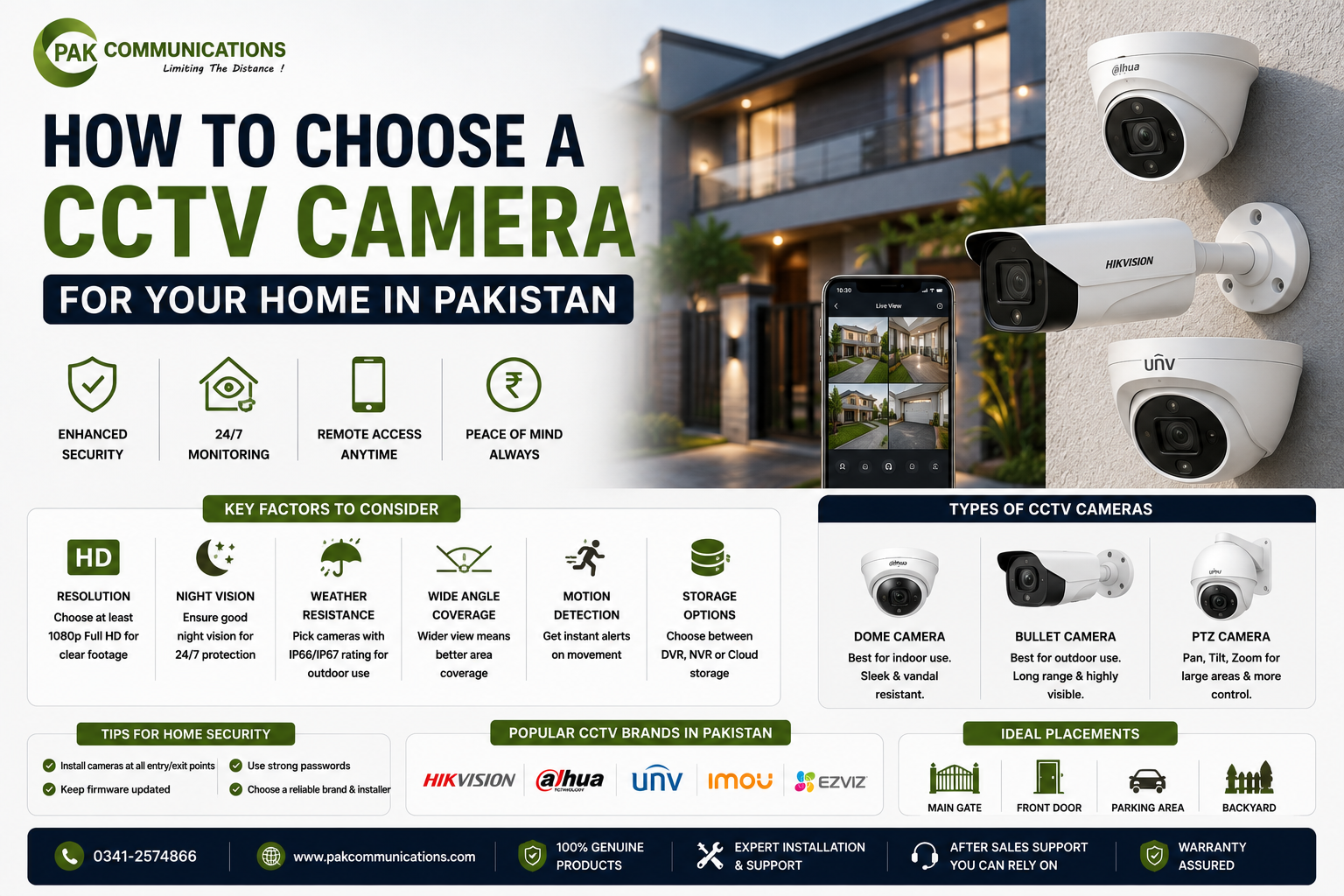
Most Pakistani homeowners make their CCTV decision at the shop counter. They pick the cheapest package available, assume all cameras work the same way, and get everything installed in one afternoon. Six months later, the gate camera produces blurry footage at night, an outdoor camera has water damage from the first monsoon rain, and the system shuts down every time load shedding hits. Choosing the right cctv camera for home means matching camera type, resolution, night vision and recorder to the specific demands of your property. This guide walks through every step so you get it right the first time.
Why Most Pakistani Homeowners Buy the Wrong CCTV Camera
Choosing by Price Instead of Position Requirement
Price is not a camera specification. A camera covering a narrow interior corridor has completely different requirements from a camera watching a 15-metre gate approach. When buyers choose purely by budget, they end up with a 2MP camera on a gate that needs 4MP, or an indoor-rated camera on an outdoor boundary wall. Each position in your home has a specific coverage distance, lighting condition and identification requirement. Mapping specifications to positions before you spend anything is the most important step in the process.
Buying Without Checking Night Vision Type
Standard infrared cameras produce black and white footage at night. ColorVu cameras produce full colour footage even in total darkness. These are fundamentally different outputs, and which one you get depends entirely on the model you select. Pakistani homeowners who skip this question before buying frequently discover their gate camera captures a dark silhouette rather than a recognisable face during load shedding. Night vision type must be confirmed before selecting any camera model.
Ignoring Load Shedding Impact on Camera Performance
Load shedding affects your CCTV system across multiple points. WiFi cameras lose connectivity when the router loses power. DVR and NVR recorders stop recording without UPS backup. PoE cameras connected to a switch go dark if that switch has no backup power. A system that has not been designed around Pakistan’s load shedding reality fails at the moments it is needed most. Every step in this guide accounts for that.
Step 1: Decide How Many Cameras Your Pakistani Home Needs
Establish your camera count before selecting any model. Too few cameras create blind spots that reduce the value of your entire investment.
Single-Storey Home Camera Count
A single-storey Pakistani home needs a minimum of four cameras for baseline coverage: the main gate or entrance, the rear door or back boundary wall, the car parking or driveway area, and one wide view of the front face of the property. Homes with a longer perimeter, a side entrance or a separate servant quarters gate should plan for five or six cameras from the start rather than retrofitting later.
Multi-Storey Home Camera Count
A multi-storey home in Pakistan typically needs six to eight cameras. The ground floor requires the same four positions as a single-storey property. Upper floors benefit from one camera covering the main staircase and one covering any rooftop access point or rear terrace. Properties with multiple entry gates or blind boundary wall corners should include those positions in the count during planning.
Apartment Camera Count
A standard Pakistani apartment needs two to three cameras. One should cover the main apartment door from inside the entrance hallway, one should cover the building lobby or parking bay if accessible, and one should cover the rear balcony where it presents a realistic access point. Apartment residents in finished buildings usually choose WiFi cameras because routing cable through completed walls is not practical.
Step 2: Choose Between Indoor and Outdoor Cameras
Every position in your camera count falls into one of two categories. Using the wrong housing type for a position leads to camera failure within months.
Which Positions Need Outdoor-Rated Cameras
Any camera mounted outside the fully enclosed interior of your home requires a weatherproof outdoor housing. This includes all boundary wall positions, gate-facing cameras, driveway cameras, roof and terrace positions, and any camera on the external face of the building. Karachi’s humidity, dust and monsoon rain are sufficient to destroy an unprotected indoor camera within one season. No outdoor position should ever use an indoor-rated camera, regardless of how sheltered it appears.
Which Positions Suit Indoor Cameras
Staircase cameras, corridor cameras, reception area cameras, interior room cameras and building lobby cameras all fall within the indoor category. Indoor cameras carry no weatherproofing cost, which keeps the per-unit price lower for interior positions. They are available in both dome and bullet styles and suit all standard interior applications.
IP67 vs IP66 Weatherproofing for Pakistan
IP66 cameras resist powerful water jets and dust ingress, which is adequate for all standard outdoor positions in Pakistani homes including gate, driveway and boundary wall placements. IP67 adds full submersion protection and becomes relevant only for ground-level cameras in localities where standing water accumulates during heavy monsoon rains. For most residential properties in Pakistan, IP66 is the correct rating to specify.
Step 3: Choose the Right Resolution for Each Position
Resolution determines how much usable detail your footage contains. The goal is to match resolution to what each position actually needs to accomplish, not to buy the highest specification available across every camera.
When 2MP Is Enough for Pakistani Homes
2MP (1080p Full HD) is adequate for general coverage positions where detecting movement or activity is the primary goal. Interior staircase cameras, corridor cameras, parking area overview cameras and close-range rear boundary cameras all work well at 2MP. At distances below eight metres, 2MP delivers footage that is clear enough for most residential monitoring purposes.
When 4MP Is the Right Upgrade
4MP cameras are worth the investment for positions where identification is required at distances between eight and fifteen metres. If a camera looks down a long driveway, covers a gate approach from a distance, or monitors a boundary position where a person would be more than five metres from the lens, the additional sharpness of 4MP makes a practical difference to how useful that footage is.
Gate and Boundary Positions That Need 4MP Minimum
The gate camera is the most important identification position in any Pakistani home CCTV system. This is where you need to read a number plate, identify a visitor or capture usable footage of an unknown individual. A 4MP camera correctly positioned at the gate produces footage suitable for identification and police reporting. A 2MP camera at the same position frequently delivers footage that is too soft for reliable identification beyond five metres.
Step 4: Choose the Right Night Vision for Load Shedding
Night vision performance is what separates a useful system from one that lets you down at the most critical hours. Before confirming your night vision choice, checking the best home security cameras available in Pakistan will help you compare which models include ColorVu and which are standard IR, so you can make an informed decision across your budget.
Standard IR: What It Delivers During Load Shedding
Standard IR cameras switch to black and white recording when ambient light drops below a usable threshold. Built-in infrared illuminators provide near-infrared light that the sensor detects, producing a monochrome image showing movement, body shape and general activity. During load shedding, standard IR cameras continue operating normally on UPS power. For interior positions and close-range coverage, standard IR is adequate and keeps camera costs lower.
ColorVu: Full Colour During Complete Darkness
ColorVu cameras combine a large aperture lens, a high-sensitivity sensor and a supplemental white light to produce full colour footage in total darkness. During load shedding at night, a ColorVu gate camera captures clothing colour, facial features and vehicle colour. That level of detail is significantly more useful for incident reporting than monochrome footage. The supplemental white light produces a faint visible glow at night, which most Pakistani homeowners also consider a useful deterrent.
Which Night Vision Type Suits Pakistani Gate Positions
Gate cameras and road approach cameras benefit most from ColorVu because these are the positions where load shedding and identification requirements overlap most critically. Interior positions with backup lighting or general monitoring positions that rarely require incident-level footage are well served by standard IR cameras at a lower cost per unit.
Step 5: Choose Between Wired and WiFi CCTV for Your Home
Wired System Advantages for Pakistani Homes
A wired CCTV system transmits video through physical cable that does not depend on your home WiFi network. Wired cameras are unaffected by router reboots, WiFi congestion or router power cuts during load shedding. For new construction or properties undergoing renovation where cable can be routed during the build, a wired system provides more stable long-term performance and is easier to expand over time.
WiFi Camera Advantages for Finished Properties
WiFi cameras eliminate the need to route cable through finished walls, false ceilings or completed conduit. For tenants in rented properties, for owners with fully finished interiors, and for positions such as a distant gate where cable routing is expensive or disruptive, WiFi cameras offer a practical installation path without structural work. They support the same remote viewing and motion alert features as wired systems.
Load Shedding Impact on Both Systems
Both system types require UPS planning. A wired system needs UPS coverage for the DVR or NVR and the camera power supply units. A WiFi system needs UPS coverage for both the cameras and the WiFi router. Without router backup power, WiFi cameras go offline during load shedding even if the cameras themselves remain powered. Sorting your UPS requirement before installation is the step most commonly skipped and most commonly regretted.
Step 6: Choose the Right Recorder for Your Home
The recorder captures, stores and provides remote access to your footage. Choosing the right type and storage size matters as much as choosing the right cameras.
For current ip camera price in pakistan and compatible NVR options suited to home installations, reviewing the IP cameras range gives you up-to-date pricing on both cameras and recorders before you finalise your specification.
DVR for Analog Camera Systems
A DVR connects to analog cameras via coaxial cable, compresses footage using H.264 or H.265 encoding, stores it on an internal hard drive, and provides remote access through apps such as Hik-Connect. DVR systems are the lower-cost option and are the right choice where budget is the primary constraint or where existing coaxial cable infrastructure is already in place from a previous installation.
NVR for IP Camera Systems
An NVR connects to IP cameras via Cat6 cable. PoE NVRs deliver both the network connection and camera power through a single cable per camera, simplifying installation. NVR systems support higher resolution cameras, offer better compression efficiency and typically deliver sharper remote viewing quality. For properties with no existing cable infrastructure building a system from scratch, a PoE NVR with IP cameras is the recommended modern approach.
Hard Drive Sizing for Pakistani Homes
A 4-camera 2MP system using H.265 compression records approximately 30 days of continuous footage on a 1TB hard drive. A 4-camera 4MP system requires approximately 2TB for the same period. An 8-camera mixed system should be planned with a minimum of 4TB. Pakistani homeowners generally target 30-day retention to ensure footage is available even if an incident is only noticed several days after it occurs.
Complete Home CCTV Camera Checklist for Pakistani Buyers
Before placing your order, confirm each point:
- Camera count matches the number of positions identified in your property walkthrough
- Every outdoor position has an IP66 or IP67 rated camera specified
- Gate and all boundary wall positions have 4MP resolution as a minimum
- Gate and road approach cameras have ColorVu night vision specified
- System type (wired or WiFi) matches the installation reality of your property
- DVR or NVR has sufficient channels for your count plus at least two spare channels for future expansion
- Hard drive is sized for a minimum of 30 days retention at your chosen resolution
- UPS plan covers the recorder, all power supply units and the WiFi router
Frequently Asked Questions
How Many CCTV Cameras Does a Pakistani Home Need?
A single-storey home needs a minimum of four cameras. A multi-storey home needs six to eight. An apartment needs two to three. The exact count depends on the number of entry points, boundary wall length and whether there are specific positions such as a separate garage or servant quarters that require dedicated coverage.
Which Is Better for a Pakistani Home Gate: Bullet or Dome Camera?
A bullet camera is the better choice for a gate in most cases. Bullet cameras use a longer focal length lens suited to the straight-line distance a gate approach requires and present a visible deterrent profile. Dome cameras work better at corners and overhead positions where a wide field of view matters more than coverage distance.
Does Load Shedding Affect CCTV Recording?
Yes, without UPS backup your system stops recording the moment load shedding begins. A properly sized UPS keeps the recorder, cameras and router running through a standard load shedding cycle. The cost of a suitable UPS is a small part of the total system investment and it is the single item that determines whether your system works when you actually need it.
Can I View My Home CCTV on My Phone from Anywhere in Pakistan?
Yes. Both DVR and NVR systems support remote live viewing and playback through apps such as Hik-Connect. Once configured during installation, you can monitor your home from any location with a mobile data or WiFi connection. The recorder must maintain an active internet connection for remote access to work, which is another reason router UPS backup matters.
What Is the Best CCTV System for a Rented Home in Pakistan?
WiFi cameras are the most practical option for rented homes. They require no cable drilling through finished walls, making the installation fully reversible when you vacate. A WiFi camera with a microSD card for local storage, or a small WiFi NVR for multi-camera use, gives adequate coverage without permanent modification to the property.
Conclusion
Choosing the right CCTV camera for your home in Pakistan follows a clear sequence. Decide how many cameras you need. Assign indoor or outdoor housing to each position. Match resolution to the identification requirement of each position. Select night vision based on your load shedding reality. Choose between wired and WiFi based on your property type. Then select a recorder with storage sized for your retention target.
Working through these six steps before visiting a supplier means you arrive knowing exactly what you need. That knowledge protects your investment and ensures your system performs from the first week rather than disappointing you later.
To browse the complete range of security cameras for home in Pakistan, including current pricing on IP systems, analog packages and WiFi options, you can compare full specifications and make a confident final decision.