

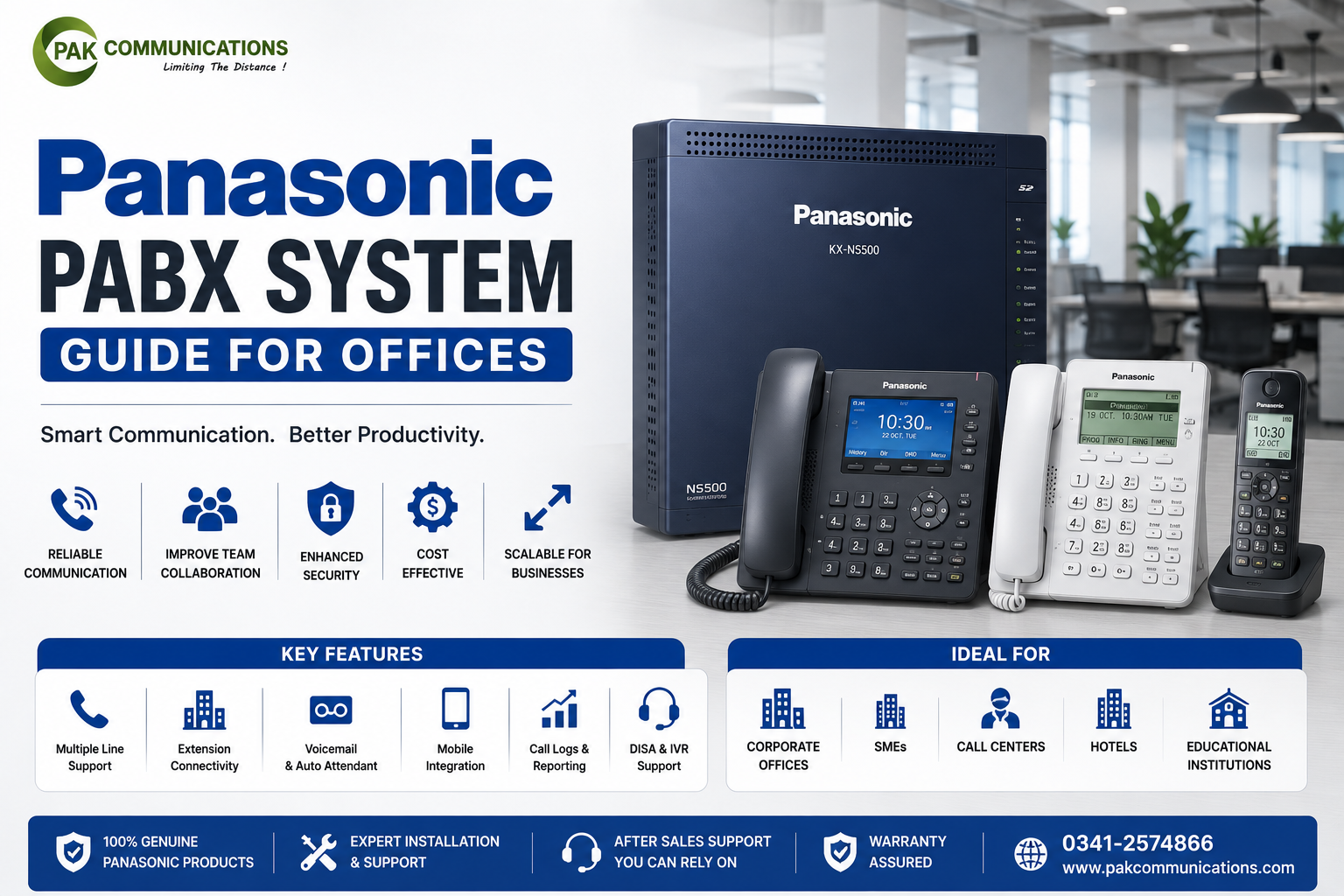
Panasonic is the most recognised name in office telephony across Pakistan and much of South Asia. Walk into almost any office with a working phone exchange and there is a strong chance the unit in the server room or the cabinet behind reception carries the Panasonic label. That recognition comes from decades of consistent product availability, a strong network of local technicians, and hardware that runs reliably for years without attention.
But being the most recognised brand does not automatically make it the right choice for every office. This guide covers what the Panasonic PABX range actually includes, which series suits which office size, what to check before buying, and the one situation where Panasonic is not the strongest option.
Why Panasonic is a Common Choice for Office PABX
Panasonic’s position in the Pakistani office market comes down to four practical advantages that matter more than brand name alone.
The first is parts and expansion card availability. Panasonic expansion cards, handsets, and replacement components are stocked by suppliers across all major cities. When an office needs to add extensions or replace a handset, the parts are available locally within days rather than weeks.
The second is technician familiarity. Because Panasonic has been the dominant brand in this market for so long, the majority of telephony technicians have hands-on experience with the programming interface, the wiring conventions, and the common fault patterns of Panasonic units. Finding qualified support is rarely difficult.
The third is product longevity. Panasonic PABX units are built for long service life. Many offices still run units that are eight to twelve years old without significant issues. This matters for total cost of ownership in a way that initial purchase price alone does not capture.
The fourth is the Panasonic KX series range, which covers offices from five staff to several hundred within a single consistent product family, making it possible to stay with one brand as the business grows.
Panasonic PABX Series Overview
The Panasonic PABX range relevant to most Pakistani offices sits within two main series.
The KX-TES and KX-TEM series are designed for small offices. These units typically support two to three trunk lines and eight to sixteen extensions in their base configuration, with limited expansion capability through add-on cards. The programming is straightforward, the handsets are standard analog, and the setup requires minimal technical complexity. A small business, clinic, school, or retail operation with a team of five to fifteen people fits comfortably within this series.
The KX-NS series is designed for medium to large offices and is significantly more capable. It supports both analog and digital handsets, accepts a wider range of expansion cards for additional trunk lines and extensions, includes a built-in auto-attendant with multi-level IVR, and offers IP connectivity for offices that want to connect remote staff or branch locations. The programming is more involved and benefits from a technician with specific KX-NS experience, but the additional capability justifies that complexity for offices that will use it.
There are also older KX-TDA and KX-TDE series units still in circulation in the second-hand market. These are capable systems but are no longer in production, which affects spare part availability and long-term support. New purchases should focus on current production models within the KX-TES, KX-TEM, or KX-NS range.
Key Features to Check in Any Panasonic PABX Model
Before shortlisting any specific Panasonic model, confirm these six points for the unit you are evaluating.
Expansion card support. Does the unit accept additional cards for more trunk lines and extensions? A unit that cannot expand beyond its base capacity will need to be replaced when the office grows, which costs more than buying the right size from the start.
Handset compatibility. Does the unit support analog handsets only, or does it also support digital feature phones with display screens and programmable keys? Reception desks and management positions benefit significantly from digital handsets, while standard staff desks work well with analog phones.
Built-in auto-attendant. Most current Panasonic models include a built-in auto-attendant that answers calls and routes them through a recorded menu. Confirm that the specific model includes this and that the number of IVR levels is sufficient for the office’s call routing needs.
Voicemail ports. Some models include built-in voicemail capacity, while others require an external voicemail card. Confirm which applies to the model you are considering and whether the voicemail capacity matches the number of staff who need it.
Door phone support. If the office needs intercom connectivity at the entrance or gate, confirm the model has an available door phone port. Not all entry-level units include this.
Programming interface. Smaller Panasonic models are programmed through the operator handset using key sequences. Larger models support PC-based programming through dedicated software, which is faster and easier to document. Confirm which method applies and whether your technician has experience with it.
Which Panasonic Series Suits Your Office Size
Matching the right series to the office size prevents both the most common purchasing mistakes in office telephony: buying too small and running out of capacity, or buying too large and paying for features the office will never use.
For a small office with five to fifteen staff, the KX-TES or KX-TEM series covers all standard needs. One to two trunk lines, eight to sixteen extensions, standard analog handsets, basic auto-attendant, and call transfer and hold. Simple, reliable, and well supported.
For a medium office with sixteen to fifty staff, the KX-NS series with appropriate expansion cards is the right level. Four to eight trunk lines, twenty-four to forty-eight extensions, a mix of digital and analog handsets, multi-level IVR, and department call groups.
For a large office with fifty or more staff, or any office with a second branch location or remote workers, the KX-NS series with IP capability handles the scale and connectivity requirements. Multiple trunk groups, fifty-plus extensions, softphone support, and branch connectivity through the same exchange.
To browse available models within each series and confirm current stock and port configurations, check the full range of Panasonic PABX system options and match the specification to your office size and extension count before making a final decision.
What to Check Before Buying a Panasonic PABX
Four checks before purchase prevent the most common post-installation complaints.
Port count with growth room. Count your current extension needs and add at least 20 percent for growth. If you need sixteen extensions today, buy a unit that supports twenty or twenty-four. Running out of ports within a year of installation is avoidable at the purchase stage and expensive to fix after the fact.
Expansion card availability. Confirm that the expansion cards for the specific model you are buying are currently stocked by suppliers in your city. A model that is in production but whose expansion cards are on long lead times is effectively a closed system.
Local technician support. Before buying, ask your supplier whether they have certified or experienced Panasonic technicians available for programming and ongoing support. A well-chosen unit with poor support becomes a liability faster than a lesser brand with strong local service.
Warranty terms. Confirm the warranty period and whether it is backed by the official brand distributor or only by the shop. Official distributor warranty provides better coverage and clearer resolution in case of hardware failure.
Once the unit is selected and purchased, planning the installation correctly is as important as the purchase itself. The PABX system installation checklist covers every step from site survey and cable planning to programming and testing, in the right order for any Panasonic setup.
When Panasonic is Not the Right Choice
Panasonic is an excellent choice for traditional and hybrid PABX environments. It is not the strongest choice in two specific situations.
The first is a fully cloud-based or software-defined communication environment. If the office wants a system where all call management, IVR configuration, and reporting happen through a browser-based dashboard with no on-site hardware, there are purpose-built cloud PBX platforms that are better suited to this model than a Panasonic on-premises unit.
The second is an office that needs deep CRM integration and advanced softphone features as the primary mode of operation. While the KX-NS series supports IP calling and has some integration capability, dedicated IP PBX platforms are more flexible in this area and have larger ecosystems of compatible software.
For the vast majority of Pakistani offices that need reliable on-premises telephony with strong local support, Panasonic remains a strong and practical choice. The situations above are the exceptions, not the rule.
Conclusion
Panasonic is a reliable, widely supported PABX brand that covers offices from five staff to several hundred within a single consistent product family. The right series depends on the office’s current extension count, expected growth, and whether analog, digital, or IP capability is needed. Spare parts are available locally, technician support is accessible, and the hardware life is long enough to make it a sound long-term investment for most office setups.
If you are ready to shortlist a model, browse the full range of options from a trusted supplier of office PABX system in Karachi and confirm the port count, expansion options, and warranty terms before placing your order.
Frequently Asked Questions
Which Panasonic PABX is best for a small office?
For a small office with five to fifteen staff, the KX-TES or KX-TEM series is the most practical choice. These units cover standard calling needs, are straightforward to install and program, and are widely supported by local technicians. Confirm that the model you choose has at least one expansion card slot so the system can grow with the team.
Can Panasonic PABX systems be expanded later?
Yes, most Panasonic models in the KX-TES, KX-TEM, and KX-NS range accept expansion cards that add more trunk lines and extension ports. The maximum expanded capacity varies by model, so confirm the expansion ceiling of any unit before purchasing. Buying a model with room to grow to at least 20 percent above current needs is always the right approach.
Does Panasonic PABX support IP calling?
The KX-NS series supports IP calling through dedicated IP extension cards and trunk cards. Smaller models in the KX-TES and KX-TEM range are primarily analog systems and do not natively support IP calling without additional hardware. If IP capability is a requirement, confirm that the specific model includes the necessary cards or has slots available for them before buying.