

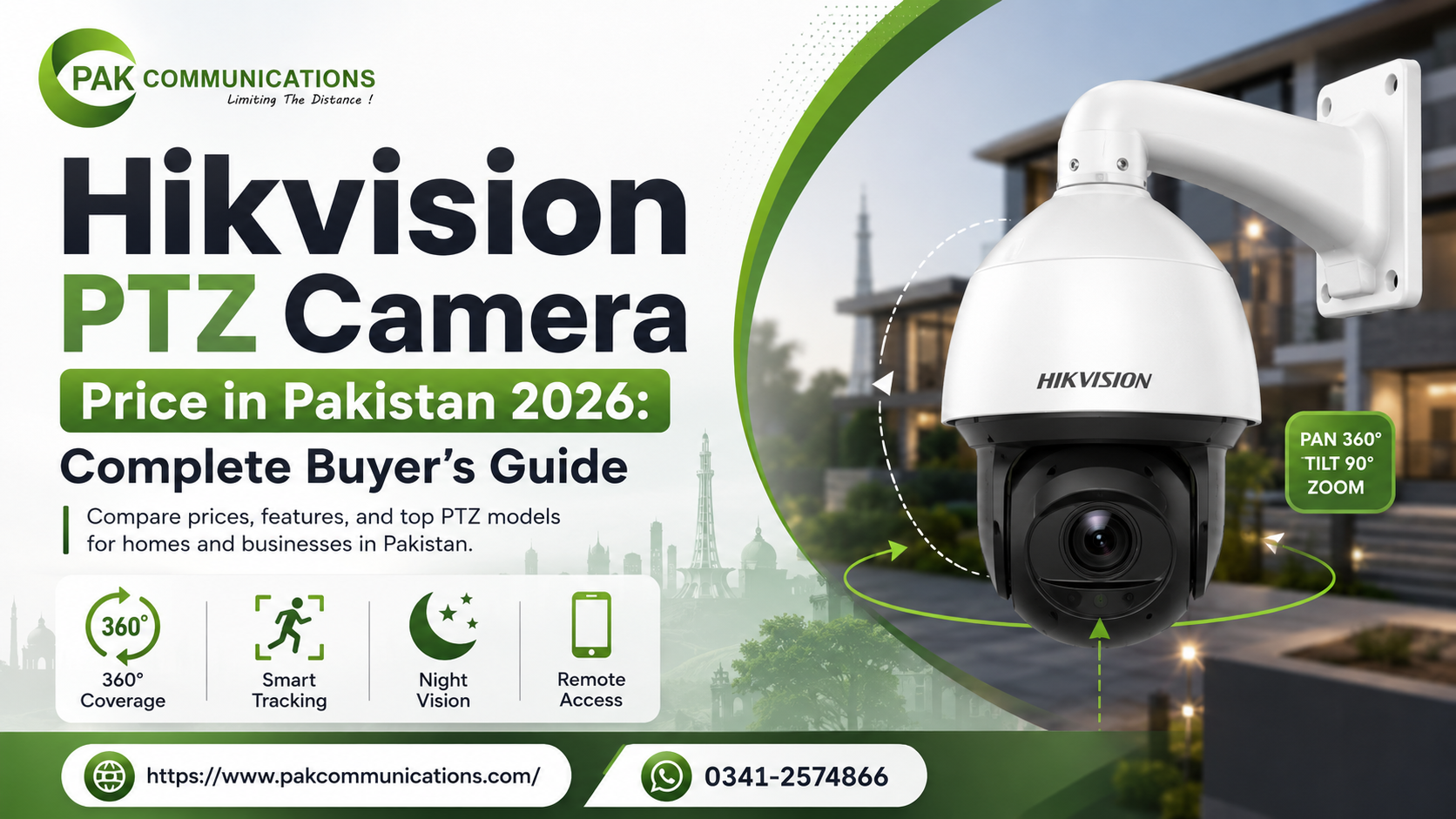
Pakistani buyers who need to monitor a large open area from a single camera position face a coverage problem that no fixed-lens camera can solve. A factory compound, a school campus courtyard, a commercial car park, a warehouse dispatch area, or an extended boundary perimeter contains more ground than any single fixed camera can cover with sufficient resolution to identify faces or number plates across the full coverage zone. Installing multiple fixed cameras to cover the same large area requires additional cameras, cable runs, recorder channels, and installation work at each additional camera position. Hikvision PTZ cameras solve this specific problem by combining a motorized horizontal pan mechanism, a motorized vertical tilt mechanism, and an optical zoom lens in a single camera unit that covers the entire large area with its pan and tilt range while using its optical zoom to pull in on any specific location within that coverage zone for close identification detail at any moment. For the complete range of Hikvision security cameras in Pakistan including all PTZ models currently in stock, visit PAK Communications before reading further.
Contact PAK Communications:
- Phone: (021) 4832293-4
- WhatsApp: 0341-2574866
- Email: info@pakcommunications.com
- Address: Suite #08, 4th Floor, Dar-ul-Furqan Building, Gulshan-e-Iqbal Block 13-B, Main University Road, Karachi
- Hours: Mon-Sat 9:30 AM – 6:30 PM
What Is a Hikvision PTZ Camera and How Does It Work?
PTZ stands for Pan, Tilt, and Zoom, which describes the three independent motorized functions that distinguish a PTZ camera from every type of fixed-lens camera. Each function is independently controlled and can be operated simultaneously, giving a Hikvision PTZ camera the ability to reposition its coverage in real time in response to a detected event or a manual control input.
Pan, Tilt, and Zoom Functions Explained
The pan function is the horizontal rotation of the camera’s lens mechanism around its vertical axis. Hikvision PTZ cameras pan continuously through 360 degrees, meaning the camera can rotate in either direction without a mechanical stop point. This continuous 360-degree pan range means a single PTZ camera mounted at a central elevated position in a property can face any direction at any time, covering the complete horizontal perimeter around its mounting point without any gap in the horizontal coverage range.
The tilt function is the vertical movement of the camera’s lens mechanism up and down along its horizontal axis. Hikvision PTZ cameras tilt from a horizontal position looking straight ahead to a fully downward position looking directly below the camera mounting point, with a tilt range that covers every elevation angle a surveillance application requires. The combination of full 360-degree pan and full 0 to 90-degree tilt means a PTZ camera mounted at an elevated position can aim its lens at any point on the ground surface within its optical zoom range around the mounting position.
The zoom function is an optical zoom lens that magnifies the image of a distant subject without digital quality loss. Unlike digital zoom, which simply enlarges a portion of the camera’s sensor image and produces pixelated footage at high magnification, optical zoom uses a physically moving lens element to produce a genuinely magnified image at the same resolution as the unzoomed image. A Hikvision PTZ camera with 4x optical zoom at a factory perimeter position can zoom in to read a number plate or identify a face at a distance four times beyond the unzoomed identification range, maintaining full resolution footage throughout the zoom range.
Manual Control and Auto-Tracking Operation
A Hikvision PTZ camera can be operated in two fundamentally different modes depending on whether a human operator is monitoring the live feed and controlling the camera, or whether the camera is operating autonomously without active operator supervision.
In manual control mode, a security guard at a monitoring station uses a PTZ joystick controller connected to the NVR, or a software joystick in the Hik-Connect app on a smartphone or tablet, to direct the camera’s pan, tilt, and zoom position in real time. The operator watches the live feed on a monitor and repositions the camera to follow events of interest as they occur. This operation mode is suited to Pakistani commercial and industrial installations where a dedicated security desk is staffed during the hours when active monitoring is required.
In auto-tracking mode, the PTZ camera uses its onboard AcuSense AI processing to detect human or vehicle subjects entering the camera’s current field of view and automatically pans, tilts, and zooms to keep the detected subject centred in the frame as it moves through the coverage area. This automatic subject following continues until the subject leaves the camera’s coverage zone or a new detection event overrides the current tracking target. Auto-tracking mode is suited to Pakistani installations where no dedicated security operator is available to control the camera manually, including residential properties, small commercial properties, and unmanned after-hours monitoring applications where the PTZ must respond to intrusion events automatically without human supervision.
Preset Positions and Patrol Routes
Hikvision PTZ cameras support the saving of up to 300 preset positions, where each preset stores the exact pan angle, tilt angle, and zoom magnification setting for a specific coverage point in the camera’s environment. A factory installation might store presets for the main gate, the side access gate, the loading dock, the fuel tank area, and each corner of the perimeter wall, allowing a security operator to jump instantly to any named position by selecting it from the preset list rather than manually panning and tilting to find it.
The patrol route function directs the PTZ camera to cycle through a series of saved preset positions automatically on a configurable timed schedule. A Pakistani warehouse installation with 10 preset positions covering all areas of the compound can be configured to dwell on each position for 5 to 15 seconds before moving to the next, completing a full patrol sweep of the entire compound every 2 to 3 minutes without any operator input. The patrol route continues running autonomously during hours when no security operator is present, providing systematic compound coverage equivalent to a guard physically walking the perimeter.
Types of Hikvision PTZ Cameras Available in Pakistan
Hikvision Speed Dome PTZ Camera
The speed dome is the most common PTZ form factor in Pakistani commercial and industrial installations. It consists of a sealed dome housing that contains the complete pan, tilt, and zoom mechanism inside a weatherproof and vandal-resistant enclosure. The dome housing makes the camera compact relative to its coverage capability and protects the internal pan and tilt mechanism from weather, dust, and deliberate interference. Hikvision speed dome cameras mount on ceilings, walls, and poles using standard mounting adapters that position the camera at the correct height for the coverage zone it needs to reach.
Outdoor speed dome cameras from Hikvision carry IP66 weatherproofing ratings and IK10 vandal-resistance ratings on commercial grade models, confirming their suitability for Pakistani outdoor positions including rooftop mounts, pole mounts in open areas, and exterior building wall mounts exposed to monsoon rainfall and dust. The IR illumination on speed dome models extends to 50, 80, or 100 metres depending on the model specification, providing complete night coverage of large areas during load shedding when ambient lighting is absent.
Hikvision Network PTZ Camera (IP PTZ)
Hikvision IP PTZ cameras connect to the NVR over a Cat6 network cable and transmit compressed digital video over the network connection, in the same way that any fixed IP camera in a Hikvision system operates. The distinction with a PTZ camera is that the NVR also sends PTZ control commands to the camera over the same network cable, directing the pan, tilt, and zoom movements. This combined data and control connection over a single Cat6 cable makes installation cable routing straightforward for new Pakistani CCTV systems being built from scratch with network infrastructure.
PoE power delivery from the NVR’s built-in PoE ports powers compact 2MP PTZ models directly over the Cat6 cable without requiring a separate power supply at the camera mounting position, which simplifies installation at elevated pole or rooftop positions where running a separate power cable adds significant cost and installation complexity. Larger 4K and high optical zoom PTZ models draw more power than PoE can supply and require a separate 12V or 24V AC power supply at the mounting position.
Hikvision Turbo HD PTZ Camera (Analog PTZ)
Hikvision Turbo HD PTZ cameras connect to a DVR recorder over the same coaxial cable infrastructure used by standard Turbo HD analog cameras, making them the correct choice for Pakistani properties with existing analog CCTV coaxial infrastructure where the owner wants to add PTZ capability without replacing the existing cable layout. The PTZ control commands from the DVR travel over the existing coaxial cable to the Turbo HD PTZ camera, eliminating the need for a separate RS-485 control cable between the DVR and the PTZ camera that older analog PTZ systems required.
Turbo HD PTZ cameras are available up to 5MP resolution in the current Hikvision product range, providing a meaningful resolution upgrade over legacy analog installations while working within the same coaxial cable infrastructure. The current Pakistan market price for entry-level Turbo HD PTZ cameras is lower than equivalent IP PTZ models, making them an accessible PTZ entry point for Pakistani businesses upgrading from an existing analog system without the budget for a full IP infrastructure replacement.
Hikvision PTZ Camera Price in Pakistan 2026
Hikvision PTZ cameras are priced significantly above fixed-lens cameras of equivalent resolution in Pakistan’s authorized dealer market because the motorized pan, tilt, and zoom mechanism, the optical zoom lens assembly, the PTZ control processor, and the sealed housing that contains the complete mechanism all add component cost above a standard fixed camera. The price premium over a fixed camera is justified by the coverage capability that a single PTZ camera delivers, which in large-area applications replaces multiple fixed cameras and reduces total system cost including cabling, installation, and recorder channels.
For Pakistani buyers who need fixed IP cameras alongside a PTZ camera in the same installation, the full current range of Hikvision IP camera price in Pakistan across all resolution tiers and feature specifications is listed on the PAK Communications Hikvision IP camera page with current stock availability.
Hikvision 2MP PTZ Camera Price in Pakistan 2026
A 2MP Hikvision PTZ camera with 4x optical zoom is currently priced between Rs 35,000 and Rs 50,000 in Pakistan’s authorized dealer market. A 2MP Hikvision PTZ with 8x optical zoom is priced between Rs 45,000 and Rs 65,000. A 2MP Hikvision PTZ with auto-tracking capability and AcuSense detection is priced between Rs 55,000 and Rs 75,000 depending on the specific model series and included features.
The 2MP PTZ camera is suited to Pakistani installations where the primary requirement is coverage of a moderate-sized open area at reliable identification resolution without the per-camera cost of higher resolution models. Small to medium factory outdoor areas, residential society main gates with long approach roads, and small commercial car parks with two to four vehicle lanes are typical Pakistani installation applications for the 2MP PTZ tier.
Hikvision 4MP PTZ Camera Price in Pakistan 2026
A 4MP Hikvision PTZ camera with 4x optical zoom is currently priced between Rs 55,000 and Rs 80,000 in the authorized market. A 4MP Hikvision PTZ with 16x optical zoom is priced between Rs 75,000 and Rs 110,000. A 4MP Hikvision PTZ with AcuSense AI auto-tracking and 16x optical zoom is priced between Rs 85,000 and Rs 125,000.
The 4MP PTZ camera delivers meaningfully higher identification resolution than the 2MP tier, extending reliable facial identification distance and improving number plate readability at the same zoom level. Medium to large factory compounds, school campuses with a sports field and multiple building frontages, hospital outdoor areas, and commercial building car parks with more than four vehicle lanes are typical Pakistani applications for the 4MP PTZ tier.
Hikvision 4K PTZ Camera Price in Pakistan 2026
A 4K (8MP) Hikvision PTZ camera with 16x optical zoom is currently priced between Rs 120,000 and Rs 180,000 in Pakistan’s authorized market. A 4K Hikvision PTZ with 32x optical zoom is priced between Rs 160,000 and Rs 250,000 depending on the model and included features.
The 4K PTZ camera is suited to large Pakistani industrial installations, hotel and resort exteriors, shopping mall outdoor areas, and any application where the combination of maximum resolution and maximum optical zoom is required to identify subjects at the greatest possible distances from the camera mounting point. At 32x optical zoom combined with 4K resolution, a Hikvision PTZ mounted on a factory rooftop can produce identification-quality footage of a subject at distances of 80 to 100 metres, which is beyond the capability of any fixed-lens camera configuration at equivalent total system cost.
All prices listed are indicative based on current authorized dealer market rates. Contact PAK Communications directly for confirmed current stock pricing and availability before finalizing any PTZ purchase.
Where to Use a Hikvision PTZ Camera in Pakistan
Factory and Industrial Compound
A Pakistani factory compound typically has a perimeter boundary of 200 to 500 metres or more depending on the size of the facility, with multiple entry and exit points, an outdoor vehicle yard, a loading dock area, and a production building exterior. Covering this compound with fixed cameras requires placing cameras at every boundary wall section, every entry point, and every open yard area, which multiplies camera count, cable runs, and recorder channels significantly above what a PTZ-based coverage strategy requires.
A single Hikvision PTZ camera mounted on a rooftop position or an elevated pole at the centre of the compound covers the full 360-degree perimeter with its pan range and reaches every corner of the compound with its optical zoom. The PTZ patrol route can cycle through preset positions at the main gate, side gate, loading dock, fuel tank area, and perimeter corners on a regular schedule, while the auto-tracking function responds immediately to any detected human or vehicle entering a restricted zone outside working hours.
School and University Campus
Pakistani school and university campuses include large outdoor areas including sports fields, playgrounds, car parks, and building frontages that require coverage beyond what fixed cameras at individual building positions can provide. A Hikvision PTZ camera on the roof of a central administrative building covers the sports field, playground, and car park simultaneously with its pan range and can zoom to identify any specific person or vehicle in any of these areas from the single rooftop mounting position.
After-hours monitoring of a Pakistani school campus with auto-tracking PTZ capability detects any person entering the campus outside school hours and automatically follows their movement throughout the campus perimeter, alerting the security manager through Hik-Connect push notifications with the PTZ footage of the detected intruder.
Commercial Car Park
Pakistani commercial car parks connected to shopping centres, office buildings, and hospitals require vehicle number plate identification at entry and exit lanes and general overview coverage of the parking area. A Hikvision PTZ at the car park entrance and at one or two elevated positions within the car park covers all vehicle lanes, the parking bays, and the entry and exit points from a small number of camera positions with zoom-assisted number plate identification at the lane positions.
The patrol route function on a PTZ covering a Pakistani commercial car park can be configured to sweep through all sections of the parking area on a regular cycle, confirming vehicle presence and detecting after-hours activity without requiring a security guard to physically walk the car park for each patrol round.
Large Residential Society Main Gate and Common Areas
Pakistani residential societies with large common areas including parks, clubhouses, community pools, and multi-entry gate complexes benefit from PTZ cameras at key elevated positions that cover the common areas with pan and tilt coverage and provide gate monitoring with optical zoom identification of approaching vehicles and pedestrians.
A Hikvision PTZ at the main gate of a Pakistani residential society mounted on an elevated pole above the entry lane covers both the inbound and outbound vehicle lanes, the pedestrian entry point, and the visitor waiting area from a single camera position. The guard at the gate security post monitors the PTZ live feed on a small monitor and uses the joystick controller to zoom in on approaching vehicles to read number plates or check faces against a visitor register without leaving the security post.
Hikvision PTZ Camera and NVR Configuration
A Hikvision PTZ camera requires a recorder that supports PTZ control protocol alongside video recording, because the recorder must send pan, tilt, and zoom movement commands to the camera in addition to receiving and recording its video stream. Hikvision NVR models with PTZ control support add the PTZ camera to the channel list and provide a software joystick interface on the NVR monitor output for manual PTZ directional and zoom control. The NVR also stores the PTZ camera’s preset positions and patrol route configuration, maintaining these settings independently of the camera’s own internal memory.
Pakistani buyers who are sizing their NVR for an installation that includes PTZ cameras alongside fixed IP cameras must confirm that their chosen NVR model supports PTZ control on the channels where PTZ cameras will be connected, and that the NVR’s total channel processing bandwidth accommodates the PTZ camera’s resolution alongside all fixed camera streams simultaneously. The complete guide covering Hikvision NVR channel count selection, PoE power budget calculation, simultaneous resolution processing limits, and hard drive sizing for all Pakistani IP camera installation scales is available in the Hikvision NVR price in Pakistan buyer’s guide.
The PTZ camera’s PoE power requirement must also be confirmed against the NVR’s per-port PoE wattage for compact PTZ models drawing less than 25 watts, or against external PoE injector or separate power supply specifications for larger models drawing more than 25 watts. Connecting a high-power PTZ camera to a standard 15-watt NVR PoE port causes the camera to operate in an underpowered state where pan and tilt movements may be slow or unreliable.
Hikvision PTZ vs Fixed Camera: When to Choose PTZ for Pakistani Installations
The decision between a PTZ camera and multiple fixed cameras for a Pakistani installation position should be made on the basis of total system cost comparison and coverage effectiveness comparison at the specific property, not on the basis of either camera type being universally superior.
For a standard Pakistani residential home with four defined positions at the gate, car porch, perimeter corners, and interior, fixed cameras at each position deliver better coverage outcomes than a PTZ camera because each fixed camera provides continuous full-resolution recording of its specific position without the coverage gaps that occur when a PTZ is aimed at a different position during a patrol route. A PTZ camera covering all four home positions can only monitor one position at a time, and an event at the gate while the PTZ is aimed at the rear boundary is not captured. Fixed cameras at each position record every event simultaneously at all positions regardless of what is happening elsewhere on the property.
For a factory compound, school campus, or large commercial car park where the coverage area is too large for fixed cameras to cover completely at useful resolution without a very large number of cameras, a PTZ camera or a small number of PTZ cameras combined with fixed cameras at specific high-priority positions delivers better total system value. The total cost of the PTZ camera plus its installation is compared against the cost of all the fixed cameras, cable runs, and recorder channels that would be required to achieve equivalent coverage, and in large-area applications the PTZ solution is typically lower in total system cost while delivering equal or superior coverage outcomes.
Conclusion: Is a Hikvision PTZ Camera Right for Your Pakistani Property?
A Hikvision PTZ camera is the correct specification for any Pakistani property where a large open area requires coverage that fixed-lens cameras cannot provide at equivalent total system cost, or where an unmanned installation needs auto-tracking capability to follow detected subjects without a dedicated security operator. Factory compounds, school campuses, large commercial car parks, hospital outdoor areas, and residential society common areas are the Pakistani property types where PTZ cameras deliver the coverage and cost outcomes that justify their higher unit price compared to fixed cameras.
For standard Pakistani homes, small retail shops, and compact offices where surveillance positions are individually defined and close-range coverage from fixed cameras fully addresses each position requirement, fixed bullet and dome cameras at each position remain the correct and more cost-effective choice. The team at PAK Communications can evaluate whether your specific Pakistani property installation requires PTZ cameras or whether fixed camera configurations fully address your coverage requirements at lower total system cost. Browse the complete range of Hikvision CCTV camera in Karachi at PAK Communications or contact us directly on WhatsApp 0341-2574866 for a free pre-sale specification consultation before finalizing your PTZ or fixed camera decision.