

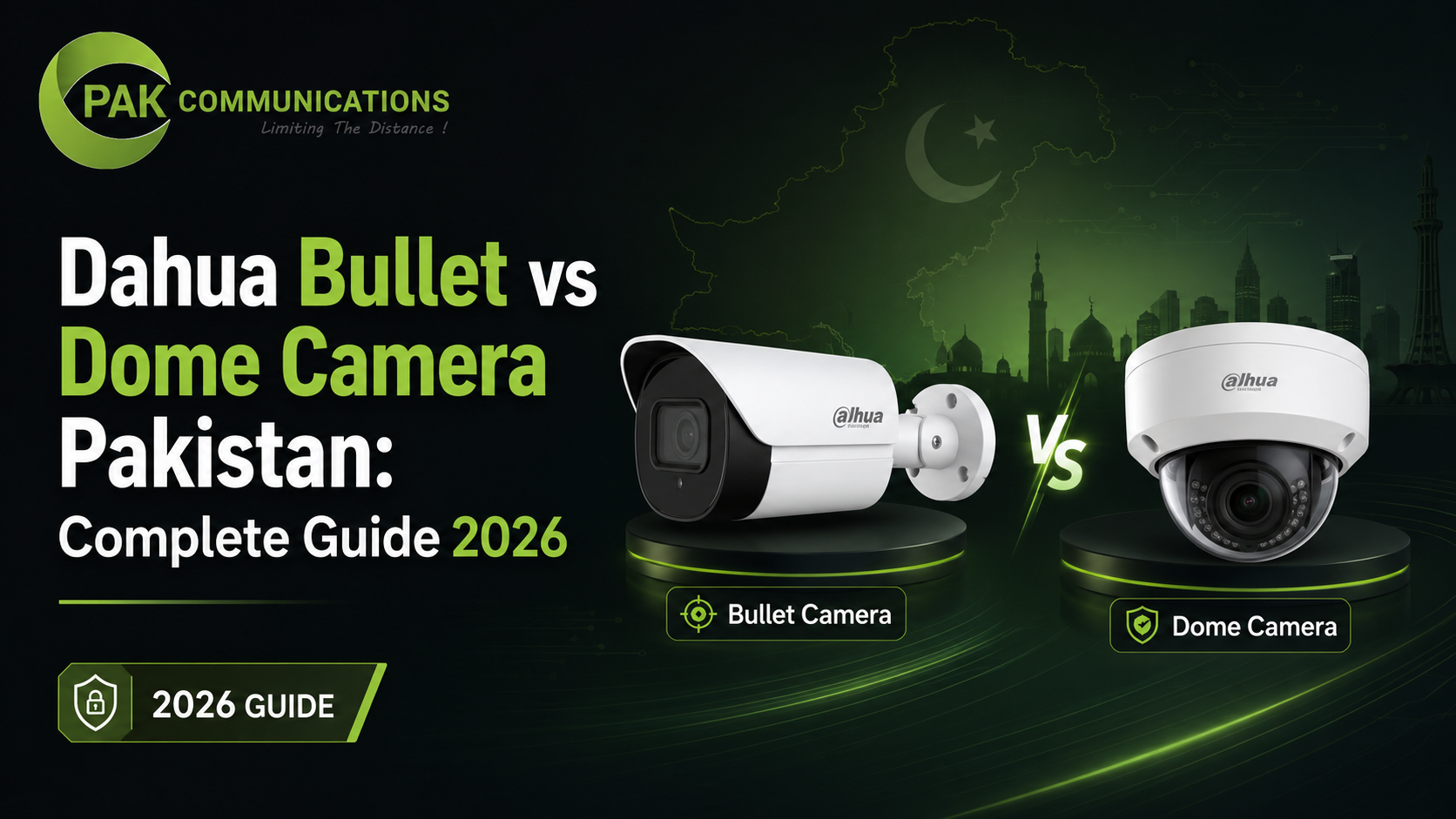
Buying a Dahua camera in Pakistan involves one decision that most buyers make without enough information: bullet or dome. Both camera types connect to the same NVR, record at the same resolutions, and carry the same IP weatherproofing ratings. The difference is in their physical form factor, their visible deterrence profile, their installation requirements, and the specific coverage angles each delivers most effectively.
A Pakistani factory owner in SITE Area Karachi and a homeowner in a DHA housing society may both need outdoor CCTV coverage, but the correct camera form factor for each property is different. The factory owner needs a camera that signals visible surveillance to deter unauthorized entry. The homeowner may prefer a discreet camera that monitors without drawing attention. Bullet and dome cameras serve these needs differently, and choosing the wrong form factor for your property reduces the effectiveness of your CCTV system regardless of the resolution or IR specification you select.
This guide covers exactly what separates bullet cameras from dome cameras in practical Pakistani surveillance terms, which property types suit each form factor, where turret and eyeball cameras fit between the two, and how to make the correct choice for your specific site before purchasing.
For current stock and pricing across all Dahua camera form factors, you can check Dahua CCTV price in Pakistan at PAK Communications before reading further.
Contact PAK Communications:
- Phone: (021) 4832293-4
- WhatsApp: 0341-2574866
- Email: info@pakcommunications.com
- Address: Suite #08, 4th Floor, Dar-ul-Furqan Building, Gulshan-e-Iqbal Block 13-B, Main University Road, Karachi
- Hours: Mon-Sat 9:30 AM – 6:30 PM
What Is a Bullet Camera and How Does It Work
A bullet camera gets its name from its cylindrical housing that resembles a bullet or short tube. The camera lens, sensor, IR LEDs, and all internal components sit inside this elongated housing which is mounted on a fixed bracket that positions the camera at a specific angle toward the coverage area. Once installed, a bullet camera points permanently in one direction unless the mounting bracket is physically adjusted.
Bullet cameras are the most visually recognizable CCTV camera form factor in Pakistan. Their protruding cylindrical shape is immediately identifiable as a surveillance camera from a distance, which contributes to their deterrence value in commercial and industrial settings.
Physical Design and Housing
Housing Shape and Size
Dahua bullet cameras range from compact models with housings roughly 15 centimeters in length to larger models with housings exceeding 25 centimeters for premium IR and zoom specifications. The elongated housing accommodates a larger lens assembly than dome cameras of equivalent specification, which is why bullet cameras generally deliver longer IR range at equivalent price points compared to dome cameras.
Mounting Bracket Design
Bullet cameras mount on an adjustable bracket that attaches to a wall, pole, or ceiling surface. The bracket allows the installer to set the horizontal and vertical angle of the camera during installation. Once the bracket is tightened, the camera angle is fixed. Adjusting the coverage angle after installation requires loosening the bracket, repositioning the camera, and retightening, which takes only a few minutes but requires physical access to the mounting point.
IR Range Advantage of Bullet Form Factor
One of the most significant practical advantages of bullet cameras over dome cameras is IR illumination range. The elongated bullet housing accommodates more IR LEDs arranged in a larger array around the lens, and the housing geometry allows the IR illumination to project in a focused beam aligned with the camera’s field of view rather than dispersing in multiple directions.
Why Bullet IR Outperforms Dome IR at Equivalent Specification
A Dahua bullet camera and a Dahua dome camera at the same price point will typically show a meaningful difference in IR range specification, with the bullet camera delivering longer range. This is because the dome camera’s curved protective cover scatters some IR illumination, and the compact dome housing limits the size and number of IR LEDs that can be arranged around the lens. For Pakistani outdoor installations where load shedding means cameras operate on IR illumination for several hours every night, this IR range advantage is a practical consideration that favors bullet cameras for long-distance outdoor coverage.
Visible Deterrence Profile
Bullet cameras are the preferred form factor for deterrence-focused installations in Pakistan. Their protruding shape is visible from a significant distance and communicates clearly to anyone approaching a property that surveillance is active. This visible deterrence effect has genuine value for Pakistani commercial and industrial properties where preventing unauthorized entry is as important as recording incidents after they occur.
Deterrence in Pakistani Commercial Settings
Factories in SITE Area and Korangi Industrial Area, petrol pumps along major Karachi roads, warehouses in industrial zones, and commercial plazas with outdoor parking areas all benefit from the visible deterrence profile of bullet cameras positioned at entry points and perimeter walls. The psychological effect of a clearly visible bullet camera facing an entry point reduces opportunistic theft and unauthorized access attempts more effectively than a less visible dome camera covering the same angle.
Installation Considerations for Bullet Cameras
Mounting Height and Angle
Bullet cameras in Pakistani commercial installations are typically mounted at three to five meters height on walls or poles with the bracket angled downward to cover the target area. The correct downward angle balances coverage distance with the ability to capture facial detail at the primary identification zone directly below and in front of the camera.
Sun Glare and Shade Considerations
Bullet cameras installed facing east or west in Pakistani cities experience direct sun glare during morning or evening hours that can wash out the image temporarily. Installing a sun shield or positioning the camera to face north or south where possible reduces this effect. Dahua bullet camera housings include a built-in sun visor on most models that provides partial protection against direct sun glare without requiring a separate accessory.
What Is a Dome Camera and How Does It Work
A dome camera houses its lens, sensor, IR LEDs, and internal components inside a compact circular housing covered by a curved transparent or smoked dome cover. The dome shape gives the camera a low-profile appearance that sits flush against ceiling and wall surfaces, making it significantly less visually prominent than a bullet camera covering the same angle. This discreet profile is one of the dome camera’s primary advantages for indoor and semi-outdoor Pakistani installations where aesthetics and subtlety matter alongside surveillance capability.
Dome cameras are the most commonly installed form factor in Pakistani indoor commercial environments including shops, offices, banks, hotel lobbies, restaurant interiors, and apartment building common areas. Their ceiling-mount design, wide angle coverage, and vandal-resistant housing options make them a natural fit for controlled indoor spaces where the camera needs to blend into the environment rather than dominate it visually.
Physical Design and Housing
Dome Shape and Cover
The curved dome cover on a Dahua dome camera serves two purposes beyond aesthetics. First, it protects the lens and internal components from dust and physical contact. Second, on smoked dome models it conceals the exact direction the lens is pointing, which prevents individuals inside the coverage area from identifying blind spots by observing the lens angle. This concealment effect has practical value in Pakistani retail environments where shoplifters and dishonest staff members may attempt to identify camera angles before acting.
Compact Housing Dimensions
Dahua dome cameras have a significantly smaller physical footprint than equivalent bullet cameras. The compact circular housing typically measures 10 to 15 centimeters in diameter and extends only 6 to 10 centimeters from the mounting surface. This compact profile allows dome cameras to be installed in tight spaces, low ceilings, and decorative ceiling surfaces in Pakistani commercial interiors without creating an obtrusive visual presence.
Vandal Resistance Advantage
Dahua’s vandal dome range carries IK10 impact resistance rating, which means the housing withstands repeated physical strikes without the dome cover cracking or the internal components being damaged. This vandal resistance makes dome cameras the correct choice for Pakistani installations where cameras are installed within reach of building occupants or members of the public.
Where Vandal Resistance Matters in Pakistan
Apartment building corridors and lift lobbies in Pakistani urban housing, school and college interior corridors, public-facing retail spaces in busy commercial areas like Tariq Road and Hyderi Market, bank branch interiors, and hospital corridors all represent environments where cameras are installed within arm’s reach of potentially hostile individuals. An IK10 rated Dahua vandal dome camera in these locations survives physical interference attempts that would destroy a standard dome or bullet camera housing.
Vandal Dome vs Standard Dome
Standard Dahua dome cameras carry no IK impact rating and are suitable for ceiling installations where physical access is restricted, such as high ceilings in large retail spaces or warehouse interiors. Vandal dome models carry IK08 or IK10 ratings and are the correct specification for any installation where the camera is within reach. The price difference between standard and vandal dome models is modest and the protection benefit in accessible Pakistani indoor locations justifies choosing the vandal-rated model as a default.
Wide Angle Coverage Advantage
Dome cameras are typically fitted with shorter focal length lenses that deliver a wider field of view than bullet cameras at equivalent price points. This wide angle coverage suits indoor environments where the camera needs to cover a broad area from a ceiling mount rather than focusing on a distant specific target.
Coverage in Pakistani Indoor Spaces
A single Dahua dome camera mounted in the center of a standard Pakistani shop ceiling covers the full floor area, cashier counter, and entrance in a single frame without requiring precise directional aiming. The same coverage area would require two bullet cameras aimed from opposite corners to achieve equivalent field of view without blind spots. For Pakistani shop owners in commercial areas across Karachi, Lahore, and Islamabad, this coverage efficiency reduces the number of cameras needed for complete indoor surveillance.
Ceiling and Overhang Installation
Dome cameras are designed primarily for ceiling mount installation, which makes them the natural choice for Pakistani indoor environments with standard ceiling heights of three to four meters. They also install effectively on wall-mount brackets angled downward for corner positions, and on overhanging surfaces like canopy undersides at petrol pump islands and covered walkways in commercial plazas.
Installation Simplicity
Dome camera installation on a flat ceiling surface involves drilling a mounting hole pattern, routing the cable through the ceiling void, connecting to the camera, and securing the housing to the ceiling plate. The dome cover clips or screws on after connection is complete. This installation process is straightforward for qualified CCTV installers across Pakistan and requires no external bracket adjustment after mounting because the wide angle lens covers the full area below the camera without precise directional aiming.
Dahua Bullet vs Dome Camera: Head to Head Comparison
Understanding each camera form factor individually helps, but the buying decision becomes clearest when both are compared directly across the factors that matter most for Pakistani property owners. The comparison below covers six key decision factors with a verdict for each, followed by a summary table for quick reference before you finalize your camera selection.
Deterrence Value
Bullet cameras deliver significantly stronger visible deterrence than dome cameras. Their protruding cylindrical shape is identifiable as a surveillance camera from 30 to 40 meters away. A person approaching a Pakistani factory gate, warehouse entry, or petrol pump forecourt sees the bullet camera clearly before entering the coverage zone.
Dome cameras are less visually prominent. Their low-profile ceiling or wall mount blends into the building surface at a distance. This reduced visibility works in their favor for indoor discreet monitoring but reduces their deterrence impact for outdoor perimeter and entry point coverage.
Verdict on Deterrence
Bullet camera wins for outdoor deterrence. Dome camera wins for discreet indoor monitoring.
IR Night Vision Range
Bullet cameras deliver longer IR illumination range than dome cameras at equivalent price points for the housing geometry reasons covered earlier in this guide. A mid-range Dahua bullet camera typically offers 40 to 60 meter IR range. A mid-range Dahua dome camera at the same price typically offers 25 to 40 meter IR range.
For Pakistani outdoor installations where load shedding removes ambient lighting for extended periods, this IR range difference is a meaningful practical consideration. Outdoor positions covering distances beyond 30 meters are better served by bullet cameras whose IR illumination reaches the full coverage distance reliably during complete darkness.
Verdict on IR Range
Bullet camera wins for long-distance outdoor IR coverage. Dome camera is adequate for short to medium distance indoor and semi-outdoor positions.
Vandal Resistance
Dome cameras win on vandal resistance. Dahua’s vandal dome range carries IK08 and IK10 impact ratings that protect the housing and internal components against physical strikes. The compact dome housing with its curved cover is mechanically more resistant to impact than a bullet camera’s elongated cylindrical housing which can be bent or broken at the bracket joint under sustained physical attack.
For Pakistani installations in accessible indoor locations including school corridors, apartment lobbies, retail shops, and bank branches, IK10 vandal dome cameras provide a level of physical protection that bullet cameras cannot match.
Verdict on Vandal Resistance
Dome camera wins for accessible indoor and semi-outdoor positions. Bullet camera is adequate for elevated outdoor positions beyond physical reach.
Installation Flexibility
Bullet cameras offer greater installation flexibility for outdoor positions. Their adjustable bracket allows precise directional aiming at installation and re-aiming later without replacing the camera or housing. They install on walls, poles, and ceilings with equal effectiveness and their elongated housing accommodates longer cable runs inside the housing before the cable exits to the wall surface.
Dome cameras offer greater installation flexibility for indoor ceiling positions. Their flush mount design suits standard Pakistani ceiling heights and suspended ceiling systems used in modern commercial interiors across Karachi and Lahore office buildings. Outdoor dome cameras require a specific vandal outdoor housing rated for weatherproofing which adds to the unit cost compared to equivalent bullet cameras with integrated weatherproof housings.
Verdict on Installation Flexibility
Bullet camera wins for outdoor wall and pole installations. Dome camera wins for indoor ceiling installations.
Coverage Angle
Dome cameras win on coverage angle for indoor environments. Their shorter focal length lenses deliver wider fields of view that cover broad indoor spaces from a single ceiling mount position. A standard Dahua dome camera covers a 90 to 110 degree horizontal field of view that captures a full Pakistani shop floor or office interior from a central ceiling position.
Bullet cameras use longer focal length lenses that deliver narrower fields of view focused on specific distant targets. A bullet camera covering a factory perimeter wall or a petrol pump entry gate delivers sharper identification quality at distance but covers a narrower angle that may require additional cameras to eliminate blind spots in wide open areas.
Verdict on Coverage Angle
Dome camera wins for wide angle indoor coverage. Bullet camera wins for long distance focused outdoor coverage.
Aesthetics and Visual Profile
In Pakistani commercial interiors where the building owner wants surveillance without creating an intimidating environment for customers and visitors, dome cameras are the clear choice. Retail shops along Tariq Road and Zamzama, hotel lobbies in Clifton and DHA, restaurant interiors across Karachi’s dining areas, and corporate office receptions in Blue Area Islamabad all use dome cameras specifically because their low-profile appearance maintains the interior aesthetic while delivering full surveillance coverage.
Bullet cameras in indoor environments create a more institutional surveillance appearance that suits security-focused settings like banks, government offices, and high-security commercial facilities but feels out of place in customer-facing retail and hospitality interiors.
Verdict on Aesthetics
Dome camera wins for customer-facing indoor commercial environments. Bullet camera wins for security-focused settings where visible surveillance is the priority.
Quick Comparison Summary
| Factor | Bullet Camera | Dome Camera |
|---|---|---|
| Deterrence | Strong outdoor deterrence | Discreet indoor monitoring |
| IR Range | Longer at equivalent price | Shorter at equivalent price |
| Vandal Resistance | Standard housing | IK08 to IK10 available |
| Installation | Outdoor wall and pole | Indoor ceiling |
| Coverage Angle | Narrow focused long distance | Wide angle short to medium distance |
| Aesthetics | Visible security presence | Discreet low profile |
Which Pakistani Properties Suit Bullet Cameras
Bullet cameras are the correct form factor choice whenever the primary surveillance requirement combines long-distance outdoor coverage, visible deterrence, and IR night vision range beyond 30 meters. The Pakistani property types below consistently benefit from bullet camera installations over dome cameras based on these three factors.
Factories and Industrial Sites
Pakistani industrial properties in SITE Area Karachi, Korangi Industrial Area, Sundar Industrial Estate Lahore, and Hattar Industrial Estate Khyber Pakhtunkhwa share a common surveillance requirement: long perimeter walls, large outdoor yards, and entry points where visible deterrence reduces unauthorized access attempts during and after working hours.
Perimeter Wall Coverage
Bullet cameras mounted on perimeter wall corners at four to five meter height cover the full wall length in both directions with focused IR illumination reaching 40 to 60 meters. The visible deterrence profile of bullet cameras facing outward from perimeter walls communicates clearly to anyone approaching that the boundary is monitored. This deterrence effect is particularly valuable for Pakistani industrial properties that operate night shifts or remain unoccupied during weekend and public holiday periods when security staff presence is reduced.
Entry Gate and Loading Dock Coverage
Factory entry gates and loading docks require cameras that deliver identification-quality footage at distances where vehicles and personnel approach before entering the monitored zone. A bullet camera mounted above the entry gate captures approaching vehicles and personnel from 20 to 40 meters away, providing identification footage before any incident occurs rather than only recording what happens after entry. Loading dock cameras benefit from the bullet form factor’s focused coverage angle that concentrates on the dock area rather than dispersing across a wide field that includes irrelevant background areas.
Petrol Pumps and Fuel Stations
Petrol pump forecourts across Pakistani cities from Karachi to Lahore to Islamabad represent one of the strongest use cases for outdoor bullet cameras. The combination of open forecourt space, cash transactions, fuel theft risk, and the need to capture vehicle number plates at entry and exit makes bullet cameras the preferred form factor for this property type.
Forecourt Coverage From Corner Mounts
A bullet camera mounted on a corner pole or canopy support at five to six meter height covers the full forecourt width with a focused field of view that captures every fuel island and the cashier cabin in a single frame. The 40 to 60 meter IR range on mid-range bullet models maintains this coverage during load shedding hours when forecourt canopy lighting may be reduced or absent.
Warehouses and Storage Facilities
Warehouses in Pakistani industrial and commercial zones face consistent theft risk from both external intruders and internal personnel. Bullet cameras mounted at warehouse entry points, along exterior walls, and covering goods-in and goods-out areas deliver the combination of deterrence and long-range IR coverage that this property type requires.
Outdoor Yard and Vehicle Movement Areas
Large outdoor storage yards adjacent to Pakistani warehouses typically have vehicle movement areas where forklifts, trucks, and personnel move across distances of 20 to 50 meters from any single camera position. Bullet cameras with 30x optical zoom on PTZ models or long-range IR on fixed models cover these distances with identification-quality footage that dome cameras at equivalent price points cannot match.
Farmhouses and Large Residential Compounds
Farmhouses on the outskirts of Karachi along the Super Highway and Hub River Road corridor, and large residential compounds in areas like DHA City and Bahria Town, have perimeter coverage requirements that exceed what dome cameras are designed to deliver. Perimeter walls spanning 50 to 200 meters between camera positions require bullet cameras with strong IR illumination to maintain night vision coverage across the full wall length.
Corner and Gate Position Coverage
Bullet cameras at farmhouse perimeter corners cover two wall sections simultaneously when mounted at the correct angle, reducing the total number of cameras needed for full perimeter coverage. Main gate positions benefit from bullet cameras that capture vehicle number plates from the road approach distance before the vehicle reaches the gate, providing identification footage of every vehicle that approaches regardless of whether it enters.
Outdoor Parking Lots and Commercial Plazas
Open parking lots at commercial plazas along Shahrah-e-Faisal, Tariq Road, and other major Karachi commercial strips have coverage distances and deterrence requirements that favor bullet cameras over dome cameras. Parking lot cameras need to cover wide open areas from elevated positions where IR range and directional focus matter more than the wide angle coverage that dome cameras deliver in compact indoor spaces.
Which Pakistani Properties Suit Dome Cameras
Dome cameras are the correct form factor choice whenever the primary surveillance requirement combines discreet indoor coverage, wide angle field of view, vandal resistance for accessible positions, and aesthetics that suit customer-facing commercial environments. The Pakistani property types below consistently benefit from dome camera installations over bullet cameras based on these factors.
Retail Shops and Commercial Stores
Pakistani retail shops across commercial areas in Karachi, Lahore, and Islamabad represent the single largest dome camera use case in the country. The combination of indoor ceiling mounting, wide angle coverage of the full shop floor, discreet appearance that does not intimidate customers, and vandal resistance for accessible positions makes dome cameras the default correct choice for retail environments of all sizes.
Small and Mid-Size Shops
A standard Pakistani retail shop with a floor depth of 6 to 12 meters from the entrance to the back wall is covered completely by one to two dome cameras mounted on the ceiling. A single dome camera positioned centrally covers the cashier counter, the main floor area, and the entrance simultaneously with a 90 to 110 degree wide angle field of view. Shop owners in busy commercial areas like Hyderi Market, Bahadurabad, Liberty Market Lahore, and F-7 Markaz Islamabad benefit from the discreet dome profile that maintains a welcoming shopping environment while delivering complete surveillance coverage.
Large Retail and Supermarket Environments
Larger retail environments including supermarkets, electronics showrooms, and multi-department stores in Pakistani commercial plazas use dome cameras exclusively for interior coverage. The combination of wide angle coverage from ceiling mounts, smoked dome covers that conceal lens direction from shoppers, and IK10 vandal ratings for accessible aisle positions makes dome cameras the only practical form factor for large retail interior surveillance.
Offices and Corporate Environments
Pakistani corporate offices, government department offices, and professional services firms across Karachi’s business districts in Clifton and DHA, Lahore’s Gulberg commercial area, and Islamabad’s Blue Area and F-8 Markaz use dome cameras for interior surveillance that aligns with the professional environment aesthetic.
Reception and Common Areas
Office reception areas, meeting rooms, corridors, and common areas in Pakistani corporate buildings require cameras that blend into the interior design without creating a surveillance-heavy atmosphere for visiting clients and staff. Dome cameras mounted flush to ceilings in these spaces deliver complete coverage without the institutional appearance that bullet cameras create in interior environments.
Server Rooms and Restricted Access Areas
Server rooms, finance departments, and restricted access areas in Pakistani offices benefit from vandal dome cameras that monitor who enters and exits these sensitive spaces. The IK10 rated housing protects against tampering attempts by unauthorized personnel who gain access to these areas, and the smoked dome cover prevents individuals from identifying the exact angle of coverage before attempting unauthorized activity.
Apartment Buildings and Residential Complexes
Multi-story apartment buildings and gated residential complexes across Pakistani cities use dome cameras for common area coverage including lift lobbies, stairwells, car parking basement levels, and building entrance areas. These locations combine accessible camera positions with the need for discreet surveillance that does not create an uncomfortable environment for residents using common areas daily.
Lift Lobbies and Stairwells
Lift lobbies and stairwells in Pakistani apartment buildings are tight spaces where cameras are installed within arm’s reach of building occupants. IK10 vandal dome cameras in these positions survive physical interference attempts that standard cameras cannot. The compact dome housing fits the low ceiling heights common in Pakistani apartment building lift lobbies without creating an obtrusive presence that residents find uncomfortable.
Schools and Educational Institutions
Pakistani schools and colleges use dome cameras for interior corridor coverage, classroom entrance monitoring, administrative office areas, and canteen surveillance. The accessible nature of school corridors where students move in close proximity to camera positions makes IK10 vandal dome cameras the correct specification for educational institution interior surveillance.
Corridor and Entrance Coverage
A dome camera mounted at each end of a standard Pakistani school corridor covers the full corridor length with wide angle coverage that captures all student and staff movement between classrooms. The vandal-resistant housing survives accidental and deliberate contact from students passing through tight corridor spaces, maintaining continuous coverage without requiring frequent housing replacement.
Banks, Hotels, and Hospitality Venues
Banks across Pakistani cities use dome cameras exclusively for branch interior coverage where regulatory compliance requires complete surveillance of all customer-facing areas without creating an intimidating environment. Hotels in Karachi’s Clifton and DHA areas, Lahore’s Gulberg hospitality strip, and Islamabad’s diplomatic enclave use dome cameras in lobbies, dining areas, and corridor coverage for the same aesthetic and coverage reasons.
Dahua Turret and Eyeball Cameras: The Middle Ground
Pakistani buyers comparing bullet and dome cameras sometimes find that neither form factor fits their specific requirement perfectly. The bullet camera’s protruding profile is too visually prominent for their indoor environment, but the dome camera’s wide angle coverage and limited IR range does not suit their semi-outdoor position. Dahua’s turret and eyeball camera range addresses exactly this gap, offering a compact form factor that combines the dome camera’s low profile with the bullet camera’s adjustable directional coverage and stronger IR range.
What Is a Turret Camera
A turret camera, also called an eyeball camera in Dahua’s product range, uses a ball-and-socket mounting design where a spherical camera module sits inside a shallow circular housing. The ball module rotates freely within the socket during installation, allowing the installer to aim the lens in any direction within a wide adjustment range before locking the position. Once locked, the camera sits flush against the mounting surface with a profile lower than a bullet camera but with directional coverage flexibility that a fixed dome lens cannot match.
Adjustment Range and Aiming Flexibility
Dahua turret cameras typically offer pan adjustment of 0 to 360 degrees, tilt adjustment of 0 to 75 degrees, and rotation adjustment of 0 to 360 degrees within the ball socket. This three-axis adjustment range allows a single turret camera model to be aimed at virtually any angle from a wall or ceiling mount position, which simplifies stock management for Pakistani CCTV installers who can carry one turret model and deploy it across multiple different position requirements on the same installation.
IR Range Comparison With Bullet and Dome
Turret cameras deliver IR range performance that sits between bullet and dome cameras at equivalent price points. The ball housing geometry allows a larger IR LED array than a compact dome housing while the overall housing size remains smaller than a standard bullet camera. A mid-range Dahua turret camera typically delivers 30 to 40 meter IR range, compared to 25 to 35 meters for an equivalent dome and 40 to 60 meters for an equivalent bullet camera.
Where Turret IR Performance Is Sufficient
For Pakistani semi-outdoor positions like covered car porches, building entrance canopies, covered walkways in commercial plazas, and petrol pump canopy undersides where the coverage distance falls between 15 and 35 meters, turret camera IR performance is adequate without requiring a full bullet camera specification. This makes turret cameras a cost-effective middle ground for these specific position types.
Pakistani Property Types That Suit Turret Cameras
Residential Home Exteriors
Private homes in Pakistani housing societies including DHA, Bahria Town, and Gulshan-e-Iqbal use turret cameras for exterior wall positions that cover driveways, side passages, and garden areas. The compact low-profile housing suits the residential aesthetic better than a protruding bullet camera while delivering stronger IR range and directional flexibility than a standard dome camera at an equivalent price point.
Small Commercial Property Exteriors
Small shops, clinics, and professional offices in Pakistani commercial areas that need one or two exterior cameras for entry and side coverage benefit from turret cameras that deliver bullet-like directional coverage from a dome-like compact housing. The adjustable ball socket allows precise aiming at installation without the full mounting bracket system that bullet cameras require.
Mixed Indoor and Outdoor Installations
Pakistani properties that need a single camera model across both indoor and outdoor positions benefit from turret cameras whose IP66 weatherproofing suits outdoor positions while their compact profile suits indoor ceiling and wall positions. Using one camera model across all positions simplifies procurement, reduces spare parts inventory, and gives installers a single familiar configuration to deploy and maintain across the full installation.
Analog vs IP: Does Form Factor Change With Camera Type
The bullet versus dome decision applies equally to both analog and IP Dahua cameras. Form factor is a physical housing choice that exists independently of whether the camera transmits video over coaxial cable as an analog signal or over network cable as a digital IP stream. Pakistani buyers upgrading an existing analog system or starting a new IP installation face the same bullet versus dome decision regardless of which camera technology their system uses.
Dahua Analog Bullet and Dome Cameras
Dahua’s analog camera range covers both bullet and dome form factors across multiple resolution tiers including 2MP, 4MP, and 8MP HDCVI output. These cameras connect to Dahua DVR systems over standard coaxial cable and deliver the same form factor advantages and limitations as their IP equivalents.
Analog Bullet Cameras in Pakistani Systems
Dahua analog bullet cameras are widely used across Pakistani commercial and industrial properties that run existing coaxial cable infrastructure from previous CCTV installations. Upgrading from an older lower-resolution analog system to a current Dahua HDCVI analog bullet camera delivers significantly improved image quality and IR range while reusing existing cable runs, which reduces the total upgrade cost substantially compared to switching to an IP system that requires new Cat6 cabling throughout.
Analog Dome Cameras in Pakistani Systems
Dahua analog dome cameras serve the same indoor and semi-outdoor applications as IP dome cameras for Pakistani properties running DVR-based systems. Shop owners, office managers, and residential compound operators in Pakistan who have existing Dahua DVR systems and coaxial cabling can add analog dome cameras to expand coverage without replacing their entire infrastructure. For a complete look at the available range, browse Dahua analog cameras in Pakistan at PAK Communications to confirm current stock across bullet and dome form factors before making a purchase decision.
IP Bullet and Dome Cameras for New Installations
For new CCTV installations starting from scratch in Pakistan in 2026, IP cameras across both bullet and dome form factors are the recommended direction. Higher resolution ceilings, smarter AI feature availability, easier remote access through the DMSS app, and better long-term compatibility with Dahua’s expanding NVR ecosystem all favor IP cameras for new builds regardless of which form factor the installation requires.
Choosing Between Analog and IP Form Factors
The practical decision between analog and IP is determined by existing infrastructure rather than form factor preference. If your Pakistani property already has coaxial cabling and a working Dahua DVR, adding analog cameras in the correct form factor is the most cost-effective expansion path. If you are starting fresh or replacing a completely failed system, IP cameras in the correct form factor deliver better long-term value. For a detailed comparison of both technologies before making this decision, the Dahua IP camera vs analog guide covers the full technical and cost comparison for Pakistani buyers.
Form Factor Consistency Across Analog and IP
One practical advantage for Pakistani CCTV installers and property owners is that Dahua maintains consistent form factor design across its analog and IP ranges. A Dahua analog bullet camera and a Dahua IP bullet camera use compatible mounting brackets and similar housing dimensions, which means a property upgrading from analog to IP can reuse existing mounting positions and brackets in most cases without re-drilling or re-fabricating mounts.
Mixed Analog and IP Installations
Some Pakistani commercial properties run mixed systems where analog cameras cover established positions on existing coaxial infrastructure while IP cameras cover new positions on network cable. Dahua’s hybrid DVR and NVR products support this mixed approach, allowing both analog and IP cameras across bullet and dome form factors to feed into a single recording system. This hybrid path reduces the total cost of transitioning from a legacy analog system to a modern IP installation by spreading the upgrade cost across multiple phases rather than requiring a complete system replacement in a single investment.
Frequently Asked Questions
Which is better for outdoor use in Pakistan, bullet or dome camera?
Bullet cameras are better for most Pakistani outdoor positions. Their longer IR range, stronger visible deterrence profile, and focused directional coverage suit perimeter walls, entry gates, petrol pump forecourts, and factory yards where distances exceed 20 meters and load shedding means cameras rely on IR illumination for several hours nightly. Outdoor dome cameras are adequate for covered semi-outdoor positions like building entrance canopies and petrol pump island undersides where distances are shorter and physical protection from the canopy reduces weatherproofing demands.
Can I use a dome camera outside in Pakistan?
Yes, outdoor-rated Dahua dome cameras carry IP66 weatherproofing that handles Pakistan’s monsoon season without water ingress. However outdoor dome cameras deliver shorter IR range than bullet cameras at equivalent price points, which limits their effectiveness for open outdoor positions beyond 25 to 30 meters. For covered semi-outdoor positions like porch undersides, canopy mounts, and covered walkways in commercial plazas where distances are under 25 meters, outdoor dome cameras perform adequately and their compact profile suits the installation environment.
What is the difference between a turret camera and a dome camera?
A turret camera uses a ball-and-socket design where the camera module rotates freely for precise directional aiming before locking in position. A dome camera has a fixed lens direction determined by the housing orientation at installation with limited adjustment range. Turret cameras deliver stronger IR range and more flexible aiming than dome cameras at equivalent price points, making them better suited for semi-outdoor Pakistani positions where both directional coverage and compact housing profile are required simultaneously.
Which Dahua camera is best for a shop in Pakistan?
A dome camera is the correct choice for most Pakistani shop interiors. A single Dahua dome camera mounted centrally on the shop ceiling covers the full floor area, cashier counter, and entrance simultaneously with a 90 to 110 degree wide angle field of view. The discreet low-profile housing maintains a welcoming retail environment for customers while the smoked dome cover prevents individuals from identifying the lens direction before attempting theft or dishonest activity at the counter.
Do bullet cameras work better at night than dome cameras in Pakistan?
At equivalent price points, bullet cameras generally deliver better night vision performance than dome cameras in Pakistani outdoor conditions. The bullet housing accommodates a larger IR LED array that projects focused illumination to longer distances. During load shedding when ambient lighting disappears entirely, this IR range difference becomes a meaningful practical factor for outdoor positions beyond 25 meters. For indoor positions where distances are short and ambient lighting from backup sources is available, dome cameras perform adequately through load shedding periods.
Should I use bullet or dome cameras for my factory in Pakistan?
A combination of both form factors delivers the best factory surveillance coverage in Pakistan. Bullet cameras suit perimeter walls, entry gates, loading docks, and outdoor yard areas where long IR range and visible deterrence are the primary requirements. Dome cameras suit office interiors, reception areas, corridors, and indoor factory floor positions where wide angle coverage from ceiling mounts and vandal resistance for accessible positions matter more than IR range. Most Pakistani factory installations use bullet cameras outside and dome cameras inside.
Dahua Bullet or Dome Camera: Making the Right Choice for Your Property in Pakistan
The bullet versus dome decision comes down to three questions about your specific property. Where is the camera going, indoors or outdoors? How far does it need to cover clearly? And does visible deterrence matter more than discreet monitoring at that position?
Outdoor positions beyond 20 meters with deterrence requirements point toward bullet cameras. Indoor positions with wide angle coverage requirements and accessible mounting heights point toward dome cameras. Semi-outdoor and residential exterior positions where both compactness and directional coverage matter point toward turret cameras. Most Pakistani commercial and industrial properties end up with a combination of all three form factors assigned to different positions based on these three questions.
The most common mistake Pakistani buyers make with form factor selection is applying one camera type uniformly across an entire installation. A factory that installs dome cameras on its perimeter walls loses the deterrence and IR range advantage that bullet cameras provide at those positions. A shop that installs bullet cameras on its interior ceiling creates an unnecessarily intimidating environment and loses the wide angle coverage efficiency that dome cameras deliver from ceiling mounts.
Dahua’s camera range covers bullet, dome, and turret form factors across analog and IP technologies, all resolution tiers from 2MP to 8MP, and all weatherproofing ratings from standard IP66 to IK10 vandal resistance. Every Pakistani property type from a small Karachi shop to a large Lahore industrial site has a correct Dahua form factor and specification combination that matches its specific surveillance requirements.
PAK Communications stocks the full Dahua range across all form factors with genuine warranty coverage on every purchase. The team can advise on the correct form factor assignment for each camera position in your planned installation before you commit to a purchase, whether you contact them by phone, WhatsApp, or visit the store directly on University Road Karachi.
To browse current stock across all Dahua camera form factors and confirm availability before getting in touch, visit Dahua camera dealers in Karachi at PAK Communications and shortlist the models that match your property requirements.